Why Does the Jewish Calendar Have a Second Adar?
The Jewish leap month keeps Passover in the spring and carries meanings of its own.
In brief
- The Jewish calendar uses lunar months but keeps its years aligned with the seasons.
- A second Adar is added seven times in a 19-year cycle.
- Jewish sources associate the second Adar with reconciliation, mercy, and redemption.
- In a leap year, Purim is celebrated in the second Adar, while Purim Katan is observed in the first.
The Missing Purim#
After finishing an article about Tu BiShvat, I looked at the calendar, thinking it was time to start thinking about Purim. Suddenly, I discovered that Purim was missing! Well, not quite: It was there, but a month later than I expected. In its place were the words Purim Katan (Minor Purim), followed the next day by Shushan Purim Katan (Minor Shushan Purim). What did all this mean? And where did an entire extra month come from, anyway? Why is it needed?
The Leap Year#
Anyone familiar with the Gregorian calendar knows what a leap year is: a year to which an extra day, February 29, is added. Those familiar with the Islamic calendar know that it, too, adds a day in a leap year. Why is that day needed? And why does the Jewish calendar need an entire extra month—the second Adar, or Adar Bet?
The Gregorian and Islamic calendars are fundamentally different. The first is based on the Earth's orbit around the sun; the second is based on the moon's orbit around the Earth.
The basic unit of the Gregorian calendar is the solar year. A calendar year has 365 days, while an astronomical solar year lasts approximately 365 days, five hours, and 49 and a half minutes. Because a calendar year must contain a whole number of days, the difference between the astronomical and calendar years must be made up.
Otherwise, the seasons would begin to slip, and eventually New Year's Day would fall in autumn instead of winter. To keep the months in step with the seasons, the solstice—the day when one pole is farthest from the sun and the other is closest to it—must always fall on the same date.
That is why an extra day is added every four years. Since the solar year is less than a quarter of a day longer than the calendar year, further adjustments and rules are needed to determine which years are leap years. But our purpose here is not to explain every detail of the calendar calculation, so this general explanation will suffice. The months of the Gregorian calendar are not tied to astronomical factors; the year is divided into months simply for convenience.
The Islamic calendar is based on the moon's orbit around the Earth. Its basic unit is therefore the lunar month. A lunar cycle lasts 29.53 days. Since a month must consist of a whole number of days, the Islamic calendar alternates between months of 29 and 30 days. But because the lunar cycle is a little longer than 29 and a half days, an extra day must occasionally be added. The Islamic calendar, too, therefore has leap years.
An Islamic year consists of 12 months, or 354 days. Because this does not match the length of the solar year, Islamic months continually move through the solar calendar and the seasons, which are determined by the position of the Earth's axis relative to the sun. Thus, an Islamic month corresponds to the moon's cycle but not to a season, while the Islamic year has no connection to astronomical factors. Time is divided into years for various practical purposes.
The Jewish Calendar#
What principles underlie the Jewish calendar? Maimonides (the Rambam) answers this question at the beginning of the Laws of Sanctification of the New Moon in his Mishneh Torah:
The months of the year are lunar months, as it says, “This is the monthly burnt offering for each month of the year” (Numbers 28:14), and it says, “This month shall be for you the beginning of the months; it shall be the first of the months of the year for you” (Exodus 12:2). The Sages said that God showed Moses the moon in a prophetic vision and said, “When you see it like this, sanctify the month.”
The years by which we reckon time are solar years, as it says, “Observe the month of spring and offer the Passover sacrifice to the Lord your God, for in the month of spring the Lord your God brought you out of Egypt” (Deuteronomy 16:1).
How much longer is the solar year than the lunar year? Nearly 11 days. Therefore, when these extra days accumulate to about 30, a little more or a little less, we add another month, making a year of 13 months. This is called a leap year. A year cannot consist of 12 months and several days, for Scripture says “the months of the year”: A year must consist of months, not days. [Maimonides, Laws of Sanctification of the New Moon 1:1–2]
The Torah thus sets the following requirements for the calendar:
- Time is divided into months that correspond to the lunar cycle. These months are sanctified by the supreme Jewish court, the Beit Din (rabbinic court), on the testimony of qualified witnesses.
- Time is also divided into years. The supreme court must count the years and determine and announce the sabbatical and Jubilee years.
- Passover, which is always celebrated on the 15th of Nisan, must be celebrated in the spring. The months must therefore correspond to the seasons, which are determined by the solar calendar. In other words, the Jewish year must correspond to the solar year.
- A year must consist of a whole number of months.
To meet all these requirements, an extra month must occasionally be added to the 12-month year.
Understanding the Gregorian and Islamic calendars also helps us understand the Jewish calendar. Because the Jewish calendar is both solar and lunar, its month corresponds to the lunar cycle, while its year corresponds to the Earth's orbit around the sun. Both months and years thus have astronomical meaning, and the seasons always fall in the same months. But to make such a calendar, it is not enough to account for the fact that the solar year and the lunar month each contain a fractional number of days. The Earth's orbit around the sun and the moon's orbit around the Earth must also be brought into alignment.
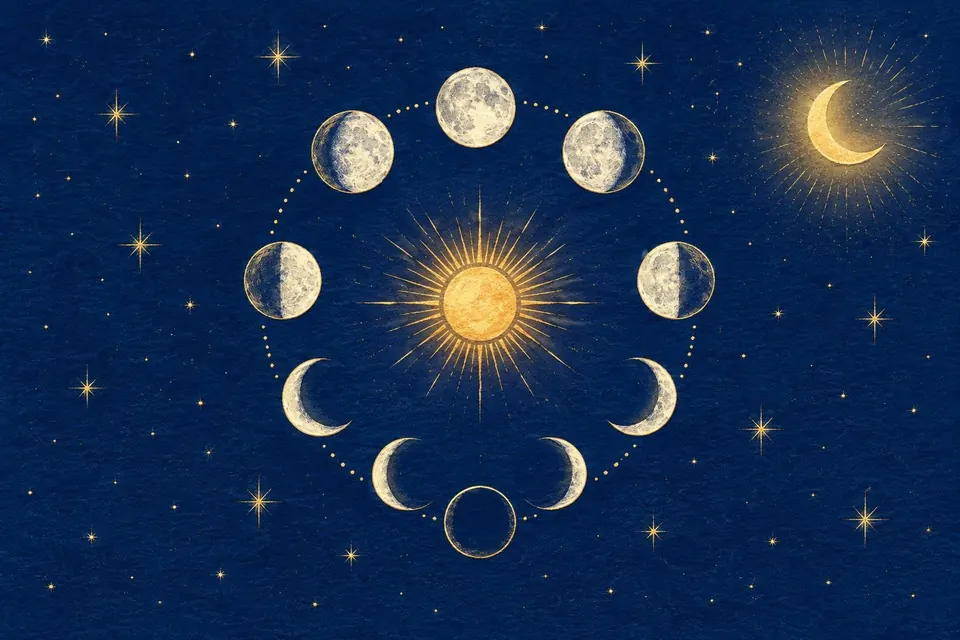
Taking a 12-month year as our basis, a lunar year lasts 29.53 × 12 = 354.36 days. That is 10.88 days—or 10 days, 21 hours, and 11 minutes—shorter than the solar year. To make up the difference, an entire month must periodically be added to the lunar year. This is Adar Bet. It is always a short month, and it is added seven times in a 19-year cycle. That makes up 29 × 7 ÷ 19 = 10.68 days per year. The remaining two tenths of a day, or four hours, are made up by replacing 29-day, or “short,” months with 30-day, or “full,” months.
When Is a Month Full and a Year a Leap Year?#
As we explained, the lunar cycle lasts approximately 29 and a half days. Both 29-day and 30-day months are therefore needed to keep the months in step with the moon. How is the length of a month determined?
The beginning of tractate Rosh Hashanah discusses how the month was sanctified before the Temples were built, during their existence, and for some time after the destruction of the Second Temple. In that era, the supreme court in Jerusalem determined when each month began. If witnesses testified that they had seen the new moon 29 days after the beginning of the month, the court declared the month short, meaning 29 days long. If no such witnesses were found, the court declared the month full on the 30th day after it began.
A leap year, too, was established by a decision of the court, though not on the testimony of witnesses. Midrash Rabbah describes the decision as follows (Shemot Rabbah 15:20):
The decision to make a year a leap year is made by 10 elders. When our Sages wanted to declare a leap year, they would do the following: Ten wise elders would enter the study hall together with the head of the court. They would lock the door behind them and discuss the matter all night. At midnight they would say to the head of the court, “We ask that this year be made a leap year of 13 months. Join us!” He would answer, “I agree with your judgment.”
At that moment, a light would emerge from the study hall and appear before them, and they would know that God was pleased with their decision, as it says, “Light shines in the darkness for the upright; He is gracious, compassionate, and righteous” (Psalms 112:4). Whatever they decided, God would agree with them, as it says, “I call to God Most High, to God who agrees with me” (Psalms 57:3) ...
In the days of King Solomon, too, when Solomon wanted to make a leap year, he would invite seven elders ... Solomon, Nathan the prophet, and Gad the seer were there as well—10 people in all.
When exactly is the 13th month added? Maimonides writes (Laws of Sanctification of the New Moon 4:1):
Only Adar is ever added. In such a year there are two Adars, the first Adar and the second Adar ... Why is this particular month added? Because of the spring season: so that Passover will fall in that season, as it says, “Observe the month of spring”—meaning that this month, Nisan, which follows Adar, must fall in the spring.
How Is the Calendar Set Today?#
Maimonides goes on to explain that decisions to add a second Adar and testimony about the appearance of the new moon were accepted only in the Land of Israel, and only by judges who had a special ordination, semicha, passed down from generation to generation beginning with Moses. How, then, was the Jewish calendar determined at times when Jews did not live in the Land of Israel, and how is it determined today, when that ordination has been lost?
Maimonides writes in the fifth chapter of the Laws of Sanctification of the New Moon:
When there is no Sanhedrin in the Land of Israel, the beginning of the month and the leap years are determined by calculation, as we do today. This is a law received by Moses at Mount Sinai: When there is a Sanhedrin, the beginning of the month is established by the testimony of those who saw the moon. When there is no Sanhedrin, the calendar is established by calculation, and there is no need to see the moon.
When did all Israel begin to use this calculation? At the end of the period of the sages of the Talmud, when the Land of Israel had been devastated and no permanent court remained there. But in the days of the sages of the Mishnah and the Talmud, until the era of Abaye and Rava, everyone relied on the calendar established in the Land of Israel. [Maimonides, Laws of Sanctification of the New Moon 5:1–3]
The Talmud quotes the verse “For this is your wisdom and understanding in the eyes of the nations” (Deuteronomy 4:6) and says that there is a special mitzvah to calculate astronomical events. The wisdom of the Jewish people is revealed to other nations precisely through their knowledge of these calculations (Shabbat 75a).
Many early halachic authorities list this as a separate commandment. Sefer Mitzvot Gadol (positive commandment 47) says that by calculating when astronomical phenomena such as the appearance of the new moon and eclipses will occur, and by knowing how these events will affect crops, Jews can determine which months should be full and which should not, and which years should be leap years. This, in turn, will demonstrate the wisdom of the Jewish people.
The Maharal of Prague adds in Or Chadash that the complex astronomical calculations known to the Sages show that they had prophetic inspiration, through which they learned how to establish an accurate calendar.
The Chazon Ish writes that a person who studies the Laws of Sanctification of the New Moon in Maimonides' Mishneh Torah fulfills the mitzvah of Torah study. Much of this section is devoted to highly complex formulas for calculating the positions of various astronomical bodies. His nephew, the great Rabbi Chaim Kanievsky, a guide for our generation, adds that according to many halachic authorities, a person who studies these laws also fulfills the commandment: “Keep and observe them, for this is your wisdom and understanding in the eyes of the nations, who will hear all these laws and say, ‘Surely this great nation is a wise and understanding people’” (Deuteronomy 4:6).
Why Don't the Lunar and Solar Years Match?#
From the Torah's perspective, nothing in the world is accidental. This applies to everything around us, including astronomical phenomena. The Torah explains the reason and meaning behind the difference between the cycles of the sun and the moon.
The Talmud says (Chullin 60b):
Rabbi Shimon ben Pazi pointed out a contradiction in a Torah verse. In Genesis (1:16) it says, “God made the two great lights,” but later in the same verse it says, “the greater light and the lesser light.” How can this be? The moon said to God, “Master of the Universe, can two kings wear one crown at the same time?” God said to her, “Go and make yourself smaller.”
The Midrash on Ecclesiastes, commenting on the verse “What is crooked cannot be made straight, and what is lacking cannot be counted” (Ecclesiastes 1:15), says (Ecclesiastes Rabbah 1:37):
“What is lacking cannot be counted”: When God made the lunar year 11 days shorter than the solar year, He made it so that no matter how many years pass, how many periods go by, or how many leap years are made, the lunar year will never equal the solar year.
The Sages' words make clear that the moon's diminishment in Chullin also included a shortening of its cycle. Shnei Luchot HaBrit says this as well. Many commentators, including Meor VaShemesh, explain that the meaning of this diminishment is the struggle against pride. The one who wanted to be more important and higher than the other was forced to yield first place to her rival.
Rabbi Tzadok HaKohen, however, argues in Machshavot Charutz (14) that the moon's willingness to yield shows humility. The fact that the moon is not a source of light but merely reflects the sun's radiance symbolizes a person's recognition that everything they have—health, abilities, children, or wealth—is owed to God. Below we will see why these qualities are associated specifically with the moon.
The Lights and the Nations#
The Midrash says (Shemot Rabbah 15:27):
God entrusted Israel with the secret of sanctifying the moon. Why is Israel called “My firstborn son” (Exodus 4:22)? Because the Torah says, “He must acknowledge the firstborn, the son of the unloved wife, and give him a double portion of all he has” (Deuteronomy 21:17). Just as the firstborn inherits a double portion, Israel inherits two worlds: this world and the World to Come.
Therefore God entrusted Israel with the secret of sanctifying the moon, so that they would reckon time by the moon and idolaters by the sun. Just as the sun shines only by day, the idolaters rule only in this world. And just as the sun is made of fire, they will be sentenced to fire in the World to Come, as it says, “For the day is coming, burning like an oven” (Malachi 3:19).
The Talmud also says, “Jews reckon their calendar by the moon, and idolaters reckon theirs by the sun” (Sukkah 29a).
But Israel's connection with the moon is not limited to the commandment to sanctify the new month and maintain a lunar calendar. If we think carefully about the creation of the two lights, we can find surprising parallels between their story and the history of our people.
The Twins#
After many years of waiting, our matriarch Rebecca gave birth to twins. Even before their birth, a struggle began between them. As the Torah says:
The children struggled within her, and she said, “If so, why am I like this?” ... And the Lord said to her, “Two nations are in your womb, and two peoples will emerge from within you. One people will be stronger than the other, and the older will serve the younger” (Genesis 25:22–23).
The struggle between the brothers continued throughout their lives. The younger, Jacob, managed to buy the birthright from his older brother and receive from their father the blessings he had intended for Esau. Nevertheless, Esau became the ancestor of a great nation that eventually enslaved Jacob's descendants. The twins' story recalls what happened to the sun and the moon during the creation of the world. By examining several passages from the Talmud and other sacred books, we will see a connection between the twins and the lights.
Each nation is governed through a particular spiritual force. The angel of Esau, the ancestor of several nations, is Satan, the angel of evil. The Talmud says (Yoma 20a):
Rami bar Chama said: The numerical value of הַשָׂטָן, “the Satan,” is 364. For 364 days of the year he has permission to accuse. On Yom Kippur he has no permission to accuse.
This passage clearly associates the solar year with Esau. But the Talmud contains even more explicit hints. It says (Megillah 6a–b):
Jacob said to God, “Master of the Universe, do not let the wicked Esau fulfill his innermost desire. ‘Do not let his evil plan succeed’” (Psalms 140:9). This refers to Germamia of Edom: Were it not for God's will restraining them, they would go out to war and destroy the whole world.
Rabbi Chama bar Chanina said: In Germamia of Edom there are 300 crowned princes, and in Rome there are 365 leaders. Every day they go to war against one another and kill one of them. Then they set about finding another ruler ...
Ulla said: ... The great city of Rome measures 300 parsa (a distance of roughly 2.5 miles) by 300 parsa. It has 365 markets, one for each day of the solar year. The smallest is the bird market, which measures 16 mil (a distance of roughly 0.6 miles) by 16 mil. Each day the king dines in one of them ...
The Maharal of Prague emphasizes that this Talmudic passage clearly connects the number 365 with Esau, since Edom is descended from Esau. He adds that the sun's red color—a color the Kabbalists associate with judgment and severity—alludes to Esau, in whom these qualities are dominant. The moon's color, white, is Jacob's color, because it is associated with kindness and gentleness, qualities characteristic of Jacob.
Jacob has another similarity to the moon. His descendants were divided into 12 tribes, each descended from one of his sons. Later, however, one tribe was divided in two: Joseph's sons, Manasseh and Ephraim, each became the ancestor of a tribe. The same thing happens with the months of the year. There are 12 months, but sometimes, when the year becomes a leap year, Adar is divided into two separate months, the first and second Adar.
God governs the world through the constellations, called mazalot in the sacred language. Each month of the Jewish calendar corresponds to a constellation and a tribe. Adar is the month of Joseph's tribe. When Adar is divided in two, the first Adar corresponds to Joseph's first son, Manasseh, and the second to his second son, Ephraim.
The word for “year” in the sacred language, שנה (year), has a numerical value equal to the number of days in a lunar year.
Nevertheless, the Talmud makes clear that an ordinary lunar year also contains the quality of judgment. The Mishnah says (Mishnah Eduyot 2:10):
Five judgments last 12 months: the judgment of the generation of the Flood, 12 months; the judgment of Job, 12 months; the punishment of Egypt, 12 months; the punishment of Gog and Magog in the future will last 12 months; and the punishment of the wicked in Gehenna, 12 months, as it says, “... And it shall be from month to month” (Isaiah 66:23).
The Second Adar#
Only the second Adar, which appears in a leap year, is an exception to the rule. In this month, things do not happen quite as they usually do. Rabbi Chaim of Sanz emphasizes in Divrei Chaim, at the beginning of the section on Tetzaveh, that the month is intended to join and restore harmony between the lunar and solar years. This corresponds to the teaching that God will restore the moon's former status in the future, as it says, “The light of the moon will be like the light of the sun” (Isaiah 30:26). Esau, moreover, will repent and restore friendly relations with his brother Jacob.
Interestingly, even now, while the conflict between Jacob and Esau continues, Jacob enjoys special good fortune in this month. The commentary Chizkuni, written by Rabbi Chizkiyah ben Manoach in 13th-century France, comments on the verse “Moses said to Joshua, ‘Choose men for us and go out to fight Amalek’” (Exodus 17:9):
Choose people who were born in the second Adar and are not afraid of witches. For this month has no mazal—that is, no ruling constellation—and the people of Amalek are sorcerers who can cast spells only during one of the 12 months, when one of the 12 constellations rules. When none of the constellations rules, their sorcery does not work.
Bnei Yissaschar, by Rabbi Tzvi Elimelech Shapira of Dinov, explains that in this month the usual rule of nature, through which God governs the world, does not apply. In the second Adar, the Jewish people are under God's special care. Divrei Chaim says that God's exceptional mercy toward people is revealed in this month.
The Jerusalem Talmud (Megillah 1:6) says that the events of Purim took place in the second Adar. Bnei Yissaschar explains that God deliberately caused Haman's lot to fall in this month, because Haman was descended from Amalek, and it is precisely at this time that Amalek has no ability to harm Israel.
Future Redemption#
As we mentioned, in the future the moon's status will be restored, Jacob will be at the head of the nations, and Esau will be compelled to make peace with him. But this will not happen all at once. First, Jacob must defeat Esau. He can do this only with the help of his son Joseph, as the prophet Obadiah writes: “The house of Jacob will be a fire, the house of Joseph a flame, and the house of Esau straw” (Obadiah 1:18).
Only after the first redeemer, a descendant of Joseph, comes can the Messiah from the house of Judah arrive. The prophet Ezekiel writes that the first redeemer will be from the descendants of Ephraim:
Say to them: Thus says the Lord God: I am taking the stick of Joseph, which is in the hand of Ephraim, and of the tribes of Israel joined to him. I will put it together with the stick of Judah and make them one stick, and they will become one in My hand (Ezekiel 37:19).
As we mentioned above, the second Adar is associated with Ephraim.
The Talmud in Megillah discusses in which Adar Purim is celebrated in a leap year. This passage contains a clear hint that a descendant of Ephraim must appear before the coming of the redeemer from the house of Judah. The Talmud says: “The main thing is to bring one redemption close to the other”—the redemption of Purim close to the redemption that took place in Nisan (Megillah 6b). And tractate Rosh Hashanah says that just as the redemption from Egypt took place in Nisan, so too the future redemption will take place in Nisan (Rosh Hashanah 11a).
Purim Katan#
Because Adar can become two months, several interesting questions arise. What, for example, should someone do if they were born in an ordinary year but the year they reach adulthood is a leap year, or vice versa? The same question applies to a yahrzeit (anniversary of a death), which the deceased person's children must mark in a special way.
The law is that someone born in an ordinary year marks their birthday in the second Adar and is not considered an adult until the corresponding date in the second Adar. The yahrzeit of a person who died in an ordinary year, however, is observed in the first Adar of a leap year. Someone mourning a close relative in a leap year says the special prayer Kaddish for them for 11 months, just as a mourner does in an ordinary year. Thus, in a leap year, the mourner finishes saying it two months before the anniversary of the death, rather than one month before, as is normally the case.
In light of what we have explained, these laws become even clearer. The first Adar is associated with judgment and nature, so the anniversary of a death is observed in that month. The second Adar is associated with making up what is lacking and with completeness, so a birthday belongs in that month.
Once the Talmud concludes that Purim is celebrated in the second Adar, the question arises whether any “trace” of the anticipated holiday remains in the first Adar. The Mishnah says that “there is no difference between the first and second Adar except the reading of the Megillah and gifts to the poor” (Mishnah Megillah 1:4; Megillah 6b). One might conclude from this that a festive meal should be held in both the first and second Adar. Nevertheless, halachic authorities write that it is not our custom to hold festivities on Purim Katan. Someone who does make a special meal on that day should celebrate on the 14th, even if their city observes Shushan Purim.
On Purim Katan and Shushan Purim Katan, Tachanun (a prayer of supplication) is omitted. Hespedim (funeral and memorial eulogies) are forbidden on these days.
Keep reading
More →Rosh Chodesh Laws and Customs
- Blessing the New Month: Shabbat Mevarchim
- Yom Kippur Katan
- Rosh Chodesh Laws and Customs
When and How to Say Kiddush Levana
- Overview
- The Time Window
- Differences in Custom
Why Did Mordechai Refuse to Bow to Haman?
Mordechai’s choices in the Purim story reveal his understanding of spiritual and material effort.
PurimPurim, Lots, and the Meaning of Chance
The name Purim invites us to consider the difference between chance and divine providence.







