Shavuot: Accepting the Torah, Not Only Receiving It
Why the revelation at Sinai was not a miracle, and what it means for each of us to accept the Torah today.
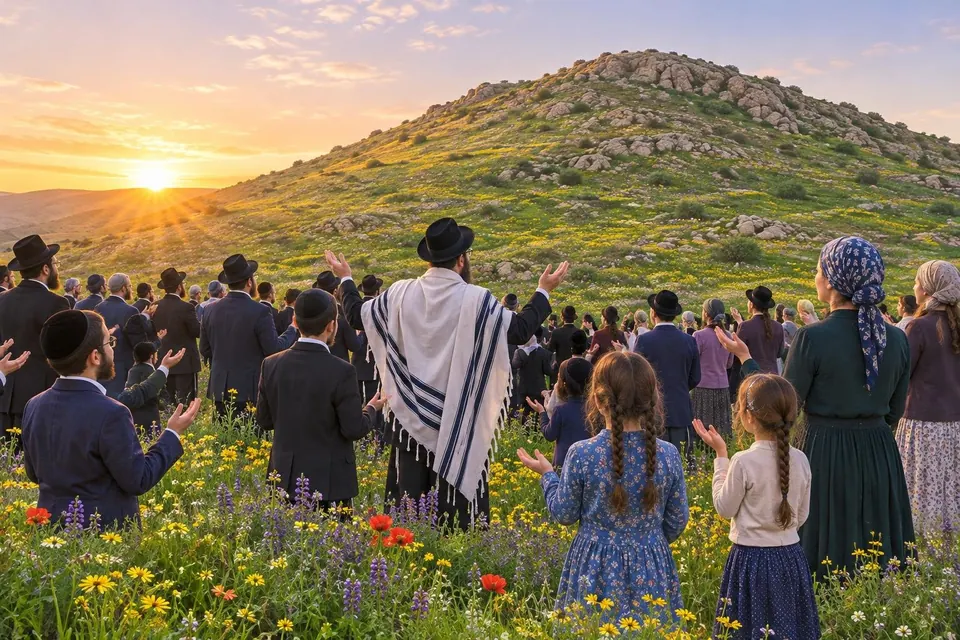
In brief
- Shavuot is the festival of accepting the Torah, and for later generations the acceptance matters more than the giving.
- Maimonides teaches that Israel's faith rests on the revelation at Sinai, not on miracles, because every miracle leaves room for doubt.
- Adam's sin mixed good and evil; the Jews at Sinai rose to Adam's level before the sin by saying "we will do" before "we will hear."
- The Torah gives us strength to stand in the good against evil, and awe of God is what keeps a person from sin.
Shavuot is the festival of accepting the Torah. Today I want to speak not so much about the giving of the Torah as about its acceptance. The giving of the Torah was the greatest event in human history: God revealed Himself to people and gave them, in plain view, the knowledge of how to live. But what should concern us first of all today is the acceptance of the Torah: how fully we have accepted it, and how fully we accept it now. In my view, for later generations this is what matters most.
The book Yesod VeShoresh HaAvodah (The Foundation and Root of Service) gives a prayer for Rosh Hashanah. As we say the words "Atah niglita beanan kevodecha al am kadshecha" ("You revealed Yourself to a holy people in the cloud of Your glory"), we should awaken in our hearts a love of God and a longing for His kingdom, and ask with tears: When will we, the holy people, merit to hear the pure words of our King a second time and to grasp His divinity? This refers to the end of days. Then it will be as it was with the generation of the wilderness, of whom the prophet said: "Your eyes will see your teachers" [Isaiah 30:20]. That was the generation of knowledge, whose eyes were open. Many verses of Scripture speak of this, especially this verse of the Torah: "Vayehi bayom hashlishi bihyot haboker, vayehi kolot uvrakim veanan kaved al hahar, vekol shofar chazak meod, vayecherad kol haam asher bamachaneh" ("On the third day, as morning came, there was thunder and lightning, and a heavy cloud on the mountain, and a very powerful blast of the shofar, and all the people in the camp trembled") [Exodus 19:16]. These words move the heart to weep. When will we merit to tremble in our hearts, with awe of God, awe before Heaven? When will we rise to that level? So on Rosh Hashanah we pray that our descendants in the generations to come will accept the Torah.
Here is the plan for today's lesson. First, very briefly, just a few minutes, on the giving of the Torah: how the revelation at Sinai differs in essence from a miracle. Second, a fairly long lesson in mussar (ethical teaching) about our situation today and about how we accept the Torah today. And if we have time, a look at the Book of Ruth and how it opens for us the path to kingship over our evil inclination, so that in our inner world we are kings and not slaves.
Revelation Is Not a Miracle#
What was the revelation at Sinai? What happened on Mount Sinai? Was it a miracle? When the Jews left Egypt there were ten plagues, and there was the splitting of the sea, which also had many components. Perhaps the giving of the Torah was one more miracle of this kind? Maimonides (the Rambam) says that it was not.
In the Laws of the Foundations of the Torah [Yesodei HaTorah 8:1], Maimonides writes that the Jewish people believed in the Almighty, and in Moses as His faithful prophet, not because of the miracles that happened in Egypt. A person whose faith rests on miracles, "yesh belibo dofi," has a flaw in his heart. He assumes that in time an explanation will be found for it all: some planets drew close to each other, and that is why the sea parted; something happened, and that is why the manna began to fall; the Nile bloomed and the fish in it died. Of course, all these things happened at Moses' word and stopped at his word too, and to suppose that events followed one another so precisely by themselves is unrealistic. Still, a trace of distrust remains inside a person. So what, says Maimonides, did the Jews believe with complete faith? The revelation at Sinai. There was no miracle there. There was a divine revelation.
The general idea is this. While the Jewish people stood at Mount Sinai, when the Torah was given and, above all, accepted, people lost their freedom of choice, the freedom to choose to sin. The events were so overwhelming that a person could not sin. But a person's task is to repair himself and the whole world, and the essence of that repair is that a person freely chooses good and does not follow evil. So he must have freedom of choice, that is, the ability to do evil. That is why the Almighty does not perform miracles all the time and does not reveal Himself all the time: it would deprive a person of freedom of choice, and the whole idea of our service would become unreal. Our service is to repair our own part of the world and make it elevated. If a person sins, he has not fulfilled his task, which means that he must have the possibility of sinning. The Almighty must not take away a person's freedom of choice. That is the difference between a miracle and the revelation at Sinai.
But what is revelation, and how does it differ in essence from a miracle, if after it faith became complete and no one had even the slightest doubt deep in the heart? Any new ideology in this world fades quite quickly. Take communism: the first generation sacrificed their lives for it, the second no longer sacrificed their lives but still held on to the ideas somehow, the third told jokes, and in the fourth generation communism ceased to exist. What had to happen so that nothing like this would befall the Torah?
Since the Almighty does not perform miracles in every generation, let alone revelations, later generations can only learn from earlier ones. The children, the second generation, who did not themselves leave Egypt or receive the Torah at Mount Sinai, naturally have some skepticism. They "scan" their parents and teachers. Suppose Jewish faith rested only on miracles. The second generation would sense that the first, who had seen everything with their own eyes, truly believe, but that deep in their hearts there are a couple of percent of doubt: What if the frogs simply multiplied and spread in every direction, the palace of Pharaoh included, because of some radiation, some radioactive explosion in the heavens, on the earth, or under the earth? Seeing that the first generation believes 98 percent, the second will believe 85. The third, to whom the second will tell the story, will believe 55 percent, and the fourth will find it hard to keep the commandments for the sake of ideas that seem weightless to them. Notice that the very same thing happened right after the creation of the world. Adam was created by the hands of the Almighty. His son Seth became the foundation, the base. But his grandson Enosh already lived at the time when fundamental idolatry began all over the earth: people worshiped absolutely everything, separating this world from God, and the idea of God stopped interesting creation.
So what happened at Sinai? There was no miracle. A miracle is a breach of mathematical expectation. If one frog had come out of the Nile, it would not have surprised anyone much. A hundred frogs, a thousand, the same. But when suddenly there was an enormous number of them at exactly the right time, that was a miracle, because mathematical expectation had been breached. The same goes for the plague on the cattle. If one animal had died, or a few, everyone would have found it perfectly natural; but all of them died. Hail? Well, sometimes there is hail like the hail in Egypt. A miracle is nothing more than a breach of mathematical expectation.
The revelation at Sinai was a phenomenon of a completely different kind. At its end the Torah sums it up: "And all the people saw the voices and the flames, and the sound of the shofar, and the mountain smoking. And when the people saw it, they trembled and stood far off" [Exodus 20:15]. What does it mean to see voices? "Kol haam roim et hakolot." In Hebrew, "kol" means both "voice" and "will." It is impossible to see a voice, but the whole people saw the will: they saw this world in a completely different way. The divine will was revealed in the world.
How is that possible? At the beginning of creation it says that the Almighty created light and separated the light from the darkness. What does "separated" mean? The Midrash says that the Almighty said: It is not fitting for the wicked to enjoy this light. And He hid it away for the righteous in the World to Come. The righteous in the World to Come are in precisely this light of the divine presence. And what does this light do? It reveals the divine will in the world. That is exactly what happened: the light of the divine presence was revealed, it flooded the whole universe, and it disclosed the will of God. This is why revelation differs from a miracle. No one will ever be able to say that once in a thousand years the planets shifted, or that something else happened, because there was neither a miracle nor any material event. There was only a vision of the world flooded with divine light, revealing the will of God.
Here is a simple example. If you cover a book with a sheet of thin tracing paper, you can't see anything. If you shine a spotlight through that screen, the letters of the book show through. That is what happened at Mount Sinai. The Book of Exodus reports exactly this: "All the people saw the voices and the flames, and the sound of the shofar." And what does it mean to see flames? To see a fire that will not tolerate the lower forms of matter. Fire will not tolerate lower forms of matter; the Torah is given as fire, as it says in the Book of Deuteronomy. "And when the people saw it, they trembled and stood far off." What were they afraid of? Of such a revelation of divinity, which went down in history as the revelation at Sinai. And they said to Moses: "You speak with us; we can't bear this any longer." And Moses said to the people: "Do not be afraid, for God has come in order to test you, so that awe of Him will be on your faces and you will not sin" ("tihyeh yirato al peneichem levilti techetau") [Exodus 20:16-17]. This is the very idea we started with: when a person feels awe before God, he will not sin; he has no freedom of choice, and he cannot commit a sin.
Now let's return to the handing down of the tradition from generation to generation. When the teachers of the first generation told their children and students about the miracles of the Exodus, the children saw that somewhere inside the teachers a small doubt remained about the complete truth of the events they described. But when the teachers told about the revelation at Sinai, about God's revealing Himself on Mount Sinai, the children saw that their teachers believed what had happened one hundred percent, absolutely. That is how it has been handed down from the first generation to the second and onward, all the way to our own day: a complete transmission of truth. This is what Maimonides is saying. The Jews did not come to believe in Moses and in God with complete faith on the strength of miracles, because every miracle has a "dofi," a flaw, "du-pi," a double interpretation. They came to believe with complete faith in the Almighty, and in Moses as a prophet, on the strength of the giving of the Torah at Mount Sinai.
Moses Sums Up the Revelation at Sinai#
Now let's open the fourth chapter of the Book of Deuteronomy. These are the last weeks of Moses' life, forty years after the giving of the Torah, and he is summing up the revelation at Sinai.
"Now, Israel, listen to the statutes and the laws that I teach you to keep, so that you may live, and come, and inherit the land that the Lord, the God of your fathers, is giving you." Moses tells us the purpose of giving the Torah to a person: that he may live, he and his children, and that he may inherit the Holy Land. This is the only way to inherit it.
The first commandment: "Do not add to what I command you, and do not take away from it." So any nonsense, any "samizdat" (self-published underground writing) produced in such a situation, is forbidden and breaks this commandment of the Torah. There can be no distortion of the Torah, and if it happens, it is a violation of this commandment.
"Your eyes have seen what the Lord did because of Baal Peor: for every man who followed Baal Peor, the Lord your God destroyed from among you." Baal Peor is the only deity that survives today, apart from the worship of oneself. The essence of worshiping Baal Peor is to defecate on it [Sanhedrin 64a]. So the only kind of idolatry left today is when people "defecate" on values, thereby exalting themselves above some other values: a person wants to be king over any and all values. Moses says: You saw what became of those who followed Baal Peor. Nothing was left of them, not even a memory. "But you who cling to the Lord your God are all alive today" [Deuteronomy 4:4]. Life becomes firmly established only when a person clings to God.
"See, I have taught you statutes and laws, as the Lord my God commanded me, so that you would act accordingly in the land you are entering to take possession of it. Keep them and do them, for that is your wisdom and your understanding in the eyes of the nations, who, when they hear of all these statutes, will say: Surely this great nation is a wise and understanding people." When the nations of the world see the blessing that the Jewish people receive for keeping the commandments, they will say that this nation is truly great, for it has divine commands that brought it to all this spiritual and material greatness. "For what great nation has gods so near to it as the Lord our God is whenever we call on Him? And what great nation has statutes and laws as just as all this teaching that I am giving you today?" Notice that in the Torah there is not a single commandment, or at least I haven't found one, that it would be embarrassing to keep, embarrassing to talk about, embarrassing to raise children on, or embarrassing to speak about in a lecture.
"Only take heed, and guard your soul very carefully, so that you do not forget the things that your eyes have seen, and so that they do not leave your heart all the days of your life." What does Moses call for? To remember the revelation at Sinai, the giving of the Torah on Mount Sinai. "And make them known to your children and your children's children: the day you stood before the Lord your God at Horeb, when the Lord said to me: Gather the people to Me, and I will let them hear My words, so that they will learn to fear Me" (or rather, to tremble before Me; the translation here is inexact) "all the days that they live on the earth, and so that they will teach their children."
And now the Torah gives the words of Moses in which he sums up completely what really, in essence, happened at Mount Sinai: "And you came near and stood at the foot of the mountain, and the mountain burned with fire to the heart of heaven." This is fire that illuminates and burns away everything coarse, everything that does not accord with truth. "Darkness, cloud, and mist." A question arises: if it was darkness, cloud, and mist, then what happened there? The answer is this: for the Jews who accepted the Torah it was a light that lit up the whole world, and for those who did not accept the Torah it was darkness, cloud, and mist. They saw absolutely nothing there. Notice how relevant this is today. People who accept the Torah see in it a vast, fundamental teaching that floods their paths with light and opens their eyes. For those who have no interest in it, all of it is darkness, cloud, and mist, and their whole life is wrapped in these three things: darkness, cloud, and mist. Mist is haziness: for people who have no God, everything is hazy on the largest scale, covered in fog.
Moses draws one more important conclusion: "And the Lord spoke to you out of the midst of the fire; you heard the sound of words, but you saw no form, only a voice." No picture. During the revelation at Sinai there was no image and no event that could be described as a material phenomenon, such as frogs multiplying or the Egyptian river rotting. There was neither a miracle nor a material event that differs from ordinary life only by breaching mathematical expectation. "You saw no form at all," says Moses, "only a voice." That was the essence of the revelation at Sinai. "And He declared to you His covenant, which He commanded you to keep, the Ten Commandments, and He wrote them on two stone tablets." That is how the summary of what happened at Mount Sinai ends.
So divinity was revealed before all humanity, and the divine light of the presence flooded the world so that the will of God was revealed completely. It was impossible to believe this only "ninety-eight percent." I am speaking now of the first generation, which received all this: not the slightest doubt arose in them. That is why they spoke the words that went down in history: "Naaseh venishmah," "We will do and we will hear." Having seen the divine will, we will carry out all of God's will to the very end, and "venishmah," "and we will hear," means that we will learn how exactly to carry it out. This is the first generation, called the generation of knowledge. We are a generation deprived of knowledge. What can we do in this situation?
Adam's Sin and the Mixing of Good and Evil#
I'll share with you a text called "Milestones of History." It is a teaching of the Novardok yeshiva. I have shortened it a little, keeping the main points, because we won't have time for all of it. For those who are interested, there is the book Mussar of the Novardok Yeshiva, which collects the teachings of mussar that can really repair a person's life and help him acquire elevated qualities, so that his whole life starts to run completely differently. We need this text today to understand what has happened since those times. What happened to the first man? What exactly was the problem that made him sin? What did it lead to? And how does the Torah help repair his sin?
The first man introduced a mixture of good and evil, for himself and for all his descendants. The Torah is the cure for this mixture, for the porridge that gathers inside us. Let's try to understand how the Torah helps us and why the Almighty gave it to us.
"Cursed is the ground because of you; in sorrow you will eat of it all the days of your life, for you are dust, and to dust you will return." A man created with the dichotomy of an elevated soul and a body that also holds divine light arrived at these results within the very first day. The situation is rather sad, and it is clear that the Torah is needed to repair it.
The account of the tree of the knowledge of good and evil is hard for us to grasp. How could it happen that the first man, the crown of creation, made by the Creator and containing within himself all human souls (all the later souls were included in Adam, and the soul of each of us is a small piece of Adam), on the very first day violated an unambiguous divine command, knowing that certain death awaited him? Man became mortal. Even we, with our limited understanding, wouldn't have acted that way. Can one even imagine such a thing?
The point is that we usually sin either out of laziness or out of passion. That is why Gehinnom has two compartments: a cold one for the lazy and a hot one for the passionate. But Adam had no passion for eating from the tree of knowledge. It isn't that the Almighty forbade him to eat from this tree and at the same time planted such a passion in him that he couldn't resist. There is no passion for trees. People who are not gluttons have no passion for food at all: they eat when they are hungry, because that is how a person is made, but they have no passion, and certainly not a passion for one particular kind of food.
Maimonides believes that Adam's sin was rooted in a mistake. But this needs explaining. How could a person make a mistake whose mind, before the sin, was not clouded by any attachments or urges of nature? If we suppose that his thinking could tell good from evil but that he erred, taking falsehood for truth, then what complaint can there be against him? And further: With what did the serpent tempt Eve, how did it confuse her? How could Eve listen to the serpent's words that they would not die? Did she really believe the serpent more than the Creator? How are we to understand that when the serpent asked, "Did God really say: You shall not eat from any tree in the garden?" Eve answered: "Only of the fruit of the tree in the middle of the garden did God say: Do not eat of it and do not touch it, lest you die"? What does "lest" mean? The Creator had warned them of certain death.
Adam's thinking before the sin was not subject to any outside influences. Natural desires could not distort his thinking, cloud his understanding, or spoil his knowledge of good and evil. He understood the essence of evil but did only good: both good and evil were in him, but evil had no influence on him at all. It was a sort of hump on Adam, separated from him by a screen, a powerful armored door. He carried this hump on himself as something external, fundamentally separate, and evil did not affect him in any way. His mind was like the mind of an angel, say our Sages, and matter was for him only an outer covering and garment, as it says: "You clothed me in skin and flesh." And just as we aren't embarrassed by our clothes, neither was he ashamed.
The very word for "clothing" in Hebrew, "levush," comes from "lo bosh," "is not ashamed": a person is embarrassed to be without clothes and is not embarrassed by his clothes. The reason, by the way, is very interesting. We differ from one another mainly not by the features of our bodies but by the radiance of our faces. According to the law of the Talmud, a person cannot be identified by parts of the body. If someone says, "I saw a man with such-and-such a mark on his body commit a murder," this testimony will not be accepted. But if he says, "This man here, I saw his face, it was him," that counts as an identification. A question arises: Why then are clothes "lo bosh," what shields us from shame? I heard from Rabbi Moshe Shapiro that a person is ashamed precisely of being the same as everyone else. Each of us needs an individual face, and so where there is no face, a person feels embarrassed. So clothing is "levush," "lo bosh," what frees us from embarrassment. And just as we are not embarrassed by our clothes and do not hide them under another layer of clothes, so the material shell did not embarrass the first man. Of this it says: "And they were both naked, Adam and his wife, and they were not ashamed." They saw no flaw in this, because everything in them was subordinate to good; and when nakedness is used in a holy way, there is no flaw in it. Adam differed from us only in that his body was for him an eternal garment that never needs to be changed.
But in one respect Adam differed substantially from the angels. Heavenly beings have no freedom of choice, and therefore no ability to do evil, since their whole essence is good. Adam was not like that. His thinking was clear and not clouded even by the slightest personal bias, and yet he could, if he wished, give up an angelic existence in favor of a life that demands constant choice. His original position was nothing like ours. We choose between good and evil, truth and falsehood, but he was choosing between soaring in the heavens like an angel and living as a man on earth. If he had wanted to be like an angel, without the slightest fear of losing his spiritual attainments, he should have stayed away from the tree of knowledge.
What is the "tree of knowledge"? Knowledge does not grow on trees. Understood correctly, it is the tree of the mixture of good and evil. To the degree that we accept the Torah adequately, we separate good from evil and arrive at the state that the Creator wanted to see in a human being made in His image and likeness. The mind of a man who had not tasted the fruit would have stayed free of the desires and wavering of this world. No force could have moved him from the righteous path. Note this: if Adam had not eaten from the tree of knowledge, no force would have moved him from that path.
But if he chooses to live in a state of constant choice, between passions whose taste he comes to know and the perfect life that can be reached only by overcoming those passions, then he should taste this fruit. Before he tasted it, evil did not influence a person; it was a hump. After he tasted it, a connection forms between this hump of the evil inclination and the person himself. Then, if a person could repair this evil that has mixed with good, and good could gain the ability to influence him, he would become entirely pure, elevated, and absolutely perfect. This is exactly what the serpent said: Taste it and you really will be elevated, if you are strong enough to process this evil. This is where real service begins, real work, when evil influences you. "This way," says the serpent, "life is easy. But try tasting the tree of knowledge and repairing yourselves, and see what comes of it." At once all a person's inner powers and inclinations are awakened and immediately join battle with his mind. If he succeeds in winning, in subordinating his qualities and bodily powers to his mind, he will rise to a level higher than before, since the reward always matches the difficulty of the test. And then he will earn eternal life, as it was before the tasting. But if he fails to overcome his nature and the natural side gains unlimited power over him, death is unavoidable, because nature itself is not eternal, just as nothing subordinate to it is eternal.
The serpent convinced Eve that they would not fall from their level but would only rise to a higher step above their own nature and inclination. Saba of Novardok says: Yes, if everything had been as the serpent described, and Adam and Eve had won this great war, they would have lost nothing and only gained. The idea of the coming of the Messiah is, in the end, exactly this: a person will repair himself and become an eternal creation, and death and the evil inclination will disappear. In the days of the Messiah all this will come true, and a person will become such that, as it says, no eye, the eye of a prophet, has seen the greatness and beauty that will be in the world with the coming of the Messiah.
But it turned out that they were bitterly mistaken. Right after they tasted the fruit, "the eyes of both of them were opened, and they knew that they were naked, and they sewed together fig leaves and made themselves loincloths." It became clear that they should not have eaten from the tree of knowledge. If they had really been able to overcome their nature easily and remain as they were before the sin, what would they have had to be embarrassed about? The call of nature had not affected the clarity of their minds in the least. What was shameful about their nakedness? Elements of evil began to show themselves, and nakedness turned out to be something that had to be covered. The human being was no longer a creature ruled by good alone.
After Adam's sin a new era began in the spiritual life of humanity. This is the main thing that concerns us in terms of accepting the Torah. As usual in mussar lessons, we don't pour from one empty vessel into another, and we don't pile up outside knowledge that sets us apart from those who lack it only by the level of our ideas. We try to understand our particular nature as people after Adam's sin and to repair ourselves, to become a little more people of life, and not of death, which the mixture of good and evil brings. People can no longer throw off the coverings of materiality and natural urges, and they must struggle all their lives with their nature and the bad traits of their souls, until either the mind or desire falls defeated in this war. This is our war, yours and mine. The evil inclination influences us to be like little animals, and the good inclination wants us to match the divine image in which we were created. The only question is: Where are we?
This is why the first question God asks the man is "Ayeka?" "Where are you?" It is not a bad idea to ask ourselves this every second, because the choice between good and evil stands before us every moment. How elevated are you, how much are you doing the will of God at each single moment? The choice between good and evil isn't something that comes up three times in a lifetime: helping an old lady across the road or pushing her under the wheels of a bulldozer. Every second you have a choice: to choose good or evil in this moment. That is why we are in a state of constant struggle. Some people don't struggle much: whatever happens, happens. But the Torah demands that we struggle, and it gives us strength for it. How? It was said precisely about the giving of the Torah: "lemaan tihyeh yirato al peneichem levilti techetau," so that awe of God will be on your faces and you will not sin. Awe of God takes away a person's ability to sin. And if there is no awe of God, a person is filled with a spirit of foolishness, and he won't do much good: he will live according to his nature. In everyone's nature there is something good and something bad, but this is the life of nature, the life of an animal. Animals too have a nature built into them, and they live by that program. But the Almighty expects a human being to repair his evil with his good.
Questions from the Audience#
Someone asks: Did Eve do teshuvah, and how many years did she live? As for how many years she lived, I have no information, I don't know; maybe someone does. As for teshuvah, I believe that she did. In any case, there are midrashim about Adam saying that for many years he was in the waters of the Gihon spring, near Jerusalem, and he was cold there [Pirkei DeRabbi Eliezer 20]; he tried to carry out repentance but could not fully repair what he had done, because if he repaired it...
Another question: If the ability to choose between good and evil is built into a person, why was the Torah given? What is built into a person is not the ability to choose; what is built in is good and evil, and the Torah came to give him strength to stand in the good against the evil. Evil is very attractive: people like to do what is evil and primitive, it is more pleasant for them. Good is much harder, because it requires concessions and the like. So the Torah is an instrument that, first of all, gives us the strength to stand against evil, and that is not easy at all.
From Adam to Abraham#
The descendants of the first man could not stand up against their strongest enemy, and with each generation the spiritual state of the world fell rapidly. People's wicked deeds reached such an extreme that the Creator regretted having made the world and said: "I will wipe out man, whom I created, from the face of the earth." That was the generation of the Flood.
Ten generations passed in which not a single person was found who chose the path of spiritual life. People lived in the darkness of ignorance, like blind people who have never seen light. And in this pitch darkness there appeared a man utterly unlike his contemporaries. At the age of three he discovered the Creator. Neither his parents nor those around him, who had long since gone astray, managed to restrain his drive to seek. Abraham's longing for truth was so strong that it overcame all the old habits, entrenched prejudices, and mistaken notions of his contemporaries, in whose atmosphere he lived. He searched, he investigated, he grasped the Lord and His Torah. Our Sages of blessed memory said of this: "Abraham kept the whole Torah even before it was given" [Yoma 28b]. And he not only kept the commandments in practice but understood what is usually hidden from people's eyes: the true motives behind human actions.
This, among other things, is exactly what the teaching of mussar is devoted to: it helps us understand what is really seething inside us, so that we do not deceive ourselves and others, and are not mistaken about the true motives of our actions, whether they are elevated or, God forbid, not at all. For our Sages of blessed memory said: "Seven things are hidden from people, and one of them is the depth of judgment" [Pesachim 54b].
Our forefather Abraham reached such a high spiritual level that the forces of evil no longer ruled him and could not make him act against clear reason. But he had not yet reached the level of the first man before the sin, whose thinking was perfect. Abraham was completely righteous, but he had not reached complete purification, as it was before Adam's sin. That is why, at the hour when Abraham took the knife in his hand to offer up his son, his eyes filled with tears. His reason was so unshakable that he overcame all obstacles, as we saw in the account of the binding of Isaac, and yet he was not free of natural emotions, which showed in his tears: he had not reached the perfection of the first man before the sin.
On this highest level the spiritual life of great people continued through the generations, people such as Shem, Ever, and the sons of Jacob, but none of them rose to the level of the first man before the sin. No one fully repaired the evil in himself, no one became eternal by removing the evil inclination entirely. The impurity that the serpent brought into the human soul did not disappear and was not washed away until the revelation at Sinai. But at the hour of the giving of the Torah the Jews rose to such a high level that the impurity left their souls completely.
First "We Will Do," Then "We Will Hear"#
So at the time of the giving of the Torah the Jewish people returned to the state in which Adam had been before the sin, before the mixing of good and evil: evil was entirely uprooted and left their souls completely. The sin of the Golden Calf brought everything back. But this concerns each of us as well: accepting the Torah today leads, to some degree, to the serpent's impurity leaving our souls, and to the same degree we come to the state of Adam before the sin. This is the purpose of the Torah, and this is why it was given to us.
The main achievement of the Jewish people, according to the teaching of Saba of Novardok, was that their promise "we will do" came before their pledge "we will hear." When the people of Israel did this, a voice rang out from heaven: "Who revealed this secret to My children?" This is what it says in the Talmud, in tractate Shabbat [88a]. They reached the level of the first man before the sin because at that moment they decided on their own, without compromise, to live by the covenant of the Creator. Notice: without arguments, without doubts, without small print at the end of a legal agreement, asterisks, conditions, and so on. By their own choice they decided to be guided only by the instruction of the Torah, with no doubt at all about whether to accept the divine teaching and follow it. They said: "We will do." We are ready to carry out the will of the Almighty just as the angels carry it out, without questions and without arguments, and "we will hear" referred only to how exactly to do it.
Who revealed to them that the main obstacle on the way to perfection is trying to hear before doing? The main obstacle is when we want to make our own decision: yes, no, I agree, I don't agree. If you found something in the Torah and, because you agree with it, you do it, then you are serving yourself, your own inner settings, whatever happens to be relevant to you. A person always wants to hear first: to think it through in advance and decide whether it is worth doing. He is always afraid that it might bring him harm and that he might not be able to bear it at all. Who revealed to them that to reach the level of the first man before the sin you have to give up personal bias, not choose what to accept and what to reject, but act on the basis of an unprejudiced mind that is ready to do the will of the Creator? As soon as their "we will do" came before "we will hear," in that instant they were completely rid of the impurity the serpent had brought into their souls.
The Torah testifies to what they achieved: "And all the people saw the voices." Our Sages of blessed memory explain: "They saw what was meant to be heard, and they heard what was meant to be seen." The understanding of the generation of the wilderness reached such heights that their senses and their minds became inseparable. In later times this is out of reach, and so the prophet Isaiah admonishes us: "Hear and hear, but do not understand; see and see, but do not know" [Isaiah 6:9]. One can hear, and one can listen; one can look, and one can see. But our natural inclinations get in the way, confusing our minds. The prophet says that although we have hearing and sight, we lack the ability to hear clearly and to see deeply. We are imperfect, and the obstacles that keep us from wholeness weaken our hearing and cloud our sight. If people truly felt the taste of life by the Torah, it would certainly add to their wisdom. In our generation a person does not strive to follow the path of the Torah fully: he takes from it only what fits his own wishes. As a result his vision is distorted, and he moves further and further from the truth. We are very far from the spiritual values and spiritual practice of those ancient generations.
Let's sum up. The festival of Shavuot is the festival of the giving of the Torah in historical perspective, but for us today the main thing is that it is the festival of accepting the Torah, an exam for each of us on how far we have accepted the Torah. "Atah niglita beanan kevodecha leam kadshecha" ("You revealed Yourself in the cloud to a holy people"). The first man brought the world into a state of mixed good and evil, and as a result mortality appeared in the world. Accepting the Torah saves a person from death, and saves all of creation from death. In the Book of Deuteronomy Moses sums it up: at the revelation at Sinai there was no picture and no miracle, only revelation, only the divine light that people saw. The divine presence was revealed, making it possible to grasp the divine will and to see it directly in reality. And the task of each of us is to lose the freedom of choice to do evil. This is possible, and the Book of Exodus sums it up: "tihyeh yirato al peneichem levilti techetau," so that awe of Him will be on your faces and you will not sin.
From a lesson by Rabbi Chaim Burshtein
Keep reading
More →What Did Mount Sinai Add to the Israelites' Faith?
The revelation at Sinai brought Israel's faith to its fullest expression and established its trust in the Torah from Heaven.
Guide · ShavuotShavuot Laws and Customs: A Guide to the Holiday
- The Month of Sivan
- The Eve of Shavuot
- Laws and Customs of Shavuot
Why Do We Count the Omer?
The counting of the Omer connects Passover and Shavuot, recalling both the Temple offering and the anticipation of receiving the Torah.
Guide · ShavuotShavuot Laws and Customs
- A Night of Torah
- Morning Blessings After a Sleepless Night
- The Tzitzit Blessing After a Sleepless Night







