Why Did the Nations Reject the Torah?
A familiar Midrash offers a lesson about accepting the challenges of serving God.
In brief
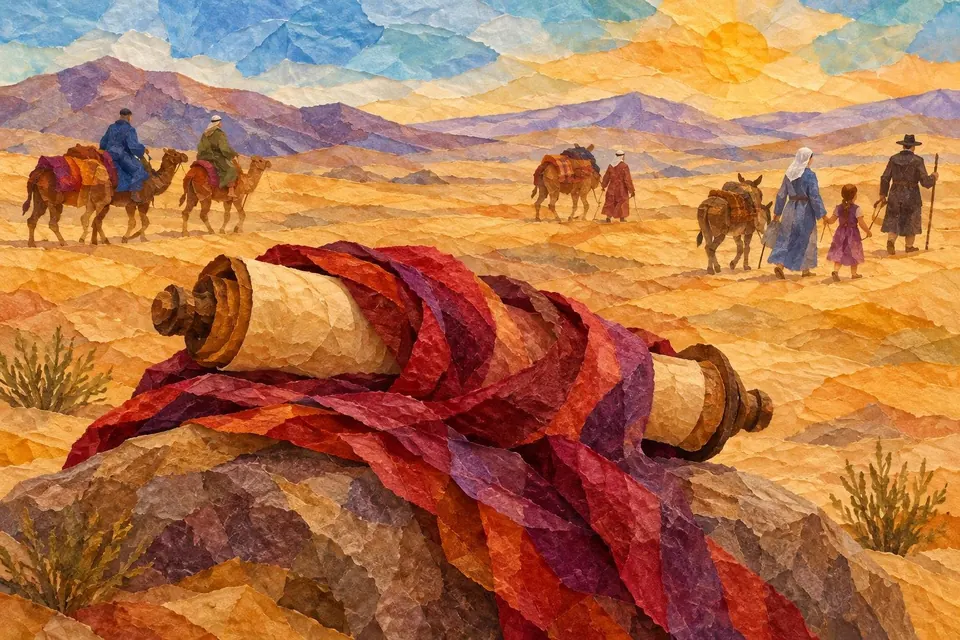
- A Midrash describes God offering the Torah to several nations before Israel accepted it.
- Each nation was told about a commandment that was especially difficult for it.
- The author’s teacher explains that accepting the Torah means accepting even the hardest demands of serving God.
- Personal weaknesses can become opportunities for service and growth.
My teacher, Rabbi Gedaliah Eisman, offered a figurative interpretation of the phrase “the resurrection of the dead from the Torah”: taking a familiar teaching of our Sages and breathing new life into it. Let us try to do that with a well-known Midrash about the giving of the Torah.
God Offers the Torah to the Nations#
The Midrash says (Lamentations Rabbah, chapter 3):
“He appeared from Mount Paran” (Deuteronomy 33:2). First, He went to the descendants of Esau at Mount Seir and asked them, “Will you accept the Torah?”
They asked Him, “What is written in it?”
He said, “You shall not murder” (Exodus 20:13).
They replied, “Our father gave us this blessing: ‘You shall live by your sword’ (Genesis 27:40). We cannot live without it.” And they did not accept it.
He went to the descendants of Ishmael in the wilderness of Paran and asked them, “Will you accept the Torah?”
They asked Him, “What is written in it?”
He said, “You shall not steal” (Exodus 20:13).
They replied, “This is our father’s legacy: ‘His hand will be against everyone, and everyone’s hand against him’ (Genesis 16:12). We cannot live without it.” And they did not accept the Torah.
He went to the Ammonites and Moabites and asked them, “Will you accept the Torah?”
They asked Him, “What is written in it?”
He said, “You shall not commit adultery” (Exodus 20:13).
They replied, “All these people have their roots in mamzerut—that is, in a forbidden incestuous union—as it says, ‘Both of Lot’s daughters became pregnant by their father’ (Genesis 19:36). We cannot live without it”—that is, without sexual immorality. And they did not accept it.
He came to the people of Israel and asked them, “Will you accept the Torah?”
They replied, “Yes, yes! Everything God has said, we will do and we will hear!” (Exodus 24:7).
As familiar as this Midrash is, it raises some difficult questions.
- Why go to the descendants of Esau and Ishmael, and to the Moabites and Ammonites, and offer them the Torah if God knew they did not want it?
Some answer that He did so to prevent them from asking, “Why didn’t You give us the Torah?” But this answer is not entirely satisfying. It feels as though there is something deeper here.
- Why did He present them with commandments they already had? All nations are required to observe the prohibitions against murder, theft, and adultery, since they are among the seven commandments given to the descendants of Noah. It would seem that He should have told them about the mitzvot of keeping Shabbat and keeping kosher, and so on. Perhaps they would have been willing to accept those.
Some write that the Torah means a person should not even have the desire to murder. That was what Esau’s descendants were unwilling to accept.
Others suggest an answer based on the Jerusalem Aramaic translation of the Torah, often called the translation of Jonathan ben Uzziel. According to that translation, “You shall not murder” includes a requirement not to be an accomplice to such acts.
Another answer draws on the Talmud in Bava Kamma 38a. It says that because the nations of the world did not keep the seven commandments, God took away their reward for observing them. On that basis, we might suggest that by offering the nations the Torah, the Creator wanted to restore their former standing and their opportunity to receive a reward.
Other commentators answer that there is a significant difference between the commandments “Do not murder” and “Do not steal” as addressed to non-Jews and those same commandments as addressed to Jews.
We still, then, do not have an answer that is fully satisfying.
- Moreover, my teacher Rabbi Eisman asked: Doesn’t it seem somewhat unfair to offer each nation something that is known to be its weak point?
Let us try to offer some answers.
Those Who Wanted to Accept#
The answer to the first question may lie in a teaching cited by the author of Kedushat Levi in the name of Rabbi Elazar Menachem of Fano. When the Holy One, blessed be He, offered the Torah to Esau’s descendants, some of them said yes. But their voices went unheard because they were such a small minority.
Yet no creature who seeks God is left without His special care. Throughout history, the Holy One, blessed be He, helps their souls undergo conversion and thus become part of the Jewish people, under the shelter of the Shechinah (the Divine Presence).
That is why on Shavuot we read the Book of Ruth. It tells the story of a Moabite woman who converted and became the ancestor of King David and, therefore, of the Messiah. What an enormous benefit we gained from the Creator of the universe approaching the people of Moab!
Accepting What Is Hardest#
My teacher Rabbi Eisman answered the third question. Accepting the Torah means accepting the yoke of serving the Creator of the world. And service finds its expression precisely in what is most difficult for you by nature.
That is why the Creator approached each nation by telling it about the aspect of service that would be hardest for it. If a nation had accepted that, it would have shown that it was ready to accept everything, because it had accepted the essence of serving God.
My teacher found support for his words in what Rabbeinu Yonah writes in Shaarei Teshuvah (Gates of Repentance), 1:6:
Now listen and understand this, for it is a most important principle. It is true that even righteous people sometimes stumble and sin, as it says: “There is no righteous person on earth who does good and never sins” (Ecclesiastes 7:20). But the righteous restrain their evil inclination. If they happen to sin once, they do not repeat it. They fight the evil inclination and repent.
But a person who is not careful to avoid a particular sin and makes no effort to stay away from it—even if it is a relatively minor sin, and even if that person is careful not to violate any of the Torah’s other prohibitions—is called by the Sages “an apostate in one matter” (Chullin 4b). Such a person is considered a transgressor, and the offense is intolerable. For if a servant says to his master, “I will do everything you command except one thing,” he has already cast off the yoke of obedience to his master and will do as he sees fit.
This is what is meant by “Cursed is the one who does not accept the words of this Torah, to observe them” (Deuteronomy 27:26): it refers to one who does not accept the obligation to observe all the Torah’s laws, from beginning to end. This is indicated by the words “who does not accept,” rather than “who does not observe them.”
The first way to understand Rabbeinu Yonah is that the essence of service is accepting the obligation to do everything, without limits. If a person makes an exception for even one small thing, that shows an incomplete acceptance of service.
But while that is true, Rabbeinu Yonah’s words go deeper. Why is a person unwilling to accept that particular small mitzvah? Because it is the one that is hardest for them. If so, violating it shows that they were not serving at all. They observed the other mitzvot only because those mitzvot seemed right and logical to them.
Now let us return to the second question. Why did the Creator tell the nations about commandments they were already required to observe? Based on Rabbi Eisman’s words, students in a kollel (a center for advanced Torah study) told me that there is an answer to this question too: Even though it was an existing commandment, it was appropriate to mention it because it was the hardest part of service for that nation.
The Cat and the Mouse#
The third question also brings to mind something else. My teacher once said to me, “Don’t be like the cat of Maimonides (the Rambam).” I asked what he meant. He explained that philosophers had once debated whether a cat could be trained so well that an observer would not recognize it as a cat. The king gave each philosopher time to prove his position.
The philosopher who believed it was possible took a kitten and trained it so well that it could dress as a waiter and walk while carrying a tray with a glass of tea and a cake, without dropping them.
On the appointed day, they came before the king. The cat walked toward him with the tray of tea and cake. Those present were already sure that the philosopher who had trained it would win.
But the other philosopher had brought a mouse in his pocket. When the cat came close to the king, the philosopher let the mouse loose. The cat immediately dropped everything on the king and ran after the mouse. The cat, it turned out, was still a cat.
My teacher said to me: You think you are a servant of God, but when you see your “mouse,” you leave everything behind and forget your service.
A person’s service, then, is bound up with their own particular “mouse”! (For Esau’s descendants, that “mouse” is murder; for Ishmael’s descendants, theft; and for the Moabites, sexual immorality.)
What should a person do if they have several such “mice”?
At first glance, they seem unfortunate, with so many shortcomings. But a deeper look will show that their soul is great and expansive. They have been given the opportunity to serve God more, by correcting as many problems within themselves as several people would ordinarily have to correct.
Let us end with a blessing: first, that we identify our “mouse” or “mice,” and second, that we find the wisdom and strength to correct the traits involved and learn not to react to them.
By Rabbi Avraham Kuperman
Keep reading
More →What Did Mount Sinai Add to the Israelites' Faith?
The revelation at Sinai brought Israel's faith to its fullest expression and established its trust in the Torah from Heaven.
Guide · ShavuotShavuot Laws and Customs: A Guide to the Holiday
- The Month of Sivan
- The Eve of Shavuot
- Laws and Customs of Shavuot
Why Do We Count the Omer?
The counting of the Omer connects Passover and Shavuot, recalling both the Temple offering and the anticipation of receiving the Torah.
Guide · ShavuotShavuot Laws and Customs
- A Night of Torah
- Morning Blessings After a Sleepless Night
- The Tzitzit Blessing After a Sleepless Night







