Why Are Baalei Teshuva Greater Than the Righteous?
Parashat Mishpatim offers a way to understand God’s special care for those who have strayed.
In brief
- The Sages say that even the completely righteous cannot stand where baalei teshuva stand.
- The Chatam Sofer compares God’s concern for someone who has sinned to a loving father’s care for an ill child.
- The Midrash describes God’s presence with Joseph when he was away from his father’s protection.
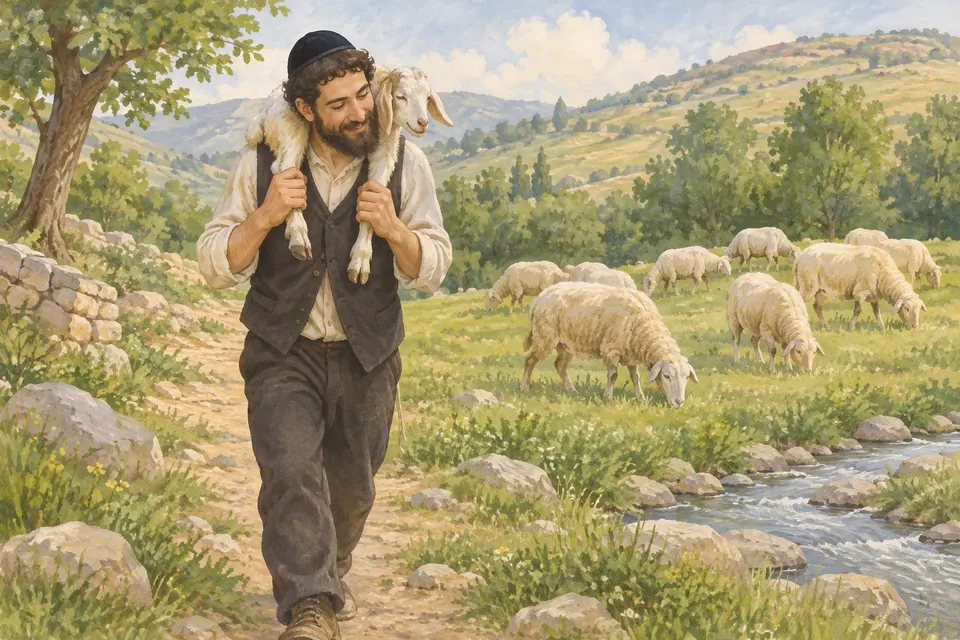
- Moses showed compassion by pursuing a single lamb that had wandered away.
Parashat Mishpatim#
“These are the laws you shall set before them: If you buy a Hebrew slave…” (Exodus 21:1–2).
The Talmud says: “In the place where baalei teshuva—people who have returned to God through repentance—stand, even the completely righteous cannot stand. As it says, ‘Peace, peace to the one who is far and to the one who is near, says God, and I will heal him’” (Berakhot 34b; see also Sanhedrin 99a; Isaiah 57:19). First it says “the one who is far,” and only then “the one who is near.”
How are we to understand this? Surely no one is more beloved to God than the completely righteous person who accepted the yoke of Heaven from childhood, never turned to false illusions, never sinned, and never missed a mitzvah.
How could God prefer to such a person a sinner who listened to the advice of the wicked, walked the path of sin, and drank from polluted wells, only to return to the Creator in shame and disgrace?
The answer is simple. Let us illustrate it with a story.
A young Torah scholar had a son, and his home filled with light. The boy was wonderful and gifted, with fine character. He was God-fearing and bright, and he studied Torah, bringing his parents great joy.
Then a second son was born. He had an intellectual disability, was unruly, and had very limited understanding. All he knew how to do was make mischief and break things; it was hard even to speak of studying with him. Nevertheless, his father sat with him with endless patience, tempting him with small prizes and sweets. With great effort, he taught him to read and use a prayer book.
One evening, the older son came home to find a celebration. There was a beautiful cake on the table, along with sweets. His brother sat at the head of the table like a king, and his father was giving him a gift.
“What are we celebrating?” the older son asked.
“We have wonderful news,” his father replied. “Your brother has begun studying the Five Books of Moses.”
“Dad,” the boy burst out, “when I was his age, I was studying Mishnah, and you didn’t throw a party like this for me.”
But how can the two be compared? The older son has a clear mind and fine character. He has discovered the sweetness of Torah and grasped its radiance. Could a person receive a more precious gift?
He will rise higher and higher until he reaches the very top. His father loves him so much and is so proud of him. But studying is very difficult for his brother, and his character is difficult too. Of course, his father will invest many times more effort in him for the smallest result. He will rejoice in his tiniest successes and encourage him to keep trying and do just a little better.
This is what the Chatam Sofer says. Immediately after the giving of the Torah, we read, “These are the laws you shall set before them.” Of all the Torah’s laws, where did God choose to begin? With the laws of a Hebrew slave who was sold into slavery because he had stolen. Why is this first? Why does the Torah begin here?
The Chatam Sofer answers: “A loving father first takes care of his sick son.”
How wonderful.
The Torah says of Joseph, “God was with Joseph” (Genesis 39:2). The Midrash asks: Was God not with the other brothers? Rabbi Yudan offers a parable:
A man was leading 12 donkeys loaded with barrels of wine. One turned aside and entered a non-Jew’s shop. The man left all the others and ran after that donkey.
People said to him, “Why are you leaving 11 donkeys to run after one?”
He answered, “The others are out in the street, in the public domain, and I’m not afraid anything will happen to their wine. But that donkey entered a non-Jew’s shop. The shopkeeper might open a barrel, and then all the wine will become non-kosher.”
So too, the brothers were under their father’s watch, and there was no reason to fear for them. Joseph, however, was a young man in an Egyptian’s house. That is why “God was with Joseph” (Bereishit Rabbah 86:4).
From this we learn that a person in spiritual danger merits greater support and the presence of God, as in “God was with Joseph.”
The Midrash also tells us that Moses, our teacher, was tested through a flock. When Moses was tending Jethro’s flock in the wilderness, a lamb ran away. Moses chased it until they reached a grove. There was a spring in the grove, and the lamb ran up to it and began to drink. When Moses saw this, he said, “I didn’t know you ran away because you were thirsty. And now you’re tired.” He lifted the lamb onto his shoulders and returned to the flock.
God said, “If you are so compassionate toward a flock of animals belonging to a human being, I swear that you will be the shepherd of My flock, the people of Israel” (Shemot Rabbah 2:2).
Moses left the whole flock to run after one single lamb that had gone astray and wandered from the right path.
Moses followed God’s way: “God was with Joseph.”
And who is that lamb? I am.
By Rabbi Yaakov Galinsky
Keep reading
More →Why Read Ruth on Shavuot? A Daily Commitment
The story of Ruth and the words of a Hasidic rebbe invite us to renew our commitment to the Torah.
ConversionConversion and Receiving the Torah at Sinai
Accepting the Torah at Sinai offers a model for conversion and for Jewish life.
CharacterLashon Hara and Free Speech: Life and Death in the Tongue
Jewish teachings on the power of speech challenge us to consider how we use our words.
CharacterKorach and Disagreement for the Sake of Heaven
What distinguishes Korach’s dispute from the disagreements of Hillel and Shammai?







