Conversion and Receiving the Torah at Sinai
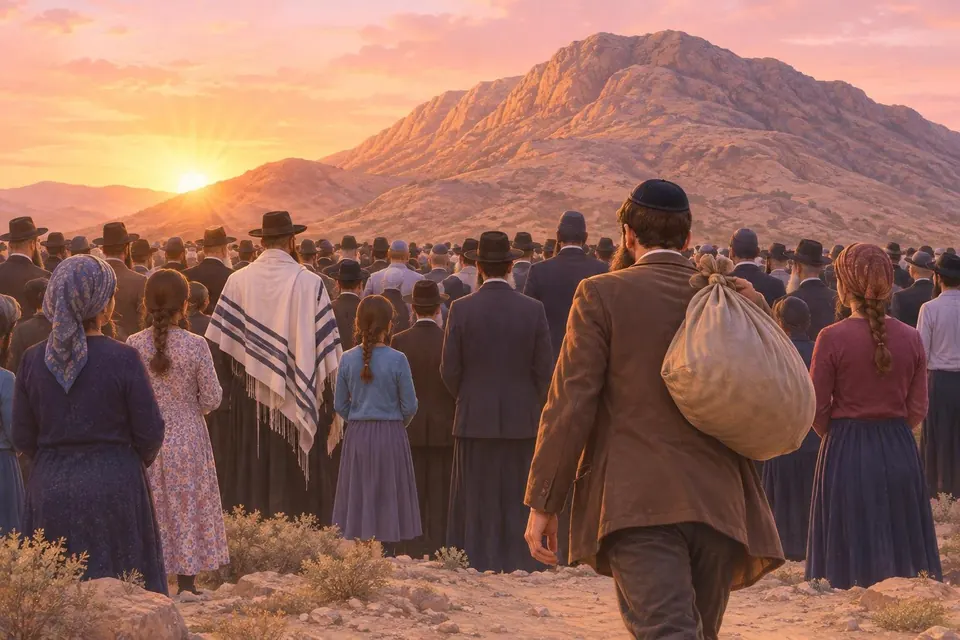
Accepting the Torah at Sinai offers a model for conversion and for Jewish life.
In brief
- At Sinai, the Jewish people accepted the Torah before knowing all it would require.
- Conversion requires accepting the Torah and the enactments of the Sages.
- Every Jew must continually renew their commitment to the Creator's will.
- Accepting the Torah gives Jewish life strong roots and a source of vitality.
Two Torah portions, Beshalach and Yitro, connect the Exodus from Egypt with the giving of the Torah at Mount Sinai. All the trials our people experienced after leaving Egypt—the splitting of the sea, Amalek’s attack, and the rest—took place during our ancestors’ counting of the omer, the period between Passover and Shavuot. We count the omer from Passover to Shavuot, and they too had a very special counting: their preparation to receive the Torah.
Our Sages teach in the Zohar that in Egypt the Jewish people had sunk into 49 levels of spiritual impurity. Each day before the Torah was given, they left one level of impurity and gained one level of holiness. They were privileged to purify themselves and, on the 50th day, reach a level of holiness fitting for receiving the Torah.
It is worth considering: How can people move in 50 days from 49 levels of impurity to the level of a nation that received the Torah at Mount Sinai? This tells us that we have enormous potential, though we can also take it in the wrong direction.
Accepting the Torah Without Conditions#
Receiving the Torah at Mount Sinai had one essential condition: an unconditional commitment to observe it.
I heard a story about a non-Jewish girl of about 14 or 15 who was brought from Russia to a school. She was very interested in Judaism and wanted very much to convert. She once told one of her teachers, “If I had been at Mount Sinai, I wouldn’t have said naase venishma, ‘we will do and we will hear.’ I would have said the opposite: nishma venaase, ‘we will hear and we will do.’ Let them first tell me what’s written, and then I would accept it.”
The teachers who knew her said that, despite her extraordinary interest in Torah, she should not convert because her approach was not a Jewish one. In the end, she did convert, but later she became nonobservant.
We are not discussing whether her conversion was valid. The case illustrates a fundamental point: it shows us the approach of the nations of the world to the Torah—to find out what the Torah requires, then use their own judgment to decide whether to accept it. They learned some of what was written in it and did not accept the Torah. Our people were different: we did not ask questions and investigate before accepting it. On the contrary, we accepted it without asking. That is an entirely different level of commitment to the Creator’s will.
The laws of conversion teach that if a convert does not accept even one of the Torah’s laws or the enactments of the Sages, the conversion is invalid. Clearly, accepting the whole Torah is essential; without it, a person cannot become Jewish.
Among the greatest converts were Ruth, Shmaya and Avtalyon, and the familiar figure of Onkelos, whose legacy our entire people have studied continually for thousands of years. Through him we received an interpretation of the Torah, Targum Onkelos.
There is a passage in that translation in Parashat Lech Lecha. Abraham leaves Haran to go to the Holy Land, and the Torah speaks of the nefesh asher asu beHaran, “the souls they made in Haran” [Genesis 12:5]. What does this mean? Rashi explains that Abraham converted the men and Sarah converted the women [Rashi on Genesis 12:5]. But Judaism as such did not yet exist; there was no Jewish people. What kind of conversion was this?
Onkelos explains the phrase as “the souls they brought under the Torah.” This concise expression tells us what becoming Jewish is: submitting oneself unconditionally to the Creator’s will.
Where do we find the Creator’s will? It is written in the Torah. For our people, receiving the Torah at Mount Sinai—accepting the whole Torah with the words naase venishma, “we will do and we will hear, we will listen” [Exodus 24:7]—corresponds to conversion. What is more, we learn many laws of conversion from the way our people received the Torah at Mount Sinai.
Today, conversion is a person’s own maamad Har Sinai, their personal experience of standing at Mount Sinai. The essence of Jewish life is a complete acceptance of the Creator’s will. In other words, conversion is not merely an “entry ticket” into Judaism; it is the essence of Judaism.
Renewing the Commitment#
A righteous convert who embraces Judaism, like any Jew, is subject to the saying that even the righteous sometimes stumble. If perfect observance were a condition, no convert could ever join the Jewish people. Rather, moved by a holy and pure yearning of the soul, a convert accepts the whole Torah. If later their evil inclination awakens and overcomes them, that is certainly a transgression, but it does not cancel the conversion.
What a convert needs is also essential to every Jew, because it is essential to Jewish life itself. Consider a parallel: there is the brit milah (circumcision) of a convert and the brit milah of a Jew. They are not quite the same. A convert’s circumcision, together with immersion in a mikveh and acceptance of the obligation to keep the mitzvot, is what makes the person Jewish. A Jew who has not undergone brit milah is Jewish, but lacks the “maintenance of the covenant.”
In other words, one kind of circumcision makes a non-Jew Jewish, but a Jew is also obligated to maintain the covenant. The same is true when a convert accepts the Creator’s will, including the enactments of the Sages. All this makes a non-Jew Jewish, but we too need it continually: it maintains our covenant with the Creator. Reciting “Shema Yisrael” is a constant renewal of our acceptance of the Creator’s will and the obligation to observe the mitzvot.
Shavuot is not simply a time when we study Torah at night. The essence of Shavuot is accepting the Torah completely, both its observance, naase, “we will do,” and its study, nishma, “we will hear.” The same is true when we read the portion about the giving of the Torah.
The Zohar writes that the purpose and order of the Torah reading in the synagogue are not simply about studying Torah. Its meaning is to reenact receiving the Torah at Mount Sinai and accepting the obligation of the Torah.
Accepting the Torah comes before studying it. In earlier generations, there was no need to say this, because it was obvious to the entire Jewish people. For us, however, it is essential. Further strengthening our awe of God and our love for the Almighty—these are very important virtues. It is valuable to read books of mussar (ethical teaching) before studying, to uplift ourselves. But accepting the obligation to keep the mitzvot comes before all these virtues. It defines our relationship with the Torah and with the Creator.
If we accept the Torah completely, then for us it is a “Torah of life.” If not, then it is a beautiful and interesting book, but not the Creator’s Torah, God forbid. And what is life? Chaim birtzono: life according to His will.
People who are only beginning to draw close to Torah, “limping on both legs,” a little religious and a little not, have not yet reached the point of accepting the Torah completely. But one thing fundamentally distinguishes our people from other nations, and a person who lives by the Torah from someone who does not: whether they accept the obligation to observe the whole Torah.
A non-Jew needs this acceptance to become Jewish, and someone returning to Torah needs it in order to return fully. Every Jew needs to keep this acceptance alive. This is the essence of the mitzvah to recite the Shema morning and evening.
Every year, when we read Parashat Yitro and on Shavuot, we need to reflect on these matters again and accept the Torah anew. Throughout the year, too, it is extremely important that, as we listen to the Torah reading and study Torah, we also accept the obligation to put into practice everything we study. In this way we can connect with the great light contained in the revelation at Sinai, a light very much like the one that will accompany the coming of the Messiah. Rabbi Moshe Chaim Luzzatto (the Ramchal) writes about this in Klach Pitchei Chochmah (138 Gates of Wisdom).
Living by the Creator’s Will#
In our classes, we often repeat the words of the Zohar: “God, the Torah, and Israel are one.” The essence of Jewish life is not simply belief, or just going to synagogue on Shabbat. It is living with the Creator, constantly, without days off. How can we live with the Creator? By accepting His will, studying it, and carrying it out.
There is another mitzvah that sustains and strengthens genuine Jewish life: tamim tihyeh im Hashem Elokecha, “be wholehearted with the Lord your God” [Deuteronomy 18:13]. What does this mean? Be wholehearted in faith and trust.
Accepting the Torah at Mount Sinai was the greatest expression of trust in the Creator. Many people still cannot understand how anyone could accept a law without knowing what it requires. What is more, in obligations between people, a person cannot simply commit to doing everything they are told. If there are no limits or clear definitions of the obligations, there is no informed acceptance of them. How, then, was it possible to accept the Torah?
There is one answer: a person can sell themselves into slavery. As a slave, they must do whatever their master says. The greatness of our people was that they had complete faith and trust in the Creator. They knew that everything He willed was for the good, and so they made themselves slaves of the Creator.
Many people, both in Israel and in Russia, call themselves religious and even consider themselves Haredim (ultra-Orthodox Jews), but have not yet accepted the Torah wholeheartedly, so that it becomes horaah, a constant guide to action. Without accepting the Torah as a whole, a person may say: What I like, I accept; what does not suit me, I do not acknowledge or observe. This is a catastrophe. This is the Reform and Conservative approach to Torah.
Rabbeinu Yonah writes in Shaarei Teshuvah (The Gates of Repentance) that a slave who rejects even one instruction from their master has thrown off the burden of the master’s authority. I am speaking first and foremost to people who consider themselves religious. We must continually return to the point of accepting the obligation to observe the whole Torah. Yes, we do not need to convert; we are Jews. But we need to live as Jews, according to the Creator’s will.
Accepting the Creator’s will is the necessary introduction to Torah study. In earlier generations, there was no need to speak about this at all; we need to repeat it constantly.
There is a discussion about the meaning of Torah lishmah (Torah study for its own sake): Is it studying Torah as a way to achieve devekut, attachment and union with the Creator, or, as Rabbi Chaim of Volozhin says, studying Torah in order to understand it? But all these aspects matter only once the Torah itself determines how we live.
Our teacher Rabbi Chaim of Volozhin does not classify as devekut a person’s immersion in the laws of how to avoid fraud. Yet there is devekut in this too: even in such subjects, a person attaches themselves to the Creator’s mind. Understanding the Creator’s mind is a very high level of devekut.
The foundation of drawing close to the Creator is that, for us, the Torah is a Torah of life. When we work to understand its laws and grasp their depth, we attach our minds, and then our bodies, to the Creator’s will, since understanding leads to action. But one thing comes first: accepting the Torah as an absolute guide to action, and studying it to learn how we should live.
What do people want in life? The most universal human desire is to live. The idea of chaim birtzono, life according to His will, and the idea of Torat chaim, a Torah of life, are the source of our enormous vitality. Our people have endured terrible disasters, exile, and persecution with extraordinary vitality. Where does it come from? Chaim birtzono.
When Rabbi Yitzchak Zilber and Rabbi Shimshon Pincus passed away, at different times, people said of them, “What vibrant people they were! How much life they had in them!” Why? They had attached themselves to carrying out the Creator’s will. The Torah gives vitality, joy, and happiness, because it is a Torah of life.
Roots That Withstand the Storm#
A Mishnah in Avot says:
A person whose deeds exceed their wisdom is like a tree with few branches but many roots. Even if all the winds of the world blow against it, they will not move it from its place. [Mishnah Avot 3:17]
Commenting on this Mishnah, Rabbeinu Yonah asks: How can a person’s deeds exceed their knowledge? It is an unexpected question and needs explanation.
There is the word melech, “king,” which is an acronym: mem stands for moach, the brain; lamed for lev, the heart; and kaf for kaved, the liver. A person has a brain, where the divine soul is found; a heart, where the ruach, the spirit, is found and where desire and choice reside; and a nefesh, the animal soul, which governs the body and resides in the liver.
A person is properly ordered when they are a melech, a king: what the mind understands governs desire; desire submits to the mind and governs the body’s powers. When a person performs a mitzvah, what is the source of the action? Certainly, the mind. The person understands that it is a mitzvah, wants to perform it, and does so.
Now Rabbeinu Yonah’s question is clear: understanding must be the source of action. If so, how can action exceed understanding? He answers that if a person accepts the obligation to observe the whole Torah, even if they know almost nothing about it—what our ancestors did at Mount Sinai and what a convert does—it is credited to them as though they had already observed it. This is what the Mishnah means: a person whose deeds exceed their knowledge, who has accepted the obligation to do even what they do not yet know, is like a tree with very strong roots.
Life is full of all kinds of storms. We live in the period of ikveta deMeshicha, the time before the Messiah’s coming, described as birth pangs. It is a difficult time, with much suffering that we do not understand. It is a time when God’s face is hidden, as the Torah says: “And I will surely hide My face on that day” [Deuteronomy 31:18]. This refers, among other things, to the war of Gog and Magog before the Messiah’s coming. All of this is part of the birth pangs before the Messiah’s coming.
We need to strengthen our roots very well, so that no storm can sweep us away, God forbid. According to Rabbeinu Yonah, this means strengthening anew our acceptance of all the mitzvot and the enactments of the Sages, for their enactments are also the Creator’s will. This is the essence of our Jewish life; it gives our roots strength. And the soil, the foundation of our lives, is our connection with the Creator. There is no stronger foundation. Everything else is a house of cards.
By Rabbi Yigal Polishchuk
Keep reading
More →Why Read Ruth on Shavuot? A Daily Commitment
The story of Ruth and the words of a Hasidic rebbe invite us to renew our commitment to the Torah.
ConversionWhy Are Baalei Teshuva Greater Than the Righteous?
Parashat Mishpatim offers a way to understand God’s special care for those who have strayed.
CharacterLashon Hara and Free Speech: Life and Death in the Tongue
Jewish teachings on the power of speech challenge us to consider how we use our words.
CharacterKorach and Disagreement for the Sake of Heaven
What distinguishes Korach’s dispute from the disagreements of Hillel and Shammai?







