Why Read Ruth on Shavuot? A Daily Commitment
The story of Ruth and the words of a Hasidic rebbe invite us to renew our commitment to the Torah.
In brief
- The readings on Shavuot are connected in different ways to converts.
- Ruth’s story recalls the Jewish people’s acceptance of the Torah at Sinai.
- The Rebbe of Piaseczno wished he could draw closer to God by converting.
- Every Jew can renew their commitment to all the Torah’s mitzvot.
Parashat Yitro tells the story of the giving of the Torah, so it is easy to understand why many of its verses were also chosen to be read on Shavuot. The haftarah (prophetic reading) for Shavuot is a passage from the book of Ezekiel. We also read the Book of Ruth.
Commentators point out that all the passages from the Hebrew Bible read on Shavuot are connected in some way to converts.
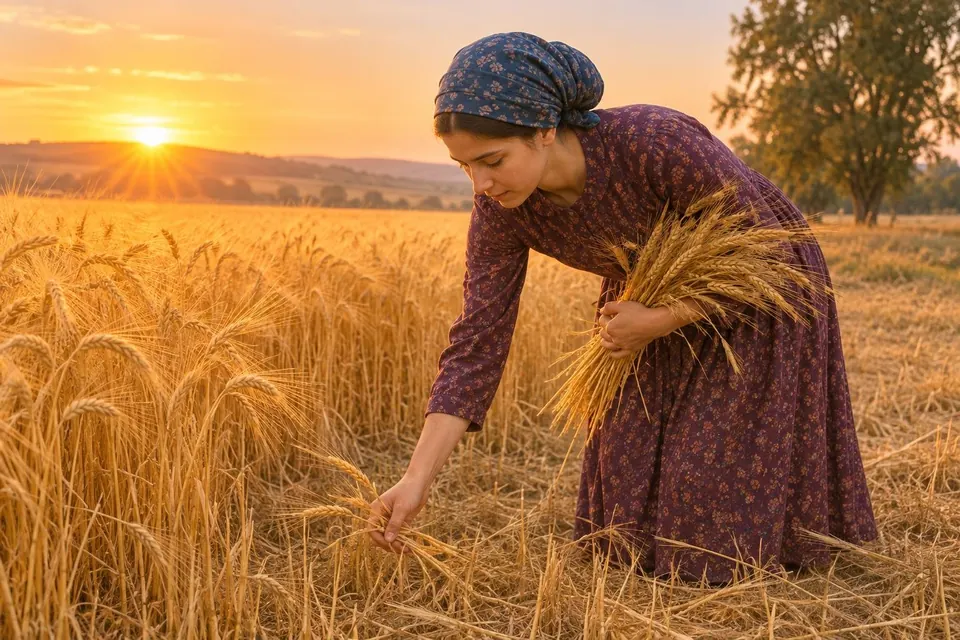
Jethro himself was a convert. The haftarah comes from the book of the prophet Ezekiel, who is said to have descended from the marriage of Joshua and Rahab, who converted. The Book of Ruth tells how Ruth joined the people of Israel, journeying from the plains of Moab to the Holy Land.
One explanation for reading Ruth on Shavuot is that, on the day the Torah was given, the people of Israel entered a covenant with the Creator and accepted the yoke of Heaven. In a similar way, conversion requires accepting the obligation to keep all the Torah’s mitzvot.
Rabbi Asher Weiss told a story about a great Torah scholar, Rabbi Kalonymus Kalman Shapira, the Rebbe of Piaseczno. He was one of the young Polish rebbes who perished in the Holocaust. May God avenge the blood of this righteous man.
In his short life, he wrote several very important books: Chovat Hatalmidim (The Students’ Obligation), Hachsharat Haavreichim (The Preparation of Young Married Men), Esh Kodesh (Holy Fire), and others. But one work stands apart in my view: a collection of intimate thoughts, more like a diary than a book.
One passage from that diary touched my heart so deeply that tears streamed from my eyes.
It describes how the Rebbe of Piaseczno spoke to the Creator:
“Master of the entire world! I want so much to bring You something, to offer something for Your sake, but I don’t know what. I want to draw closer and closer to You, but I don’t know how. What more can I add to my service of You? Study more Torah? It seems to me that ever since I was old enough to understand, I’ve devoted every free moment of my life to it. Pray more? I also try to make the most of the time set aside for that. What more can I offer You? Master of the Universe! If only I could, I would draw closer to You by converting for Your sake! But what can I do if even that is beyond my reach, since I’ve been Jewish from birth?”
That is how he poured out his soul before the Creator.
The righteous people of Poland knew Rabbi Shapira as an extraordinary person. They called him a yid hakadosh (“holy Jew”). But why him in particular?
After all, it is said of the people of Israel, “And your people will all be righteous” (Isaiah 60:21). All Jews can be righteous; all Jews carry holiness within them. Why single one person out? I think they spoke of him this way because his followers said that every day he “became” a Jew anew. Every day he “converted” again for the Creator.
The Rebbe of Piaseczno writes that he wished he could convert. But who says that each of us cannot do the same? On the contrary, each of us should.
Of course, a person cannot undergo circumcision a second time. It is forbidden to injure or mutilate oneself. And what about immersing in a mikveh for the sake of conversion? A Jew could immerse in a mikveh 610 times every day, but that would have nothing to do with the laws of conversion.
Yet there is another requirement for conversion: accepting the obligation to keep all the Torah’s mitzvot. It seems to me that every Jew can do this. We are often very selective in our approach to the mitzvot. You may meet a Jew who is very strict about observing Shabbat but is not very careful to avoid lashon hara (harmful speech). For another person, the reverse is true.
A person preparing to convert, however, does not get to choose which mitzvot are appealing and which are not. We may imagine that we have that privilege, and that being strict in one area of Jewish law will compensate and atone for unjustified leniencies in our observance of other mitzvot.
Let us imagine a completely fictional situation. A person appears before a rabbinical court, which must decide whether to accept their conversion.
The head of the court asks whether the candidate is ready to accept the yoke of Heaven and the obligation to keep all the Torah’s mitzvot. But instead of saying yes, the person begins to blush. The head of the court repeats the question, and the candidate answers, “Of course I’m ready. More or less.”
“What do you mean, more or less?” the judge asks.
The candidate can no longer hold back and explains: “Yesterday, I was walking down the street and found myself next to the respected head of our court, who was talking with someone. I’m terribly sorry, but it seemed to me that the rabbi was speaking a little lashon hara. I hope I’m not offending anyone, but if possible, I’d like to accept the obligation to keep the mitzvot to the same extent that the respected rabbi keeps them in his own life.”
However uncomfortable the situation might be for everyone present, and however ashamed the head of the court might feel, I am sure the rabbi would answer: “I’m very sorry. I’m sure you can be a good person, even a good head of a court or a community. But you cannot become a Jew. Because being a Jew means accepting the obligation to keep all the Torah’s mitzvot, without exception.”
[One must accept all the mitzvot, without exception. Even if the evil inclination later overcomes a person and they violate the law, this certainly does not cancel the conversion retroactively.]
If I had been sitting beside the Rebbe of Piaseczno when he wrote those lines in his diary, perhaps I would have tried to object: “Who says a Jew cannot convert?”
And if not every day, then at least on the festival of the giving of the Torah, each of us should say:
“Master of the Universe! I want to enter a covenant with You again, as my ancestors once did. As Jethro, Rahab, and Ruth the Moabite once did.”
Keep reading
More →Why Are Baalei Teshuva Greater Than the Righteous?
Parashat Mishpatim offers a way to understand God’s special care for those who have strayed.
ConversionConversion and Receiving the Torah at Sinai
Accepting the Torah at Sinai offers a model for conversion and for Jewish life.
CharacterLashon Hara and Free Speech: Life and Death in the Tongue
Jewish teachings on the power of speech challenge us to consider how we use our words.
CharacterKorach and Disagreement for the Sake of Heaven
What distinguishes Korach’s dispute from the disagreements of Hillel and Shammai?







