Rabbi Chaim Pinchas Scheinberg: A Life of Torah
The life of a Torah scholar, teacher, and community leader, and the partnership that sustained his work.

In brief
- Rabbi Chaim Pinchas Scheinberg studied Torah in America and at the Mir yeshiva in Poland.
- He credited his wife, Basha, with making his Torah study and leadership possible.
- He founded Yeshiva Torah Ohr in America and later moved it to Jerusalem.
- He was known for his devotion to Torah, his kindness, and his care for students and visitors.
When we read about the lives of the greatest Torah scholars of recent generations, we sometimes wonder: How is this possible in our own time? It sounds like fantasy. Can such wonders and such devotion to Torah exist in a world surrounded by materialism and the pursuit of wealth? At times, it is hard to believe.
But when a person who radiated the light of Torah lived on a neighboring street, where you could meet him, and stories of his boundless wisdom and extraordinary dedication to Torah are told not only in books but by people who knew him, even the shadow of doubt disappears. Yes, there is genuine greatness in Torah in our time, too. There are people whose great holiness makes them like an open Torah scroll.
Childhood and Youth#
Rabbi Chaim Pinchas Scheinberg, one of the greatest Torah scholars of recent generations and a guide and leader of the Jewish people, was born on 27 Elul 5670 (1910) in the Polish town of Ostrow. His father, Rabbi Yaakov Yitzchak, struggled to make ends meet in the small town and was forced to seek a living in America, which in those days was imagined as the goldene medine—the golden land.
Little Chaim and his brother Avraham lived with their maternal grandparents, the parents of their mother, Yuspa Scheinberg. His grandfather, Rabbi Shalom Tambek, was a renowned Torah scholar. Rabbi Scheinberg owed his first introduction to the world of Torah to him.
Rabbi Shalom rose at 4:30 every morning, regardless of the season or day of the week, and went to the beit midrash (study hall). One day, when Chaim Pinchas was still very young, he woke up and asked his grandfather to take him along. As his grandfather put on the boy’s shoes, he said, “Everyone will see what little Chaimale will become.”
Rabbi Yaakov Yitzchak Scheinberg spent a long time trying to establish himself in America. Like many Jews who remained faithful to the Torah, he was bitterly disappointed at first. Every Sunday he looked for a new job, and every Friday he lost it when he refused to work on Shabbat. In the summer he slept on a park bench, and in the winter in basements, with no home of his own.
But Rabbi Yaakov did not lose hope or trust in the Creator. In time, he saved enough money to open a business of his own: a tailor shop with a dry-cleaning service. He rented an apartment and was finally ready to reunite with his family after their long separation. Chaim Pinchas met his father for the first time at the age of 10.
Rabbi Yaakov Yitzchak was known as a deeply upright man. Despite the demands of his business, he rose before daybreak and went to the synagogue to study before prayer. During the day, too, he always prayed with a minyan, a prayer quorum, while Rabbanit Yuspa took his place in the shop. Rabbi Yaakov Yitzchak was also an active member of New York’s chevra kadisha (burial society).
Although obtaining a proper Jewish education was very difficult in those days, Rabbi Yaakov Yitzchak made every effort to ensure that his sons studied Torah. Chaim Pinchas first attended Yeshivat Rabbeinu Yaakov Yosef. When he was only 14, Rabbi Yaakov Yosef Herman, a pillar of Torah-observant Jewish life in America, transferred him to Yeshiva Beit Midrash leRabbanim, led by the great Torah scholar Rabbi Yehudah Heschel Levenberg. Rabbi Herman would later become his father-in-law; a book about this remarkable man, “All for the Boss,” was written.
Rabbi Chaim Pinchas studied there for two years and completed the entire Babylonian Talmud by the age of 16.
Then, again at Rabbi Herman’s suggestion, he transferred to Yeshivat Rabbeinu Yitzchak Elchanan. There he became a close student of Rabbi Moshe Soloveitchik, the son of Rabbi Chaim Soloveitchik of Brisk and brother of Rabbi Yitzchak Zev Soloveitchik. He also had the great privilege of attending classes given by Rabbi Shimon Shkop, one of the generation’s foremost Torah scholars, who was raising money in America for Lithuanian yeshivas while giving classes.
Many years later, when Rabbi Chaim Pinchas was himself a recognized Torah scholar and teacher, he said that he built his own classes on the methods he had learned from Rabbi Shkop.
His study partners in those days included men who would become great leaders of American Jewish life: Rabbi Avigdor Miller, Rabbi Mordechai Gifter, and Rabbi Nosson Meir Wachtfogel.
Rabbi Yaakov Yosef Herman had heard of Rabbi Chaim’s achievements. Among the yeshiva students, he stood out for his exceptional dedication to study. One day, Rabbi Herman invited the 19-year-old Rabbi Scheinberg to his home and announced to his wife, “I’ve found a wonderful groom for Bessie.” This was how he introduced his daughter Basha’s future husband to his wife. Basha was also known as Bessie.
The tenaim (engagement agreement) was written by one of the generation’s greatest Torah scholars, Rabbi Baruch Ber Leibowitz, head of the Kamenetz yeshiva, who was staying with the Hermans at the time. Soon afterward, Rabbi Chaim Pinchas Scheinberg received rabbinic ordination from Rabbi Baruch Ber and from Rabbi Avraham Tzvi Kamai, head of the Mir yeshiva.
At the Mir Yeshiva#
A few months after their wedding, the Scheinbergs moved to Poland with Rabbi Herman’s blessing. Rabbi Chaim Pinchas began his ascent to the heights of Torah at the great Mir yeshiva.
It is important to understand what that move meant. New York was then one of the most advanced cities in the world, with electricity, central heating, and many cars on its streets. The small town of Mir had nothing but its great yeshiva. Simple farm wagons traveled its unpaved, perpetually muddy streets. Electricity was a rarity, let alone private cars. Food had to be cooked on a simple stove, which also heated the home, and candles provided the light. In effect, moving from New York to Mir meant giving up the comforts of civilization in exchange for something greater: Torah.
Shortly before their first child was born, the Scheinbergs traveled to Radin to receive the blessing of the Chafetz Chaim. The great leader of the generation wholeheartedly blessed Rabbi Chaim Pinchas with success in Torah.
Rabbi Chaim Pinchas received a second blessing from the Chafetz Chaim in an unusual way. On one of his travels, the Chafetz Chaim visited Mir. News of his unexpected arrival quickly spread through the town, and the yeshiva students went out to greet him. Only one person remained in the empty study hall: Rabbi Chaim Pinchas, who continued studying, seemingly unaware of what was happening around him.
When the Chafetz Chaim entered the yeshiva surrounded by students, he saw a solitary figure bent over a book. He approached Rabbi Chaim Pinchas and said, “The Torah will not depart from your lips, or from the lips of your children and grandchildren, from now and forever.”
At the Mir yeshiva, people said that Rabbi Scheinberg’s place was never empty. It was quite true: during the week, he spent no more than 20 to 30 minutes a day at home, devoting the rest of his time to study. His young wife not only accepted this but encouraged him in every way she could.
Rabbi Yerucham Levovitz, the great mashgiach (spiritual mentor) of the Mir yeshiva, said he had two Chaims who were constant in their studies: Rabbi Chaim Shmulevitz and Rabbi Chaim Pinchas Scheinberg. The daughter of Rabbi Yechezkel Levenstein recalled that her father called the young Rabbi Scheinberg the “Holy of Holies” of the yeshiva.
Once, Rabbi Yerucham advised Rabbi Chaim Pinchas to travel to Brisk and attend the classes of the Brisker Rav, Rabbi Yitzchak Zev Soloveitchik. Rabbi Scheinberg went to Brisk during a vacation, attended just one class, and immediately returned to Mir. He explained to Rabbi Yerucham that the Brisker Rav’s style of study did not suit him. The mashgiach did not press him, but said that his time in Brisk would not be wasted.
During the next vacation, Rabbi Chaim Pinchas returned to the Brisker Rav, this time on his own initiative. He spent a long time in Brisk studying various Talmudic discussions in Kodashim, the order of the Talmud dealing with offerings and other sacred matters, which he had never studied in Mir.
Many years later, Rabbi Chaim Pinchas’s younger brother, Rabbi Shmuel Scheinberg, visited the Brisker Rav. He introduced himself as the brother of Chaim Pinchas Scheinberg, whom the Brisker Rav might have heard of in Poland. On hearing Rabbi Chaim Pinchas’s name, Rabbi Soloveitchik exclaimed, “Your brother is an outstanding Torah scholar.”
Ezer Kenegdo: A Helper at His Side#
To our generation, the shidduch (match) between Rabbi Chaim Pinchas and his future wife, Rabbanit Basha, may seem strange. Rabbi Herman brought a young man home and announced that he was his daughter’s groom. But even the greatest skeptics about relationships must fall silent: Rabbi Chaim Pinchas and Rabbanit Basha lived together for 81 years.
This was not a marriage in the ordinary earthly sense. It was a sacred union, surely created in Heaven by the Creator Himself. For Rabbi Scheinberg, his wife was part of the Torah he loved and to which he devoted his life. This great scholar’s extraordinary family offers all of us a clear answer about the place of a Jewish woman: she, too, is present in the study hall beside her husband as he studies Torah, even when she is not physically there. Rabbi Chaim Pinchas stressed that he owed his Torah, above all, to Rabbanit Basha.
On Simchat Torah, when Rabbi Scheinberg made his way up to his apartment surrounded by students of Yeshiva Torah Ohr and residents of the Mattersdorf neighborhood, he would first approach his wife and say, “Did you see all that? All those songs and dances are yours! They’re all in your honor, not mine!”
If the rabbanit came to the yeshiva for a celebration, Rabbi Chaim would take her into his office and tell her, “My place as head of the yeshiva rightfully belongs to you.”
Once, a brit (circumcision ceremony) was scheduled at Yeshiva Torah Ohr on the mournful day of Tisha B'Av. Rabbi Chaim Pinchas was to be the sandek (the person who holds the baby during the circumcision), and the Kaliver Rebbe, the great Torah scholar Rabbi Menachem Mendel Taub, was to recite the blessings.
The somber day weighed on everyone as they waited for the ceremony to begin—or, more precisely, for Rabbi Scheinberg, the head of the yeshiva, to give permission to begin. For some reason he delayed. Finally, when he heard sounds coming from the direction of his office, he asked the mohel (the person performing the circumcision) to begin.
After a while, those present understood: while the whole yeshiva was waiting for its head, the head of the yeshiva was waiting for his wife.
Rabbi Chaim Pinchas often “explained himself”: “The only reason I have a yeshiva is my wife.”
All her life, Rabbanit Basha did everything she could to protect her husband’s Torah study. She made great efforts to ensure that he could study without distractions. She recalled that when they first arrived in Mir, they walked through the town’s streets carrying suitcases as they searched for their home. As they passed the yeshiva building, Rabbi Chaim Pinchas asked his wife to wait.
He came out fairly soon, but his face gave him away: Rabbi Scheinberg had forgotten everything in the world except Torah. Rabbanit Basha sent him straight back to study, telling him that she would find the house and carry the suitcases herself.
A thoughtful reader might ask: Could a man who studied Torah constantly be a good husband and help his wife? After all, he came home for only 20 minutes a day. To the skeptics, I would answer that greatness in Torah is impossible without harmony in the home. Rabbi Chaim Pinchas Scheinberg understood well the role a wife plays in her husband’s Torah study—and it is far from secondary. Without a wife’s support, there can be no growth in Torah, even in the finest yeshiva. Rabbanit Basha rightfully “shared” the yeshiva head’s chair with her husband.
Rabbi Chaim Pinchas always showed his wife special honor.
Once, after “lingering” in the Mir yeshiva’s study hall for a couple of days, he brought her two oranges. The rabbanit could not understand where he had found such an exotic fruit in the small Polish town. She recalled that they were the only oranges she saw in several years.
Later, in Jerusalem, the Scheinbergs developed a special Shabbat custom. During the meal, Rabbi Chaim Pinchas would not let his wife serve. The head of the yeshiva and one of the generation’s most respected authorities on Jewish law personally brought out the courses, singing Shabbat songs as he did so.
Rabbanit Scheinberg was an extraordinary woman. Like that of her great husband, her life was filled with Torah and good deeds. She was a second mother to the yeshiva’s young students and an example and adviser on many matters to the wives of married Torah scholars. Her righteousness and openness were known to everyone around her.
Once, while the rabbi and Rabbanit Scheinberg were traveling in America, their Jerusalem apartment was robbed. The thieves left it in disarray, and family members had to work hard to put it in order before Rabbi Chaim and Rabbanit Basha returned. While cleaning, they discovered an unusual stack of envelopes bearing people’s names, untouched by the thieves. The envelopes contained money.
They later learned that the money had nothing to do with Rabbi Scheinberg. The rabbanit had collected it for poor families. No one in the household knew about this work. It was a surprising discovery even to the Scheinberg children and Rabbi Chaim Pinchas himself.
After the Scheinbergs settled permanently in Jerusalem, the telephone in their apartment was for a long time the only one in the building. It was not a luxury: many people, and not only from Israel, turned to Rabbi Chaim Pinchas with questions. He and the rabbanit answered them at almost any hour. Anyone who wished could also use the telephone in the yeshiva head’s home.
The Scheinbergs’ home was open at all hours. Once, during Chol Hamoed, the intermediate days of Sukkot, someone knocked at 11 p.m. The rabbanit opened the door to find a family with children whom she had never met. They had come from abroad, had been unable to find a hotel, and were looking for a place to spend the night. Passersby had suggested that they ask the Scheinbergs. Rabbanit Scheinberg called her sister, and together they found accommodations for the complete strangers.
Rabbi Chaim Pinchas stayed by his wife’s side until the very end. When the rabbanit became ill, he spent much time with her. His dedication to Torah did not disappear; he remained a great yeshiva head and scholar. But when the rabbanit became ill, his Torah, too, became “ill.”
Rabbi Chaim Pinchas spent long hours at his wife’s hospital bedside, singing her favorite songs to her. The medical staff insisted that Rabbi Scheinberg, who was then 99, should rest rather than come every day. But he did not listen; he came every day. When the doctors told him that the rabbanit’s kidneys had failed, Rabbi Chaim Pinchas asked whether he could give her his own.
The light of Rabbi Chaim Pinchas Scheinberg’s Torah would never have shone so brightly without the great and righteous Rabbanit Basha.
Return to America#
Shortly before the outbreak of World War II, Rabbi and Rabbanit Scheinberg returned to America. The yeshiva held a special event to mark their departure, attended even by the great mashgiach, Rabbi Yerucham Levovitz.
Back in America, Rabbi Chaim Pinchas began teaching at Yeshiva Chafetz Chaim in Williamsburg and giving classes open to all.
In the early 1960s, Rabbi Chaim Pinchas and his brother Rabbi Simcha opened a new yeshiva, Torah Ohr. It was initially located in Brooklyn, but later, after Rabbi Chaim Pinchas moved to the Land of Israel, it was transferred to Jerusalem.
Many of Rabbi Scheinberg’s American students recalled that the Scheinberg home was virtually an inseparable part of the yeshiva. He taught at Yeshiva Chafetz Chaim for nearly 25 years. Rabbi Chaim Pinchas was more than a teacher and mentor: he regarded his students as his own children. He raised money for their weddings, paid their medical bills, and bought them clothes. The rabbanit prepared food for the young men. For a time, the Scheinbergs’ daughters slept two to a bed because “unexpected guests” from among the yeshiva students often appeared, and a separate room was kept available for them.
Moving to the Land of Israel#
When the Kiryat Mattersdorf neighborhood was established in Jerusalem, the Ehrenfeld family, who were responsible for the project, asked Rabbi Scheinberg to become the spiritual leader of the new community, which was made up largely of people from America. They also asked Rabbi Chaim Pinchas to move the recently founded Yeshiva Torah Ohr to Jerusalem.
After considering the offer and visiting the Holy Land, Rabbi Chaim Pinchas decided to settle with his family in Jerusalem. Yeshiva Torah Ohr followed its longtime leader. At first it was housed in the famous Diskin Orphanage in the Givat Shaul neighborhood. In 1971, it moved to a new building in Kiryat Mattersdorf.
During Rabbi Chaim Pinchas’s 50 years in the Holy Land, the light of his Torah shone in full strength, and the entire Jewish world came to recognize his true greatness.
The Scheinbergs’ apartment in Mattersdorf was known as a home with open doors—always open. Rabbi Chaim Pinchas himself insisted that anyone who wished could approach him at almost any hour of the day or night. His door was open to all: the generation’s greatest Torah scholars and heads of its holy yeshivas, his own students, Mattersdorf residents, and other visitors who, without exaggeration, numbered in the many thousands.
Rabbi Yisrael Goldman, a student of Rabbi Scheinberg and a rabbi and authority on Jewish law in Jerusalem’s Ramot Aleph neighborhood, testified that his teacher was a yeshiva head, a rabbi, and a spiritual mentor—and not only within the yeshiva. What made him unique was that even outstanding Torah scholars do not usually combine all three roles. Rabbi Chaim Pinchas Scheinberg combined them for nearly 50 years. Even at a very advanced age, he continued to teach at the yeshiva, answer numerous questions, lead the community and the yeshiva, and take part in communal life.
The Light of Torah#
Once, a guest in the Scheinberg home asked, “Aren’t the fields and forests God created beautiful? The oceans and seas? The beauty of creation takes your breath away. Isn’t it all beautiful?”
Rabbi Chaim Pinchas replied, “Of course, it’s all beautiful, very beautiful. But it’s still not as beautiful as the words of Abaye and Rava.” The beauty and greatness of Torah were Rabbi Scheinberg’s true treasure and source of joy.
He gave many classes at the yeshiva, at different levels for different groups of students. He did not waste a minute, and there was always a book beside him. One can study in any setting: on long journeys, Rabbi Chaim Pinchas took the tractate Niddah with him and studied it on the road. According to some students, he would finish it regardless of the length of the journey.
Wherever Rabbi Scheinberg was, a book always seemed to be at hand for him to study: the commentaries of the Rashba, Ketzot HaChoshen, the Mishnah Berurah, or the Hebrew Bible. Rabbi Chaim Pinchas said that one needs neither hours nor minutes to study; 10 seconds are enough to open a book and read even one sentence.
Rabbi Chaim Pinchas was known to say that even the most outstanding Harvard student cannot be called a ben Harvard, a “son of Harvard.” Even the best academic education, he said, cannot give anything to the human soul. Torah is entirely different. A person who studies Torah becomes a true ben Torah, a “son of Torah.” Torah fills a person and strengthens the soul. Harvard can fill only the head; the soul remains empty.
For many years, Rabbi Chaim Pinchas traveled to America to raise funds for the yeshiva. He called these trips “forced exile.” Nevertheless, he understood clearly that in our time sustaining Torah study requires the effort and help of many people, and he continued to take part personally in such trips almost until the end of his life.
Once, during a fundraising trip in America, a man approached Rabbi Chaim Pinchas and asked how much he hoped to raise that day. Rabbi Scheinberg named an approximate sum. The man said he was prepared to give the money immediately, “to save the honor of a great Torah scholar who has to ask people for money to support a great yeshiva.” Rabbi Chaim Pinchas looked at him with a smile and said, “My honor has nothing to do with it. I’m doing this for the Torah.”
Rabbi Chaim Pinchas often recalled the years he spent in Poland at the beginning of his married life. Once, he found himself in a small resort near Grodno. But it was not relaxation amid nature that interested him. One of the generation’s greatest Torah scholars, his teacher Rabbi Shimon Shkop, had come to the same place. Before long, a group of gifted yeshiva students gathered in the quiet resort to hear the great scholar’s classes.
Rabbi Scheinberg considered it especially valuable that the study continued on Friday right up to the beginning of Shabbat. He called those days “a true World to Come.”
When Yeshiva Torah Ohr moved to Jerusalem, Rabbi Scheinberg decided to restore the “holy Shabbat eve” as a full day of study. To that end, he gave taxi money to students who wanted to study longer than usual on Friday so that they could get home.
Once, Rabbi Chaim Pinchas was giving a class at the yeshiva on an exceptionally hot day. The fans and air conditioners could not overcome the exhausting heat. The students sat in the hall suffering, drenched in sweat, and Rabbi Scheinberg felt no better. Nevertheless, the class continued. Suddenly, Rabbi Chaim Pinchas stopped and laughed aloud with joy. The students looked at one another: the head of the yeshiva was a very good-natured man, but laughter in the middle of a class was something new.
Rabbi Scheinberg explained, “We’re sitting here in this heat, pouring with sweat. It’s hard for us, but I’m continuing the class, and you’re listening to me. I laughed because for a moment I imagined how great your merit is compared with the discomfort you’re experiencing.”
On another occasion, Rabbi Chaim Pinchas instructed the yeshiva to admit an entire group of students whose level of Torah study was noticeably below Torah Ohr’s usual standard. Some parents of students reacted with concern, and the head of the yeshiva faced sharp criticism. Rabbi Chaim Pinchas always responded with a smile: “We didn’t open the yeshiva to gather the best students here. We opened it to make those we gathered here better.”
Serving the Creator in Everything#
It is hard to believe that this unique man lived in our generation. Even today, thousands of people among us knew Rabbi Chaim Pinchas personally. His holiness is beyond our understanding. How could one person embody so much? How did he manage to serve the Creator through literally everything he did?
Rabbi Scheinberg was not only an outstanding scholar and teacher. His Torah included unparalleled kindness and a great many good deeds, which he performed every day.
When the Scheinbergs lived in New York, Rabbi Chaim Pinchas personally delivered hot soup prepared by his wife to homeless people in the neighborhood during the winter.
Doctors had strictly forbidden a Jerusalem woman to fast on Yom Kippur. Nevertheless, she was determined to fast. In the days before Yom Kippur, Rabbi Chaim Pinchas observed a strict taanit dibur (a fast from speech), saying nothing except words of Torah and prayer. But when he heard about the woman, he immediately went to her and spent several hours urging her to listen to her doctors and not harm her health.
One of his grandsons recalled what Shabbat was like with Rabbi Chaim Pinchas. Between Kabbalat Shabbat (the service welcoming Shabbat) and Maariv (the evening prayer), Rabbi Scheinberg would study a passage from Seder Kodashim, the order of the Talmud dealing with sacred matters. After prayers, a long line formed before the yeshiva head, with people seeking a blessing and wishing him “Good Shabbat.”
Rabbi Chaim Pinchas would then study the weekly Torah portion and Targum Onkelos, its Aramaic translation, followed by a meal with his family. After the meal he studied again. He woke at about 3 a.m. and returned to his books. Many people came to see him during Shabbat, so he used the night to make up for the time he could not study.
One of Rabbi Scheinberg’s unusual customs was to wear many garments with tzitzit, the ritual fringes worn on four-cornered garments. He took the secret of this practice with him. Their combined weight sometimes reached 15–20 kilograms. Once, at an airport, a border officer stopped him and asked, “What do you have under your clothes?”
Rabbi Scheinberg calmly replied, “These are tzitzit, a Jewish religious item.” The officer was not Jewish and did not understand what the rabbi meant, so he asked for a Jewish colleague. But the Jewish officer did not understand why the rabbi had so many tzitzit either. “When I went to Jewish school, I was told that one garment with tzitzit was enough. Why are you wearing so many?”
Rabbi Chaim Pinchas sighed. “Among the many tzitzit I wear is the one you don’t wear. If you ever want to wear your tzitzit yourself, I’ll gladly share it with you.”
For 102 years, our world was blessed by the presence of a unique man who remained in the memory of everyone who knew him. The light of Rabbi Chaim Pinchas Scheinberg’s Torah and good deeds will not be forgotten by our people. He left behind a great yeshiva and thousands of students. But the most important thing each of us can and should learn from him is that endless aspiration to greatness in Torah: the desire to learn even a little more than we did yesterday.
From Rabbi Chaim Pinchas’s life, we can also learn one unchanging truth: there is no greatness in Torah without exceptional, refined character and the desire to do good for others.
May the memory of this great teacher and righteous man of the Jewish people be blessed.
Keep reading
More →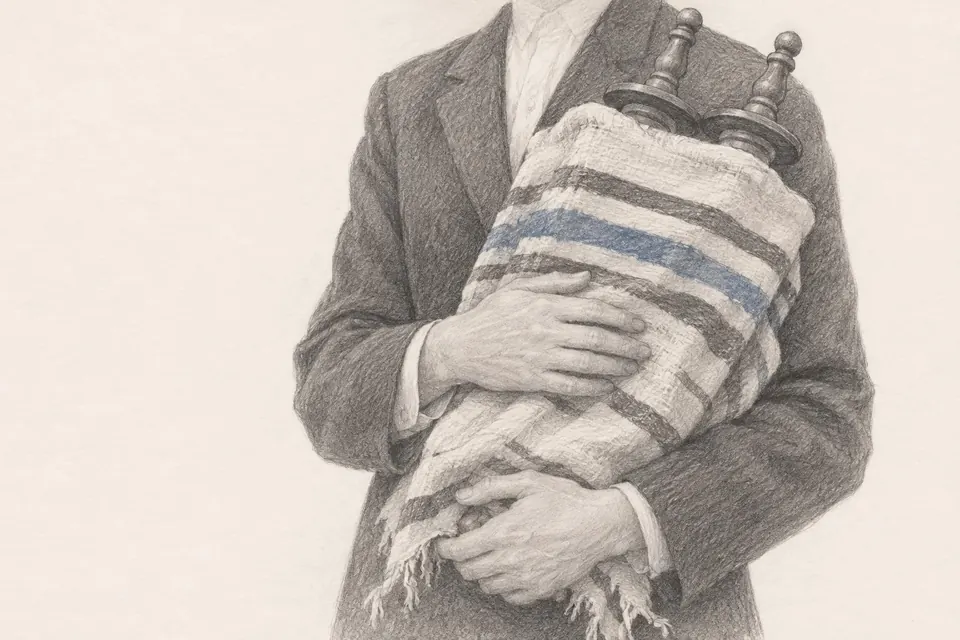
How Did the Klausenburger Rebbe Observe Holidays in the Camps?

Rabbi Aharon Leib Shteinman: A Biography
ParashaYitro: “My Sons’ Faces Do Not Yet Shine”
A Midrash about the Israelites’ recovery from slavery recalls the struggle to rebuild after the Holocaust.