How Did the Klausenburger Rebbe Observe Holidays in the Camps?
Survivors recall the Klausenburger Rebbe’s determination to observe Shemini Atzeret and Simchat Torah in a Nazi camp.
In brief
- The Klausenburger Rebbe continued to observe the Torah under the conditions of the Nazi camps.
- A fellow prisoner arranged for him to be assigned to work to protect him from a selection.
- The Rebbe refused to work on Shemini Atzeret and was brutally beaten.
- That evening, he circled a bench holding torn pages of a Mishnah.
Editor’s note: Rabbi Yekusiel Yehudah Halberstam, the Rebbe of Sanz-Klausenburg and a great Torah sage, endured terrible suffering during World War II, as did our entire people. Yet he held fast to his faith. Even in the most horrific conditions of the Nazi camps, he continued to study and observe the Torah. The stories below offer only a small glimpse of the Rebbe’s extraordinary feat of Jewish spirit in the concentration camps.
“Embracing You, Clinging to You”#
The story of how our holy teacher celebrated Shemini Atzeret and Simchat Torah is deeply moving. He spent the seven days of Sukkot in terrible suffering. There was no sukkah, no four species of plants, and no ushpizin—the welcoming of “heavenly guests.”
Some 40 years later, during a class on the Five Books of Moses and Rashi that the Rebbe gave in Jerusalem, he spoke in defense of the Jewish people. He pleaded for mercy for them, so they could fulfill the Torah’s commandments. With bitterness, he recalled: “I was in the camp during the High Holy Days and the festivals too. They forced us to work to exhaustion, and those evil men tore the kippot from our heads. They took away the few weekday and holiday prayer books we had, so we couldn’t pray. Could we serve the Almighty there? Did we have a sukkah? Was that even possible for us?”
But who could take Shemini Atzeret away from us? The entire festival is a celebration of the unity between God and the Jewish people. It is the crown of all the festivals, the culmination of the High Holy Days and the sacred days that precede it. It is the day when God says to the descendants of His beloved ones: “Come, let us rejoice together—you and I!”
The Maggid of Kozhnitz, may his merits protect us, said that Shemini Atzeret is on a higher level than Shavuot. As our Sages said in Taanit 7a: “The day of rain [Shemini Atzeret, when we begin mentioning rain in the prayer] is greater than the day the Torah was given.”
The Rebbe of Sanz-Klausenburg was in great distress, a captive of his enemies, but he would not compromise. Thanks to a note from the camp doctor, Dr. Greenboim, who was Jewish, the rabbi spent the festival days in the infirmary. He hoped to remain there for Shemini Atzeret as well.
But then something happened.
With Good Intentions#
Rabbi Moshe Eliezer Aingoren told me this story:
“On Hoshana Rabbah, the day before Shemini Atzeret, an acquaintance who worked at the camp told me a terrible secret. The next day, the ‘chief inspector’ was due to come to the camp to inspect the prisoners and conduct a ‘selection’ with the Nazi doctor, a notorious villain and sadist. They would send the sick and weak prisoners to the Dachau camp for extermination.
“It was clear that anyone who wanted to live had to go out to work that day to prove their ‘usefulness.’ I was worried about the fate of the righteous Klausenburger Rebbe and decided to do something myself.
“I hurried to Dr. Greenboim and asked him to put the Rebbe on the list of those going out to work the next day. He was astonished. Why was I suddenly asking for the opposite of what I had pleaded for before: that he declare the rabbi sick? I begged him to grant my new request, saying that I couldn’t reveal the reason just then.
“I remember that when the Rebbe learned that evening that he had to go to work on Shemini Atzeret, and that I was the reason, he was extremely upset and hurt with me. Only a day later, when everything had become clear to him, after many sick and weak Jews had been sent to the gas chambers of Dachau, he hurried over to apologize and thank me.”
Song of Songs: “They Struck Me, They Wounded Me” [Song of Songs 5:7]#
Another survivor of the camp added to this account:
“While the Rebbe still knew nothing about the reason for what was happening, he made a firm decision: ‘Whatever happens to me, I won’t go to work on Shemini Atzeret!’ He stayed in the barracks to be alone with his Creator, as was fitting for that day. But just then, they held an inspection and began counting the prisoners. They quickly discovered that one was missing.
“They immediately went looking through the barracks and found him immersed in prayer. With extreme cruelty, they dragged him to the roll-call square, where the prisoners were lined up. They tied him up and punished him in front of everyone: 25 merciless double lashes, delivered from both sides at once. When they were done with him, he was wounded, bleeding, and barely alive.
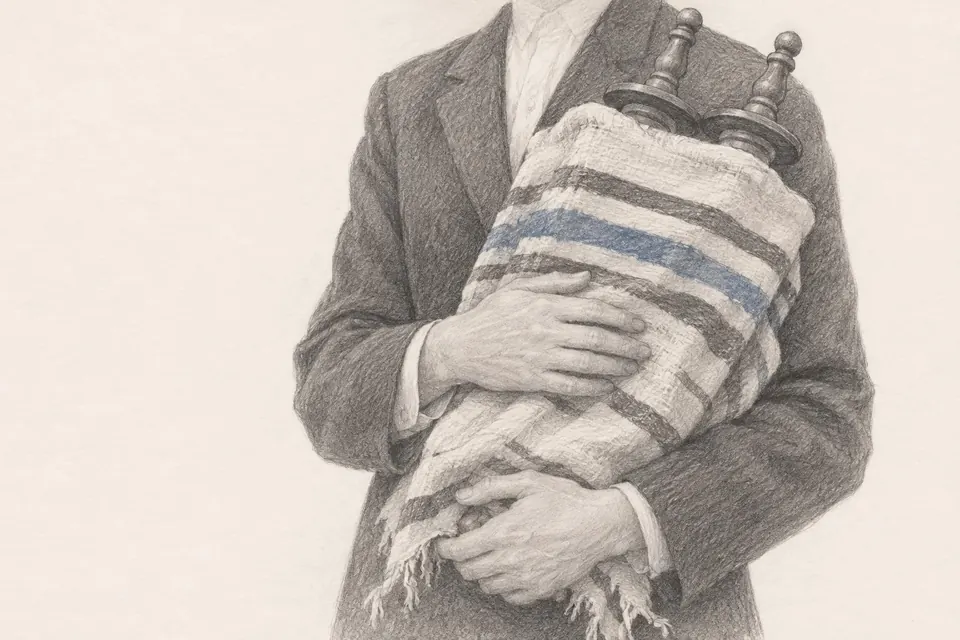
“The unfortunate Jews who witnessed it and then went out to work thought that the rabbi surely could not survive such a punishment and must already be dead. But to their great surprise, when they returned from their grueling labor after sunset, they found him alive. What’s more, he was walking in circles around a low bench in his barracks, holding loose, torn pages from a small book of Mishnah.
“As we understood it, he was performing the hakafot of Simchat Torah—the dancing in circles while holding Torah scrolls!”
The Victory Was Ours#
The sight of the Rebbe performing hakafot under the noses of the Nazi executioners, after surviving that bloody day of punishment, stirred the prisoners to their depths. As the verse says, “Though He slay me, I will hope in Him” (Job 13:15).
Before their eyes, the words sung in Sanz during the hakafot seemed to come alive. They are from the liturgical poem “I Sing a Song to My Creator”: “Your children are holy among the nations; they offered themselves as a burnt offering and peace offerings. I will bring my fat and my blood to the altar, and sing to Him like a Levite on his platform.”
Even Jews in the camp who had left the Torah behind, those who worked in the kitchen, were so moved by our teacher’s spiritual strength that they decided to make him a special kugel—a baked pudding—in secret for the next day, in honor of Simchat Torah.
In later years, our Rebbe himself often recalled his “adventures” on that Shemini Atzeret. He would say with satisfaction: “It’s true that I took many blows, and my soul nearly left me. But in the end, I defeated those evil men: I didn’t go to work on Shemini Atzeret!”
Keep reading
More →
Rabbi Chaim Pinchas Scheinberg: A Life of Torah

Rabbi Aharon Leib Shteinman: A Biography
ParashaYitro: “My Sons’ Faces Do Not Yet Shine”
A Midrash about the Israelites’ recovery from slavery recalls the struggle to rebuild after the Holocaust.