The Mezuzah: Where to Hang It, How, and Which One to Choose
A halacha lesson on where a mezuzah is required, how it is hung, who is obligated, and what makes one kosher.
In brief
- A mezuzah is hung on the right as one enters a doorway that has the form of a doorway: two doorposts and a crossbeam above them.
- It goes in the upper third of the doorway, tilted slightly; it is required in living rooms and the kitchen, and forbidden in a bathroom or toilet.
- The obligation rests on the resident, including a renter, and the rules differ for shared property, workplaces, balconies, and moving out.
- A mezuzah must be written and checked by a qualified scribe; very small, cheap mezuzot are very rarely kosher, and Ashkenazim should buy the Ashkenazi script.
What a Mezuzah Is and Where the Commandment Comes From#
We are going through several mitzvot one after another: tzitzit, tefillin, and now the mezuzah. There is one thing about the mezuzah that everyone knows: somehow, it protects the home. It hangs on the door, and on the outside of the rolled scroll is written a three-letter name of God, shin, dalet, yud. Everyone also knows what that name stands for: Shomer Daltot Yisrael, "Guardian of the Doors of Israel." So many people, even people who are not especially observant, to put it mildly, are happy to hang a mezuzah. They see it as something religious and ritual, a segulah (a protective charm), a folk belief: it guards the house, and thanks to it everything in the house will be wonderful. Let me say right away that I am not claiming the mezuzah protects. I am saying that there is a popular belief that you must hang a mezuzah because it protects. We will come back to that. First, the halacha.
What does the Written Torah say? In the prayer "Shema Yisrael," which Jews are required to recite twice a day, we find the words: "And these words that I command you today shall be on your heart" (Deuteronomy 6:6). This means that the words of the Torah must be inside us. Then it says: "And you shall speak of them when you sit in your house, and when you walk on the way, and when you lie down, and when you rise." That is the commandment to recite the Shema morning and evening. Next: "Ukshartam le'ot al yadecha", "You shall bind them as a sign on your hand," and "vehayu letotafot bein einecha", "and they shall be a symbol between your eyes." We have already discussed that this is the place on the head where an infant has a soft spot, where the hair stops growing. And finally: "Uchtavtam al mezuzot beitecha uvisharecha", "And you shall write them on the doorposts of your house and on your gates." That is what the Written Torah says about the commandment of the mezuzah.
Where to Hang a Mezuzah: The Shape of a Doorway#
As the verse says, the mezuzah goes on the doorpost of a house, and not necessarily on the door. There is an opinion, which is not the accepted halacha but is the respected view of Maimonides (the Rambam), that a mezuzah is hung only at an entrance that has a door. Where there is no door, only an opening, a mezuzah is not needed, or at most it is required by rabbinic law, and there is no mezuzah obligation there from the Torah. But our ruling is that even in such a place a mezuzah is required by Torah law, and it is hung with a blessing.
A mezuzah is hung at the entrance to a house, at the entrance to every room, and at the entrance to a property, meaning a yard. But there is one more condition: the entrance must have what our Sages call tzurat hapetach, the form of a doorway. This requires two vertical uprights, that is, doorposts, with a crossbeam lying horizontally on top of them, even if that crossbeam is a ceiling. These three boundary lines must exist. So it is far from always necessary to hang a mezuzah, and far from always possible to hang one with a blessing, in places that look to us at first glance like an entrance. Once more: the form of a doorway requires a crossbeam and two doorposts. And the crossbeam must sit directly over the doorposts, not min hatzad, not off to the side next to them. Usually that is how it is, but not always, especially in fashionable modern apartments and houses, where there are arches and round shapes. Each such case has to be examined separately. I cannot cover it in this lesson. It takes serious study, and often a mezuzah is not needed there at all.
Take a private yard. I enter the yard from the street through something like a gate. If there is a crossbar above the gate, lying on top of the two side posts, a mezuzah is needed there. If it is just a gate in a fence, with nothing above it, a mezuzah is not needed on it, because that is not what is called the gates of your house. If there are three lines, vertical on the left and right and horizontal on top, that is the form of a doorway, and a mezuzah must be hung there. People ask the same question about the gate of a private house, and the answer is the same: the gate itself does not create an obligation, but if it has the form of a doorway, a mezuzah is needed. And again I stress that the horizontal crossbeam must be directly over the doorposts, not beside them. If it is off to the side, no mezuzah is needed.
Next, the entrance from the yard into the house. If there are several entrances, a mezuzah is hung at each one, again with the limitation that it must really be an entrance and not something else.
A person may live in a cave or a yurt, where the entrance does not have the proper form. There a mezuzah is not needed. But whether the form is correct has to be determined precisely, and for that you should consult someone. Suppose, for example, that there is a curve at a certain angle (I am showing it with my hands: the crossbeam must be horizontal, and if it has this kind of shape, a great deal depends on the radius). It may well turn out that a mezuzah is needed. This is not a simple question.
Which Side, Which Rooms, and the Balcony#
Pay close attention, because people often make mistakes here. A mezuzah is hung on the right side of the entrance, going from the yard or the street into the apartment. I walk in, and the mezuzah goes on the right as I enter (not as I leave, but as I enter), no matter which side the door's hinges are on. It is always on the right of the person entering.
After that, mezuzot must hang in all the living rooms and in the kitchen, also on the right as one enters the room. If a room in the house has two entrances, you have to look at which one is used regularly. They may be on different sides, and then the mezuzah goes on the right of the entrance that is in regular use.
A room that is used not for living but, for example, as a storage closet where things are kept also requires a mezuzah if its area is four cubits by four cubits, roughly two by two meters, a little under two by two meters (about 6.5 by 6.5 feet). If the closet is smaller, a mezuzah is not needed there, and it may not be hung, because it is not a living space. A bathroom, a toilet, the spot where the washing machine stands, in short anything that counts as a place of relative impurity: there you do not hang a mezuzah and you may not. This is strictly forbidden; a mezuzah is never hung there under any circumstances. Those are the general rules, the klalim.
There is one very rare situation, tied to a certain mistake in halacha. It is a room with two entrances, with a door standing in the middle that divides it into two parts, and people enter it equally from the left side and the right. It is impossible to determine which is the right side of the entrance, because both sides are identical. Only in this situation, say the Talmud and the Shulchan Aruch, is the mezuzah hung on the side where the door's hinges are. This is the only case where we go by the door hinges.
What if, with the door closed, there is no place to hang the mezuzah? That does not happen. In the worst case, if it is impossible to carve a niche for the mezuzah in the doorpost (usually you can, but suppose the doorframe is made of the kind of armor used on a tank), the mezuzah may be hung on the outer side of the door, not on the doorpost inside but on the doorpost outside. It can and must be hung regardless. In the most difficult situation, say a person lives abroad and for some reason it is dangerous to hang a mezuzah outside, it may be hung inside. But in principle there is no situation in which it is impossible to hang a mezuzah.
The balcony, or loggia, that is part of a home is a separate topic. Here there is a serious machloket, a dispute, about where to hang the mezuzah, because a balcony can be viewed in two ways. Either I am leaving the room for the balcony, in which case the mezuzah is hung on the right as I step out from the room onto the balcony. Or, the other way around, I am entering the room from the balcony. It makes no difference that the balcony may be reachable only through the room, or that it may even be enclosed with a railing. The view of the Chemdat Daniel is that the mezuzah is hung at the entrance to the balcony, that is, as one leaves the room. The view of the Chazon Ish is that it is hung at the entrance from the balcony into the house. There is also one opinion that is not accepted: the responsa Orach LaNer hold that in such a situation a mezuzah should be hung on both sides, to fulfill the commandment according to both views. But this is not usually done. Maybe someone does it. I do not know, as you can guess, but usually nobody does. Here you should ask a rabbi and consult. Both views are worthy, and some people act one way and others another.
The size of the balcony matters. If the balcony is smaller than four by four cubits, that is, smaller than two by two meters, then according to all opinions it does not need a mezuzah in itself. What remains is the view of the Chazon Ish that a mezuzah should be hung where one leaves the balcony for the room. It will be on the balcony, but not on the right as you enter the balcony; it will be on the right as you enter the room from the balcony. If the balcony is four by four cubits, that is, two by two meters, the dispute is between the Chazon Ish, who still requires hanging it where one leaves the balcony for the room, and the Chemdat Daniel, who says to hang it where one enters the balcony. So it is better to ask a rabbi, show him a photograph, and consult about how to act in each specific case. I am giving general rules and general directions so that you know what has to be done and that you need to consult. In one lecture it is simply physically impossible to answer every question and give all the laws of the mezuzah.
If a loggia has two exits into rooms, then according to the Chazon Ish you hang two mezuzot, one at the entrance from the loggia into each of the rooms, on the right as you enter the room; that is, as I leave the loggia, on both sides.
If the exit to the balcony has no proper doorpost and the mezuzah was hung in the same plane as the door, it is kosher, perfectly kosher.
At What Height and at What Angle#
The mezuzah is hung in the upper third of the height of the doorway. If the doorway is 180 cm high (about 6 feet), a third is 60 cm (about 2 feet), and the mezuzah may be hung anywhere from 120 cm (about 4 feet) above the floor up to the very top.
How exactly is it hung? Here there is a dispute between Rashi and the Tosafot, the commentators on the Talmud, which carried over into a dispute between the Shulchan Aruch, that is, the Beit Yosef, and the Rema, that is, the glosses on the Shulchan Aruch used by Ashkenazi Jews, written by Rabbi Moshe Isserles. According to Rashi and the Shulchan Aruch, the mezuzah is hung vertically. According to the Tosafot, Rabbeinu Tam, whose view the Rema cites, it is hung horizontally. In Sephardic communities the custom is to hang it vertically, and in Ashkenazi communities at a slight angle, neither horizontal nor vertical, because many of the later authorities (Acharonim), the later commentators on the Shulchan Aruch and the Talmud, explain that this way the commandment is fulfilled according to both views. So practically everywhere, the mezuzah is hung at an angle. The size of the angle may depend on the width of the doorpost. Even a slight tilt is enough, and the commandment is considered fulfilled according to all opinions.
Someone asks: a mezuzah was nailed up at an angle by mistake, but tilted the wrong way, not toward the apartment but toward the landing. Does it have to be rehung? We are talking about baalei teshuvah, and we are afraid of being too insistent with them. Yes, it is preferable to rehang it. There is nothing terrible about its being nailed that way, but in that position it is not in line with Rashi's view or with the view of Rabbeinu Tam, so it is wrong according to all opinions. In my experience, people who are returning to observance do not object when someone helps them rehang a mezuzah. If you cannot rehang it yourself and want them to do it on their own, you can certainly suggest it, and usually there is no problem. But if you see that it will become a problem, it is better to wait and suggest it later.
Who Is Obligated: Rentals, Shared Buildings, Workplaces#
A question arises: in an apartment building, two of the apartments belong to non-Jews. Is a mezuzah needed on the main door? The Rema in the Shulchan Aruch rules that a yard or house owned by partners (chatzer shel shutafim), if one of the partners is a non-Jew, is not obligated in a mezuzah. So there is no obligation to hang one there, and perhaps it is not even appropriate to; but that there is no obligation to hang a mezuzah there is absolutely certain. A similar question: a shared door for two apartments, one owned by a Jew and the other by a non-Jew. Is a mezuzah needed on the shared door, or only on the door of the apartment? On the apartment door it is definitely needed. Shared ownership is exempt from the mezuzah obligation. If you hang one there, nothing terrible happens: you are not obligated, but you may. You should not say a blessing for it. But people usually hang several mezuzot at once and say only one blessing, so you can say it over your own door, have in mind (kavanah) that it covers the other as well, and hang one there too. But there is no obligation, and a mezuzah costs quite a lot, so if there is no obligation, then no.
Here I have to add an important halacha that I forgot to mention; that was my oversight. The verse says that the mezuzah is hung "on the doorposts of your house and on your gates." "Your house" means not only a house you bought but also a house you rent and live in. If Reuben buys a house and rents it to Simeon, the mezuzah obligation falls on the renter, the resident, and not on the owner. So in an Amigur building (a social housing program), where one of the families is non-Jewish and the apartment has not been bought out by them but is owned, the obligation likewise rests on the person who lives there, and the apartment needs a mezuzah. On the entrance door of the building, since it is shared property in which many Jews live, a mezuzah is definitely needed. There may be details to discuss, but most likely a mezuzah is needed there.
Someone asks: in the stairwell of a hostel, where there is only a staircase from the fifth floor down to the basement, there is nowhere to hang a mezuzah at the entrance to the floor. If there is technically nowhere to hang one at the entrance to the floor, then that place is not obligated in a mezuzah, and the mezuzah is hung only on the door of one's own space.
Someone asks whether the mezuzah protects only a home, and what about a business where a person works. Where I do not live, there is no obligation to hang a mezuzah, since it says "on the gates of your house." But "live" is defined as the place where a person sleeps and eats. In a workplace or an office, as I imagine it, people usually have a snack and drink coffee and tea, and sometimes put an arm on the desk and sleep for fifteen or twenty minutes to rest and then work better, so it is customary to hang a mezuzah there. The practical rule is this: if a person knows for certain that they neither sleep nor eat there, a mezuzah may not be hung with a blessing. But if they sleep there and eat at least a little, one may be lenient and hang it with a blessing.
About the synagogue: the door of a synagogue is a matter of dispute in the Shulchan Aruch. It is customary to hang a mezuzah on the door of a synagogue, especially because in most synagogues people study, drink, and sleep a little.
Rented housing has its own subtleties. If I move into a new apartment that already has mezuzot, I have to understand that the obligation rests on me, the resident, and not on the owner, and certainly not on the previous tenants. So I have to make sure the mezuzot are kosher. Suppose I move into an apartment where the Chazon Ish used to live (I am taking an unrealistic example), and the Chazon Ish tells me that these mezuzot are kosher and have already been checked. Then I do not have to check them. But if the person before me was who knows who and lived who knows how, there is no guarantee that his mezuzot are kosher and acceptable to me, and they need to be checked. And if I want to hang mehadrin mezuzot, very fine ones, I will have to buy and hang new ones.
But there is a catch. Suppose I live in the Land of Israel, moved into an apartment, whether I bought it or rented it (this matters more for a rental), and settled in. If a year or two later I leave, whether for a bigger apartment, a smaller one, or another city (there are endless possibilities), I have no right to take down the mezuzot. I must leave the same mezuzot, because a Jew will be moving into this apartment, and I may not leave that person without mezuzot. So you need to do a small calculation here: how much money you are ready to spend, and how to act properly.
Someone asks: from what moment does a tenant who has moved into an apartment and settled in become obligated to have a mezuzah? Abroad, after thirty days. For the first thirty days they are not obligated to take care of a mezuzah, because it is not yet their home. After thirty days they are obligated, but this is by rabbinic law. In the Land of Israel, immediately: they are obligated to take care of a mezuzah right away.
What should one do with expensive mezuzot when moving out? You can replace them with cheaper ones, and it is preferable to do it a few days before the move, while I still live in the apartment, so that it looks like this: I live here and I am not "changing my mezuzot"; I have hung cheaper ones. The ideal way is to do it with the intention that we are checking the mezuzot and replacing them while we are at it. In any case, mezuzot have to be checked twice in seven years. I take down the mezuzot for checking and hang others, and afterward I take the good, checked ones with me, provided that the ones I hung are kosher: not ideal, but kosher.
Another question: a person moved into an apartment that already had mezuzot, hung his own in their place on the condition that when he moved out he would take down his own and rehang the previous ones, the landlord's, and that is what he did. Is that correct? The ideal option, the best advice, is to take the landlord's mezuzot to be checked and hang other ones in the meantime, and then it is one hundred percent correct.
And if we move out of an apartment and a non-Jew moves in, the mezuzot must be taken down. This is essential.
How to Attach a Mezuzah#
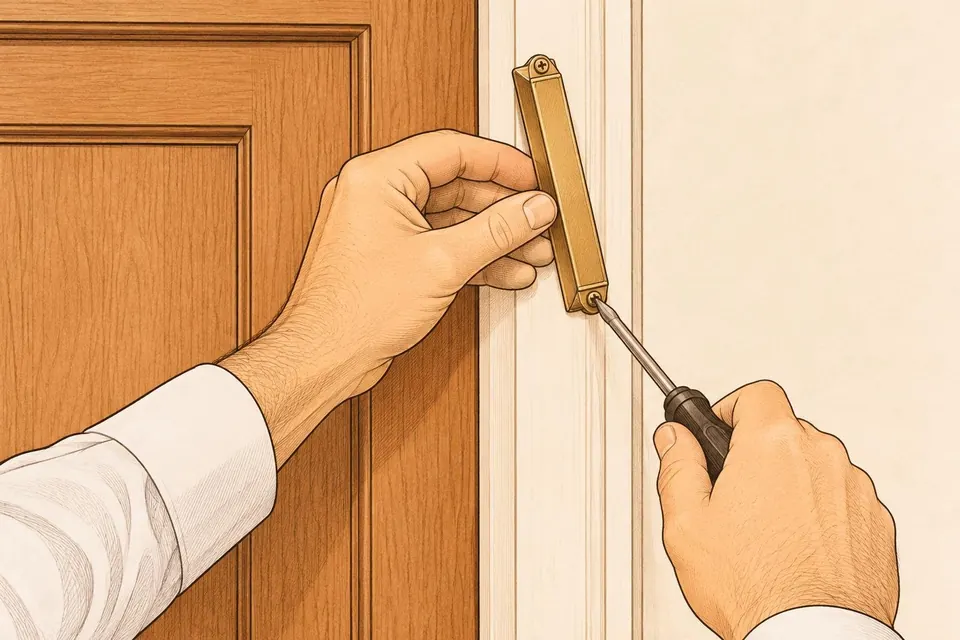
A woman may hang a mezuzah, and so may a girl. The technique is fairly simple, but the usual standard method is not easy for every woman: you drill two holes and screw the mezuzah on through the case. The case usually has holes, but the doorpost does not. If this is hard for one reason or another (there is nobody to ask, the woman cannot do it herself, or the man cannot or does not want to, out of plain laziness, and that happens too), you may glue the mezuzah, but so that it does not fall.
Someone asks why gluing is worse. Gluing is not worse, if the glue is good, the mezuzah will hold well, and there is no danger of its falling. There is no problem. But technically it often happens that, because of dampness or other reasons, the glue does not hold. So either choose good glue and do the job carefully, or hang it on screws, which will certainly hold. If a mezuzah was glued poorly and fell, God forbid, it needs to be picked up and glued on properly. Nothing more needs to be done, since it is in its case. But of course this is not right, and you should make sure that it is glued on well.
What Is Written in a Mezuzah and What Makes It Kosher#
People usually buy a mezuzah already in its case, rolled up. In fact the mezuzah is a small piece of parchment on which the first two passages of the prayer "Shema Yisrael" are written. Here are those two passages: "Hear, Israel: God is our God, God is One! You shall love God, your God, with all your heart and with all your soul..." (Deuteronomy 6:4-9), and then: "And it shall be, if you listen carefully to My commandments that I am commanding you today, and keep them, then you will have early and late rain in its time," and so on, and then "but if not," and so on (Deuteronomy 11:13-21). These same two passages of the Shema are also written in tefillin. The mezuzah does not contain the words "Baruch shem kevod malchuto leolam vaed", "Blessed be the name of His glorious kingdom for ever and ever." "You shall love God" is there, as is "if you listen carefully." The text ends with the words: "Write them on the doorposts of your house and on your gates, so that your days and the days of your children may be multiplied on the land that God swore to your fathers to give them, like the days of the heavens above the earth." That is how the text of the mezuzah ends.
What determines whether it is kosher? For a Torah scroll, tefillin, and a mezuzah (together called STaM, from the first letters of sefer Torah, tefillin, and mezuzah) there are specific laws of writing. A special script is used for them, called ktav Ashurit, Assyrian script.
What sizes are there? Whatever the size of the mezuzah, very tiny mezuzot are, in practice, very, very rarely kosher. The cheap miniature mezuzot hanging in various Israeli offices and workplaces are rarely kosher; that is just how it turns out. The scribes (soferim) who write mezuzot must have a certain level of knowledge, fear of God, and writing skill, so it is advisable to buy a mezuzah after consulting someone who knows something about it. The quality varies enormously, and so does the price. Mezuzot that are kosher, or more or less kosher, are usually ten or fifteen centimeters long (about 4 or 6 inches). About the tiny ones I do not say that they are certainly invalid (pasul), but they are many orders of magnitude worse, and it is far from always possible to determine with one hundred percent certainty whether they are kosher.
Let me tell you a story. When we were on a mission (shlichut) and went to Leningrad, to a school, the organization that ran the school sent a great many of the very cheapest mezuzot there were. I used to check mezuzot, though I no longer do, and I told one of the heads of the organization that the mezuzot they had sent were very bad. He answered: any mezuzah you find to be one hundred percent invalid, we will replace right away. And they were supposed to be handed out to families in Leningrad. Only a very great Torah scholar could say that a mezuzah is one hundred percent invalid, because it is very hard to know that there is not a single opinion according to which it is kosher. But the mezuzot were terrible, and I do not recommend hanging such ones. In the end we pooled our money and bought mezuzot ourselves to hand out to the kids, because these could not be handed out. So as a rule you should not buy the cheapest mezuzot, and it is advisable to consult someone, and that already requires personal contact.
The letters in which a Torah scroll, tefillin, and mezuzah are written follow two, or perhaps three, traditions. All of them are considered kosher. There is a Sephardic script (ktav), used by Sephardim. Ashkenazim should preferably not buy a mezuzah in the Sephardic script, because of one difference. All the other differences do not make a mezuzah non-kosher; they only lower its hiddur mitzvah, the ideal quality of fulfilling the commandment, but the mitzvah is still fulfilled validly. The exception is the letter yud, which has a tiny dot called the ukotz of Rabbeinu Tam. Sephardim do not need it; Ashkenazim do. According to most opinions, practically all of them, a yud without this dot is invalid for Ashkenazi Jews, and the mezuzah is invalid. There is no particular problem with the other letters, but because of this letter it is strongly advisable for Ashkenazim to buy an Ashkenazi mezuzah. Today many Sephardic scribes, aware of this problem and aware that their mezuzah may hang at the entrance of a building where both Ashkenazim and Sephardim live, write this dot of Rabbeinu Tam so that it is at least valid after the fact (bediavad) for everyone. But far from all do this. They are not obligated to, and some deliberately do not, because it is not their custom and it does not bother them. So you need to check.
The second script is the ktav Beit Yosef. This is an Ashkenazi script, although the name is usually Sephardic, and it is accepted in all Lithuanian circles. Many Hasidic groups (not all, but many) have adopted the script called ktav Arizal. Between the Beit Yosef script and the Arizal script there are about six small differences, and one of them would be better absent for those who do not follow the Kabbalah of the Arizal. Even so, the Chazon Ish wrote that this script is kosher for everyone. So you can buy such a mezuzah without a problem. It may be cheaper, and not a little but a lot, yet it will be kosher. But Ashkenazim who do not follow Kabbalah but follow the Shulchan Aruch are better off buying the Beit Yosef script, and practically all Ashkenazim do. Hasidim almost all buy the Arizal script, and that is perfectly fine too.
The main thing is quality, because a tiny dot or flaw in any of these scripts can make a mezuzah invalid, and there are specific laws. So the mezuzah must be written and checked by a kosher scribe, preferably a yerei shamayim, someone who fears Heaven and takes this seriously. There are quite a lot of such mezuzot today, and buying them is not hard, but it is not the cheapest option. I cannot give you the address of a store you could go to with your eyes closed. In Jerusalem I can; outside Jerusalem I cannot. Better to consult someone near you who knows the subject; that is a separate conversation.
Someone asks: "We bought an Ashkenazi mezuzah; a vav was written in it first, then it was scraped and enlarged into a zayin, and we were told that if the zayin was added on, it is not kosher." What you were told is both right and wrong at the same time: it is certainly right; the question is whether you understood it correctly. The halacha is this: in a mezuzah and in tefillin, if the next letter, and all the more so several letters, has already been written after a letter, then the earlier letter, if it is invalid, may not be corrected. But if it is valid, it may be corrected. Judging by your question, you mean the letter chet. In the Ashkenazi script it is written as two zayins joined by a special little roof. In the Arizal script, the first letter is a vav and the second a zayin, and then the little roof is added. Since both vav and zayin are kosher for Ashkenazim too, if a vav in a chet was scraped and enlarged into a zayin, that is not a problem. But if the mistake was somewhere else (say, "mezuzot" should have been written with a zayin and "mevuzot" was written with a vav, and then it was corrected), that is indeed a problem. But without seeing the mezuzah and knowing what happened, I cannot answer. The kosher status of a mezuzah has to be determined by a scribe who writes mezuzot and tefillin. As a rule, though not always, such scribes also receive a baal magiah certificate, the right to check mezuzot, Torah scrolls, and tefillin. They are the ones who also do the writing.
Checking Mezuzot and Other Questions#
A mezuzah inside an apartment has to be checked twice in seven years, that is, about every three and a half years. This check is not as thorough as the first one, when one decides whether the mezuzah is kosher. We already know that it is kosher, and the whole check is only to make sure that no moisture has seeped in and the mezuzah has not been ruined. So the check is very light. Practically anyone can do it by opening the mezuzah and seeing that there is no moisture that made the letters run. It is desirable that the person know at least a little, but there is no need to take it to a scribe and pay money for this. We are talking about a mezuzah that is kosher and is known to have been checked.
The Shulchan Aruch rules that in institutions, that is, in a shared public place such as a synagogue or an office, a mezuzah is checked twice in fifty years, that is, twice in a Jubilee cycle. But someone asked about a medical facility with a badly rusted case. Here you have to look: if there is a serious concern that moisture is getting in from outside and the mezuzah is deteriorating, it is better to take it down periodically and see what has happened to it. If there is no such concern (that depends on the location and so on), then twice in fifty years.
The mezuzah at the entrance to an apartment building, downstairs, is a mezuzah of private property, and it has to be checked the same way as in your own apartment, twice in seven years. That is approximate, not strictly required. But I repeat: the check is very light. It does not have to be handed to a scribe. Someone just needs to open it and see whether any letters have run because water got in. Nothing more needs to be done.
Is kissing the mezuzah on entering and leaving a commandment or a custom? It is a custom, connected with our wish to show respect for the mezuzah. It is very widespread and has some sources, but it is clear that it is not a commandment.
Does it matter which "little house," the case, one has? Different cases show the letter shin drawn differently, and these are the same variants I mentioned: Sephardic, Arizal, Beit Yosef, Lithuanian; in essence, three variants. But the shin on the case is not meakev, it does not hold up the fulfillment of the commandment, so there is no problem. The case is there for beauty and also as a way of showing respect for the mezuzah commandment. When a good mezuzah is hanging, it is not quite right for the commandment to be fulfilled through a cheap case.
Should a mezuzah, like a Torah scroll, be written while immersing in a mikveh? First of all, even a Torah scroll does not have to be written with immersion in a mikveh; the halacha does not require this. There are giddurim, things people do to raise their own level of holiness while writing. Many people go to the mikveh on the day they have to write the four-letter name of God or another of His names, and it makes no difference whether it is a Torah scroll, a mezuzah, or tefillin. Since a person engaged in scribal work meets the name of God every day, those who want to take this stringency (chumrah) on themselves go to the mikveh every day before writing. Those who do not take on this stringency (and I think they are the majority of scribes, although how would I know, I have no statistics) calmly write Torah scrolls and mezuzot without immersion, and the mezuzah is perfectly kosher. Someone who wants to be stringent should find out whether the mezuzah was written by a scribe who immerses in a mikveh. I know one scribe whose customer, when ordering a Torah scroll, made it a condition that the writer must immerse in a mikveh.
Someone asks: if there is a commandment to recite the Shema twice a day, then what about the Shema at bedtime? Does that mean it is not obligatory? The bedtime Shema (Shema al hamitah) is not a commandment from the Torah; the Torah commandment is twice a day, morning and evening. The bedtime Shema is recited for reasons connected with danger.
From a lesson by Rabbi Eliezer Ksido
Practical law. This page reports a ruling given for a specific question. For your own situation, ask a rabbi who knows you.
Keep reading
More →Why Are Tattoos Forbidden in Judaism?
Rabbi Shlomo Wolbe’s comparison of the body to a spacesuit helps explain the Torah’s prohibition.
ParashaEikev: Silent Witnesses
The mezuzah at the door reminds us what endures amid a changing world.
Guide · MitzvotThe Laws of Separating Challah From Dough
- General Principles
- Who Is Obligated to Separate Challah?
- Separating Challah on Shabbat and Festivals
You Do What You Can, and I Will Add My Glory
Our efforts to perform mitzvot are only one part of the story.







