Why Did Abraham Stay at the Same Inns?
Abraham’s return journey offers a lesson about wealth and the comforts we choose.
In brief
- Abraham stayed at the same inns on his return from Egypt.
- Although he had become wealthy, he did not want to grow accustomed to luxury.
- He used his wealth to support his students and guests.
- A blessing can be welcome without changing the way we live.
Parashat Lech Lecha#
Let’s begin with the principle that the deeds of the fathers are a lesson for their children.
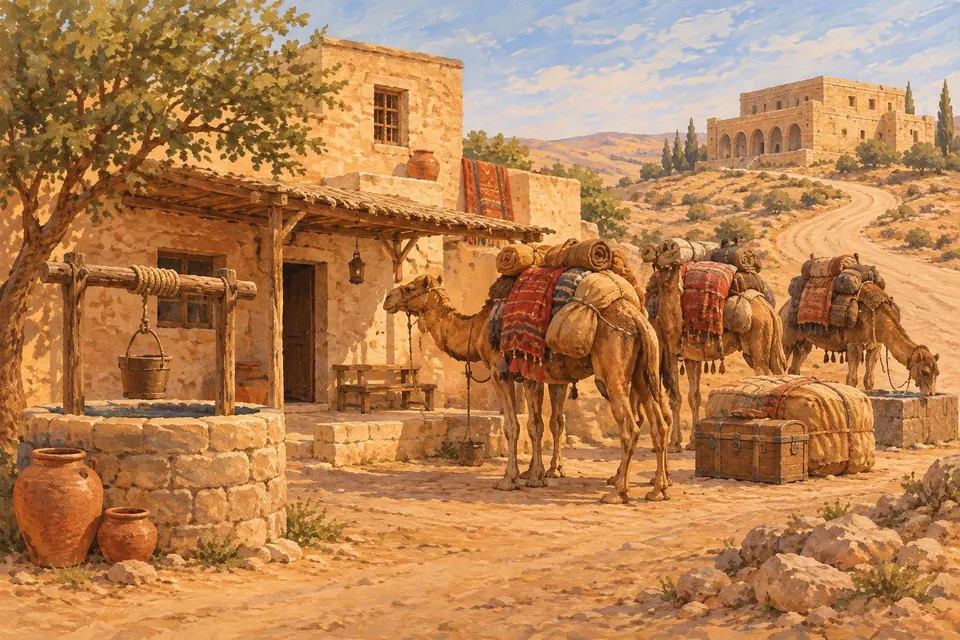
Our forefather Abraham left his country, his birthplace, and his father’s house. He came to the Land of Israel, and a famine struck. He had no choice: he “went down to Egypt to live there, because the famine was severe in the land” [Genesis 12:10]. On the way, he stayed at roadside inns, but he had no money to pay. The innkeepers extended him credit.
When he reached Egypt, Pharaoh took Sarah from him. God struck Pharaoh with a severe illness, and Pharaoh returned Sarah to Abraham, along with generous “compensation for damages.” As the Torah goes on to say: “Abraham was very wealthy in livestock, silver, and gold. He traveled by stages …” [Genesis 13:2–3]. Rashi comments: “When he returned from Egypt to the land of Canaan, he stayed at the same inns where he had stayed on his way to Egypt. This teaches us derech eretz (proper conduct): a person should not change their lodging” [Rashi on Genesis 13:3].
I have a question. I’ve heard that hotels are rated by the number of stars they have.
When you get the bill, count the stars spinning before your eyes: if there are five, it’s a luxury hotel. If there are only two, it’s a cheap one.
Imagine someone walking into a luxury hotel and saying, “You know, there’s a terrible famine in our country. People have nothing to eat. Here, thank God, you have oats for the horses and delicacies for the people. So I’d like to stay with you. But there’s one thing I should tell you up front: I have no money to pay. With God’s help, when things get better … I don’t know exactly when, or even whether they will … I’ll pay you.”
What would they say? Nothing—they would point him to the door. You have no money, and you pick the most expensive place?
I heard a story about a man who went to a professor. He complained of pains here, there, and everywhere. The professor examined him carefully, checked everything, wrote a prescription, and said, “Eight hundred dollars.”
“But I don’t have it!”
The professor was taken aback. “What do you mean, you don’t have it?”
“Just what I said. I don’t have it.”
Well, there was no point arguing. “All right, give me five hundred.” Other patients were waiting, and the professor’s time was valuable.
“But I don’t have it!”
“Listen, four hundred is half price. I can’t take less.”
They say professors are intelligent people. How is it they can’t understand Russian? “I don’t have it!”
The professor decided to take the initiative. “Well, how much do you have?”
“Nothing at all!”
“I don’t understand,” said the professor, now shocked. “When you have no money, you don’t go to a professor! You go to the public clinic!”
The patient straightened up proudly. “My father always said that health is worth more than money!”
That’s true. But if he had said up front that he had no money, he would have been left with all his ailments. Our forefather Abraham, on the other hand, surely told the truth in advance. So where would they have agreed to take him in? During a famine, and without payment? And a stranger at that, a traveler from Haran on his way to Egypt? They must have been minus-one-star inns.
On his return journey, Abraham was very wealthy in livestock, silver, and gold. Now he could have chosen the finest inns, studded with stars like the heavens. But he did not change his lodging. He stayed at the same inns for poor people. Why? Because he did not want to grow accustomed to a higher material standard of living, to delicacies and luxury.
“Abraham was very wealthy in livestock, silver, and gold.” Literally, the Hebrew says that Abraham was very “heavy.” The great Alshich, Rabbi Moshe Alshich, an outstanding sage and biblical commentator, explains: What feels heavy? Shackles. Jewelry does not feel heavy. The joy and pride it brings make its weight go unnoticed.
But our forefather Abraham was heavy, “very heavy,” with livestock, silver, and gold. They were a burden to him. He had to carry that burden to provide for his many students and countless guests. That cost a great deal of money—just imagine feeding every passerby beef tongue with mustard. But as for himself, “he wore himself out and exhausted himself” (Song of Songs Rabbah 1:49). He did not want to grow accustomed to luxury. He remained the person he had always been.
I remember when the head of the yeshiva, the great Rabbi Avraham Yaffen, son-in-law of the Saba of Novardok, came to Israel and stayed in my home. It was a tremendous privilege for me. After Shabbat, he said to me, “Let’s go visit the Steipler.” The Steipler had been his student in Bialystok. We went to see him and found him in the middle of his melaveh malkah (the meal after Shabbat): leftover challah, a herring tail, and a glass of water.
The head of the yeshiva saw this and smiled. “The same Steipler, just as he was 30 years ago!” He had not changed his “lodging.”
I say that this is why, in the Grace After Meals (Birkat Hamazon), we ask: “May the Merciful One send us abundant blessing”—but “in this house,” so that abundant blessing does not go to our heads and make us move to another home. More than that: “at this table, at which we have eaten”—so that we do not even change the furniture!
By Rabbi Yaakov Galinsky
Keep reading
More →Why Was the Manna a Test?
In Parashat Eikev, the manna reveals that abundance can be a test as well as a blessing.
Guide · Work and MoneyWhen Must You Pay a Worker Under Jewish Law?
- Basic Principles
- The Payment Deadline
- Work Ordered From a Craftsperson
Is Wealth a Harder Test Than Poverty?
The story of Abraham and Lot offers a lesson about the spiritual challenges of poverty and wealth.
Work and MoneyIf There Is No Flour, Is There No Torah?
Jacob’s request for food and clothing teaches that material needs can support a life devoted to Torah.







