Is Wealth a Harder Test Than Poverty?
The story of Abraham and Lot offers a lesson about the spiritual challenges of poverty and wealth.
In brief
- Both poverty and wealth can test a person’s faithfulness to God.
- The author reads Maimonides as suggesting that wealth makes Torah study especially difficult.
- Lot remained with Abraham through poverty but separated from him after gaining wealth.
Parashat Lech Lecha#
There are two tests: the test of poverty and the test of wealth. May the Almighty spare us these troubles.
Poverty, the Talmud says, can drive a person out of their mind and lead them to act against the will of their Master (Eruvin 41b). And of wealth it says: “Jeshurun grew fat and kicked” (Deuteronomy 32:15). Because God gave the Jews so much gold when they left Egypt, they made the golden calf (Berakhot 32a).
In the blessing for the new month, we ask for “a life in which there is awe of God and fear of sin.” Then, immediately after asking for “a life of wealth and honor,” we hasten to ask for “a life in which there is love of Torah and awe of God.” Why? Have we not already asked for awe of God? From this we see that a wealthy person needs a double portion of awe of God and extra strength in their love of Torah.
As the author of Chovot HaLevavot (Duties of the Heart) says: “Just as water and fire cannot be joined in one vessel, love of this world and love of the World to Come cannot be joined in the heart of a believer.”
Maimonides (the Rambam) states plainly that the test of wealth is harder than the test of poverty when it comes to love of Torah, not only in the area of awe of God. He writes: “Every person in Israel is obligated to study Torah, whether poor or rich, healthy or ill and afflicted by suffering, young or very old and weakened by age” (Maimonides, Laws of Torah Study 1:8).
Read carefully, we notice that he first mentions the person for whom Torah study is easy—for example, someone healthy or young—and then adds the person for whom it is very difficult: someone ill and suffering, or an elderly person whose strength is failing. So when he writes “poor or rich,” it follows that the wealthy person needs greater encouragement, because the test of wealth is harder than the test of poverty.
[If we look at the world of Jews devoted to Torah around us, we see an obvious fact: A great many Jews study Torah despite their poverty. Among the wealthy, the percentage who study Torah is much smaller.]
Let us turn to our portion. Our forefather Abraham was commanded to leave everything: “Go from your land, from your birthplace, and from your father’s house.” He was not told where to go, only that he should go “to the land that I will show you” [Genesis 12:1]. Nachmanides (the Ramban) comments that Abraham wandered among nations and through different lands, and that every step was a test. In some ways, it was a test comparable to the binding of Isaac, even though Abraham had been given great promises.
“Abraham went, as God had told him, and Lot went with him” [Genesis 12:4]. Lot went with him even though he had received no command from Heaven and had been given no promises. He simply recognized Abraham’s greatness and felt that distancing himself from Abraham meant distancing himself from life. As the Talmud says: “If a student is exiled to a city of refuge, his teacher goes into exile with him” (Makkot 10a). For without his teacher, the student cannot live.
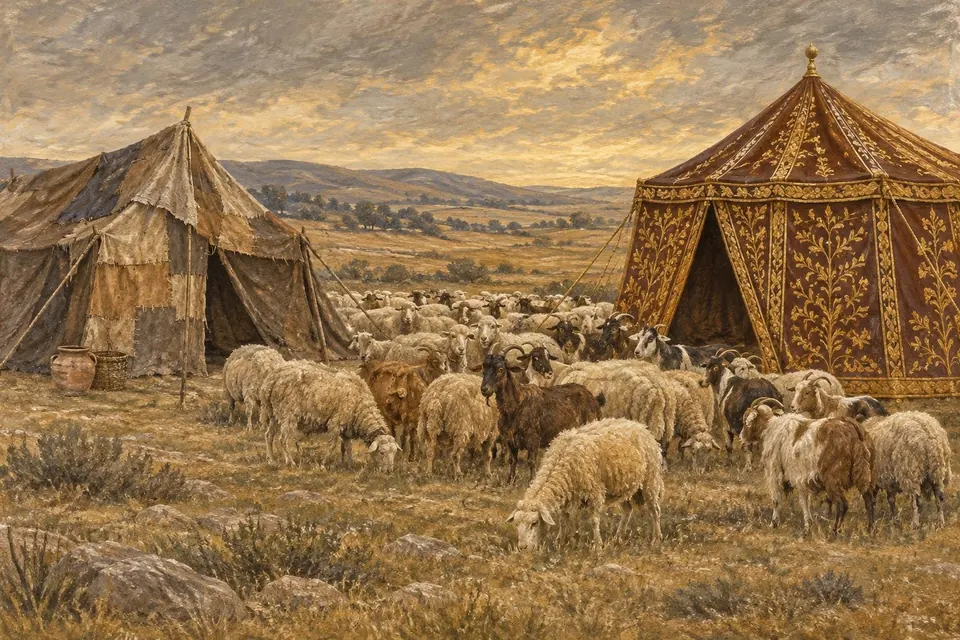
Lot suffered from the famine along with Abraham and went down to Egypt with him. He passed the test of poverty completely. Then: “Lot, who went with Abraham, also had flocks, cattle, and tents.” Immediately afterward: “The land could not support them living together,” and “there was a quarrel,” and “Lot lifted his eyes and saw that the whole Jordan plain was well watered,” and then “Lot journeyed from the east” [Genesis 13:5–7, 10–11].
Rashi explains the word mikedem (“from the east”) as a play on Kadmon, the One who preceded the world—that is, God: “He distanced himself from the One who preceded the world and said, ‘I want neither Abraham nor his God’” (Rashi on Genesis 13:11).
Lot passed the test of poverty, but he failed the test of wealth…
By Rabbi Shimshon Pincus
Keep reading
More →Why Was the Manna a Test?
In Parashat Eikev, the manna reveals that abundance can be a test as well as a blessing.
Guide · Work and MoneyWhen Must You Pay a Worker Under Jewish Law?
- Basic Principles
- The Payment Deadline
- Work Ordered From a Craftsperson
Why Did Abraham Stay at the Same Inns?
Abraham’s return journey offers a lesson about wealth and the comforts we choose.
Work and MoneyIf There Is No Flour, Is There No Torah?
Jacob’s request for food and clothing teaches that material needs can support a life devoted to Torah.







