Vayechi: What Did Jacob Mean by His Sword and Bow?
Jacob’s words to Joseph reveal the power of prayer in times of war.
In brief
- Jacob said he had taken Shechem with his sword and bow.
- Onkelos translates these words as Jacob’s prayer and personal request.
- The Brisker Rav explains the difference between regular prayer and a personal plea.
- The author describes prayer as a source of victory and protection in war.
Parashat Vayechi#
I remember the despair and fear that prevailed at the beginning of the summer of 5627 (1967), on the eve of the Six-Day War.
Egypt’s ruler, Nasser, expelled the UN soldiers from the Sinai Peninsula, closed the Straits of Tiran, blockading Eilat, and formed a military alliance with Syria and Jordan. Our prime minister stammered during his speech to the nation, the army’s chief of staff fell into depression, and the general mood was grim. Then, suddenly, the enemy’s air force was destroyed in a matter of hours. In six days, the Sinai Peninsula, the West Bank of the Jordan River, and the Golan Heights were captured, and the Western Wall was back in our hands. Everyone’s spirits soared: what a triumph, what a victory!
Rabbi Yaakov Edelstein, who was then chief rabbi of Ramat Hasharon, called me. There was a military settlement there, and they were holding a gathering of thanksgiving in the synagogue. He asked me to speak.
I began my speech like this: Do you think this was the first swift war in the history of the Jewish people? Fourteen-year-old Simeon and thirteen-year-old Levi swiftly captured Shechem and killed all the men. They took the women and children captive and seized all the property.
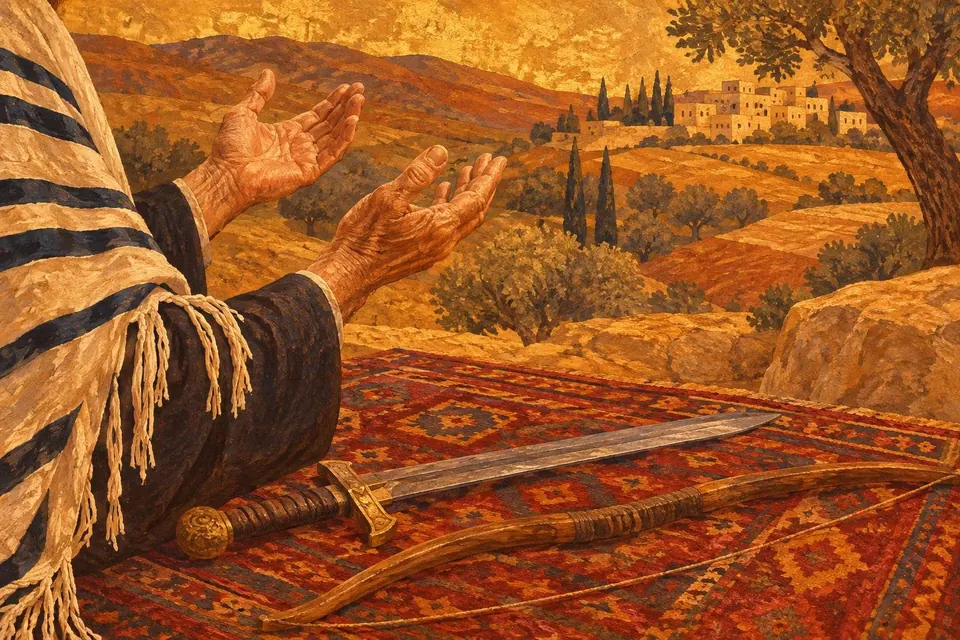
Several decades later, Jacob gave Shechem to Joseph, and Joseph is indeed buried there. Why did Jacob do this? Because Shechem belonged to him: “I took it from the Amorite with my sword and my bow” [Genesis 48:22].
This is puzzling. First, did Jacob capture Shechem? Simeon and Levi did, and it would seem to belong to them. Second, they captured it with a sword, not with a bow, which shoots from a distance.
Onkelos, however, translates the words “my sword and my bow” as “my prayer and my request.”
The Brisker Rav explains that regular prayer is compared to a sword: it is sharp and effective even with a small effort. The bow represents a personal request: its effect depends on the strength and skill of the person shooting it.
That is why the Talmud says that someone who has a sick person at home should go to a sage and ask him to plead for mercy on the sick person’s behalf (Bava Batra 116a). As Proverbs says, “The king’s wrath means messengers of death, but a wise person will appease it” [Proverbs 16:14].
In Berakhot, we read that Rabban Gamliel sent two sages to Rabbi Chanina ben Dosa to ask him to pray for his sick son [Berakhot 34b]. And in the Book of Kings, Jeroboam sent his wife to her brother, who lived in Shiloh, so that he would pray for their son. Ben Hadad, too, fell ill and sent a messenger to the prophet Elisha.
The Meshech Chochmah (a Torah commentary) writes that King David was speaking of a personal request when he said, “God has heard my plea”: for such a plea to be answered, it requires deep concentration and supplication. But “God will accept my prayer” refers to regular prayer, which does not require such intense kavanah (focused intention) [Psalms 6:10].
This is what our forefather Jacob said to Joseph and to us: Do you think Simeon and Levi captured Shechem? My prayers and my requests brought the victory.
Joshua fought Amalek in the Sinai wilderness and defeated him with the sword. How? The Torah tells us: “When Moses raised his hands” in prayer, “Israel prevailed,” and “his hands remained steady” [Exodus 17:11–12]. Rashi explains that Moses held his hands toward heaven in faithful, devoted prayer (Rashi on Exodus 17:12). This is how the enemy is defeated.
In the war against Midian, Moses mobilized “a thousand for the army, a thousand for the army,” and “sent them to the army, a thousand from each tribe” [Numbers 31:4, 6]. The Midrash says that for every thousand men from each tribe whom Moses mobilized, he recruited another thousand to carry their weapons and another thousand to pray for them.
This raises a question: War requires soldiers. Weapon bearers and support troops are needed too. But people to pray? Let the whole Jewish people pray.
The whole Jewish people undoubtedly did pray, as the outcome shows: 12,000 men overcame all of Midian, killed all the men, and took tens of thousands captive, and “not one man fell in the war” [Numbers 31:49]. But here the Torah teaches us that those who pray are also considered soldiers, and that the whole victory is thanks to them.
The Jerusalem Talmud tells this story: During the Bar Kokhba revolt, Hadrian besieged Beitar for three and a half years. For all those three years, Rabbi Elazar HaModai prayed with ashes on his head. Every day he asked God, “Master of the universe, do not sit on the throne of judgment today. Do not sit on the throne of judgment today.”
Hadrian had already lost hope and was about to lift the siege. But a Samaritan said to him, “Don’t leave. I know what to do. I’ll hand the city over to you.”
He entered the city through a sewer passage and went to Rabbi Elazar, who was immersed in prayer as always. The Samaritan approached him and pretended to whisper something in his ear. The people of the city saw this and reported it to Bar Kokhba.
“What did you whisper to him?” Bar Kokhba demanded.
The Samaritan replied, “If I tell you, Hadrian will kill me. If I don’t, you’ll kill me. I’d rather he kill me than you. I’ll tell you the secret: Rabbi Elazar HaModai told me he’s ready to hand the city over to Hadrian.”
Bar Kokhba ordered Rabbi Elazar brought before him. “What did that Samaritan say to you?” he asked.
“He said nothing to me.” Rabbi Elazar had been so immersed in prayer that he had heard nothing.
“And what did you say to him?”
“I said nothing to him.”
Bar Kokhba struck Rabbi Elazar, and he died. Immediately afterward, Beitar was captured, and Bar Kokhba was killed.
That is exactly what happened: it was not strength or courage, but prayer that protected the city.
The great Rebbe of Klausenburg, Rabbi Yekutiel Yehudah Halberstam, was once in Auschwitz. From there he was taken to clear the ruins of the Warsaw Ghetto, which had been destroyed to the ground when the uprising was suppressed. He survived and was privileged to come to the Land of Israel.
There he met Prime Minister Levi Eshkol. The Rebbe said to him, “Tell me honestly: Is it true that the situation the State of Israel is in today is worse than the condition of the Warsaw Ghetto before the uprising?”
The prime minister replied, “You must understand, I can’t admit that.”
If the desperate Warsaw Ghetto uprising had succeeded—and it had no chance of success—it would have been a miracle. And if the Six-Day War succeeded, and we survived the Yom Kippur War, when the celebrated defense minister could not withstand the strain and said, “We have come to the third destruction of the Temple,” that too was a true miracle.
So we must recognize and thank the “Rabbi Elazar HaModai” of our own time: the Torah and prayers of the students of the holy yeshivas.
By Rabbi Yaakov Galinsky
Keep reading
More →Hebrew Words for Prayer in the Haggadah
Three Hebrew words describe cries that rise to God when ordinary words fail.
ParashaKorach: The Power of Prayer
Why did Moses pray that God would not hear the prayers of Korach and his followers?
ParashaPinchas: The Trap of Routine
The daily offering teaches us to bring fresh attention and inspiration to familiar mitzvot.
PrayerCleansing the Soul Before Sleep
A bedtime prayer and other practices can help us release resentment and begin again.







