Why Bless Children With Ephraim and Manasseh?
The Friday night blessing for children recalls Joseph’s sons and the matriarchs, followed by the Priestly Blessing.
In brief
- Parents traditionally bless their children before the Friday night Shabbat meal.
- Boys are blessed to be like Ephraim and Manasseh, who grew up righteous despite their surroundings in Egypt.
- Girls are blessed to be like Sarah, Rebecca, Rachel, and Leah.
- Authorities discuss how parents who are not kohanim may use the words of the Priestly Blessing.
With God’s help
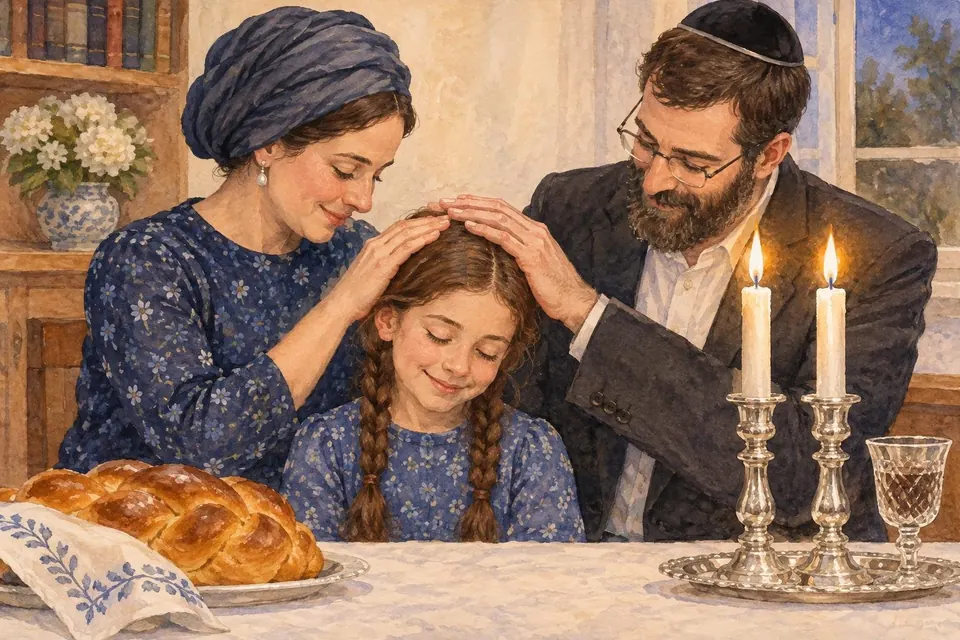
Parents have long had the custom of blessing their children on Friday night before the Shabbat meal. In some families, fathers give the blessing; in others, mothers do as well. Many authoritative sources mention this custom.
Parents place their hands on the child’s head. When blessing a boy, they say, “May the Almighty make you like Ephraim and Manasseh” [Genesis 48:20]. They then recite the Torah verses containing the Priestly Blessing: “May God bless you and protect you. May God shine His face upon you and be gracious to you. May God turn His face toward you and grant you peace” [Numbers 6:24–26]. When blessing a girl, they say, “May the Almighty make you like Sarah, Rebecca, Rachel, and Leah,” and then recite the Priestly Blessing as well.
It is easy to understand why the matriarchs are named in the blessing for girls: They are models of holiness, righteousness, and devotion. But why are Ephraim and Manasseh named in the blessing for boys, rather than the patriarchs, or Jacob’s sons, the founders of the 12 tribes of Israel, or leaders of the Jewish people such as Moses, Aaron, and King David?
Of the many explanations, let us consider one. Joseph’s sons, Ephraim and Manasseh, were the only Jews of their generation in Egypt, a land of profound spiritual impurity, marked by idolatry and extreme moral corruption, with a complete absence of decency and shame. Despite this, they grew up to be God-fearing, devout, and righteous Jews, cultivating high moral standards and admirable personal qualities.
Our teachers point out that the hand consists of 15 parts, corresponding to the number of Hebrew words in the Priestly Blessing. When parents place their hands on a child’s head, they are alluding to this, as if to say: may the blessings spoken in the three verses of the Priestly Blessing will descend upon the child.
They do this on Friday night, when the special mystery of the Shabbat queen is present, corresponding to the quality of binah (understanding). Torah scholars write that during the week a person is occupied with earning a living, while on Shabbat they are at rest, in a state of holiness, and in good spirits.
The parental blessing raises a question that requires clarification. A specific law prohibits anyone who is not a kohen (a priest) from blessing the people with the Priestly Blessing. If so, how is a person whose parents are not kohanim permitted to recite the Priestly Blessing?
According to some authorities, the parental blessing must indeed differ from the Priestly Blessing. Some report that the Vilna Gaon held that someone who is not a kohen should not place both hands on another person’s head when blessing them, to emphasize that this is not the Priestly Blessing. Others write, however, that the Vilna Gaon blessed his children with both hands. Other Torah authorities are also said to have placed both hands on their children’s heads.
One explanation is that parents, when blessing their children, do not intend to bless the people as the kohanim do. A second explanation is that the blessing for children is whispered, whereas the kohanim bless the people aloud. Others, drawing on the Jerusalem Talmud, write that someone who recites the Priestly Blessing outside prayer does not violate the prohibition.
Practical law. This page reports a ruling given for a specific question. For your own situation, ask a rabbi who knows you.
Keep reading
More →How to Make Havdalah on Wine
A guide to the wine and cup used for Havdalah after Shabbat and holidays.

Keeping Shabbat During the Holocaust: Rabbi Neuwirth’s Story
Guide · ShabbatCan Women Make Havdalah?
- Wine and Women
What Can You Use for Havdalah Without Wine?
Grape juice, raisin broth, and certain other drinks may be used for Havdalah when wine is unavailable.







