How to Run a Shabbat Meal
A guide to creating a joyful Shabbat table and involving children of different ages.
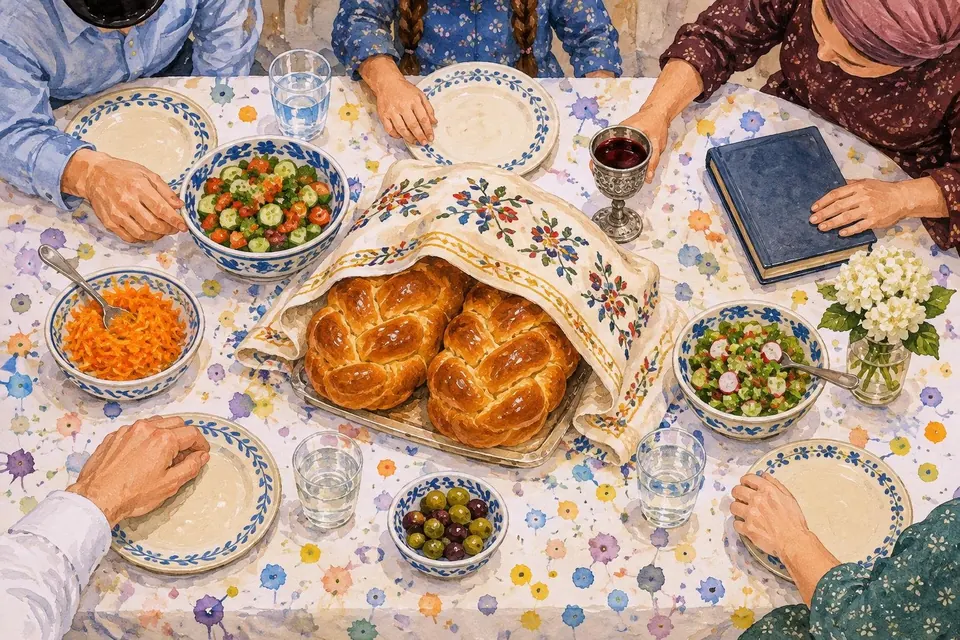
In brief
- A meaningful Shabbat meal takes both practical and spiritual preparation.
- A pleasant, relaxed atmosphere helps children absorb what they hear and remember Shabbat fondly.
- Activities and conversations should be suited to the children’s ages.
- After the children are settled, a husband and wife can study together.
Some questions never occur to people who grew up in a traditional Jewish family. How a Shabbat meal unfolds, for example, is something they have seen and need only carry on. But for those taking their first steps in Jewish life, and even for those who have observed Shabbat for years, it can be an important question.
Preparing for Shabbat#
Shabbat begins with preparation. Since observing Shabbat has two sides, spiritual and practical, preparation also falls into these two areas. In theory, the husband’s role is spiritual and the wife’s is practical.
In practice, this does not mean that a husband cannot help his wife with practical tasks. Quite the opposite: there are even circumstances in which he must help. Likewise, if she has time, a wife can prepare spiritually for Shabbat. Still, each has a primary role.
The wife, who is also the mother, will generally put the house in order, prepare the best dishes, and bathe and dress the children. She sometimes spends many hours on this, not to mention the effort involved.
But what does the husband, who is also the father, do to honor the spiritual side of Shabbat observance? How much time and effort does he devote to it? His role at the Shabbat table is to be its spiritual center. Clearly, just as his wife does, the husband must devote time and effort to preparing for the spiritual part of Shabbat.
If the head of the household sets aside time to prepare, Shabbat can be transformed from a meal that is filling but dull and empty into a Shabbat full of joy and spiritual meaning—the way it should be.
The Shabbat table plays an important role in children’s spiritual education, so it is worth considering this part of Shabbat step by step.
The Atmosphere#
The spiritual part begins with creating a pleasant, joyful, and relaxed atmosphere at the Shabbat table. Special Shabbat treats are important, too. Only in such an atmosphere can a father’s words find their way into his children’s hearts, leaving them with lasting memories of Shabbat in their parents’ home.
The meal should not be filled with criticism, reprimands, and lectures. There is no need to be strict and insist on principles precisely on Shabbat, casting a shadow over the festive atmosphere.
A father’s educational tasks differ according to his children’s ages.
Children Up to Ages 4–5#
At this age, a parent can and should sit a child on their lap, listen attentively to what the child learned in preschool, and warmly tell a short, understandable children’s story with a lesson—the one prepared in advance.
Parents need considerable wisdom and patience to help children get into the habit of sitting at the Shabbat table. At the same time, depending on their age and temperament, children need opportunities to play, move around, and then return to the table.
Children Ages 6–8#
Children of this age should sit at the Shabbat table for most of the meal. This can be achieved relatively easily if attention is focused on them. Children should be active participants. Ask them questions and find out what they learned in preschool and school. Listen to them attentively, without eating or becoming distracted while they speak. Even when guests are present, children need their share of attention.
When a family has several children ages 6–8, it is important to follow the order of seniority among them, beginning with the oldest and ending with the youngest.
At this age, tell children about great righteous people, explain the weekly Torah portion in a way they can understand, and sing Shabbat songs with them.
Children Ages 9 and Older#
At this age, preparation takes much more effort. The spiritual atmosphere and content of the Shabbat meal depend on the head of the household’s knowledge and ability to choose suitable material.
- The beginning level: The father shares what he himself studied in the weekly Torah portion or in the Talmud. This certainly helps his personal growth, but experience shows that it quickly makes the mother sleepy and causes the children to lose interest.
- A praiseworthy level: The father prepares not what he himself understood, but what his children will be interested in hearing and able to understand: a colorful story about great righteous people and Sages, a clear vort (a short Torah insight) on the weekly portion, an allegory connected to it, or a brief halacha lesson.
- A higher level: The father does more than speak while the children listen passively. Passive listening leaves an impression on a child’s soul, but not a strong one. Instead, he involves the children actively. For example, he asks questions beginning with “who,” “what,” “how many,” “when,” or “where” about what they learned in cheder (a traditional Jewish elementary school) or school.
- The questions above are useful, but their answers are generally clear-cut and short. They build knowledge, but they do not require children to think deeply or engage their emotions. To awaken not only interest but also emotional and spiritual involvement, it is better to build a conversation around age-appropriate questions that make them think, such as:
- What do you think about this?
- Put yourself in that person’s place ...
- How do you assess what happened?
- Suppose this happened. What would the consequences be?
- How would you compare one with the other?
Questions like these are hard to answer in a single word, so they prompt children to think, look deeper, and understand.
Families can also study and discuss different Torah laws at the Shabbat table: laws of Shabbat, honoring parents, blessings, proper speech, and so on. Parents can memorize Pirkei Avot (Ethics of the Fathers) with their children and then study simple commentaries together.
The Shabbat table is also a good opportunity for parents to express their reactions to events of the past week indirectly. If, for example, the children have been quarreling a lot, parents can tell stories about the harm caused by quarrels. If they have been envious, parents can tell stories about the harm caused by envy, and so on.
Of course, there are many other details and possibilities for a Shabbat meal.
The Wife#
If, for some reason, the father was unable to prepare or is simply not there, the mother should take on the spiritual role as much as she can.
Oneg Shabbat (The Enjoyment of Shabbat)#
Once the children have been put to bed—or, if they are older, are busy playing or reading—the husband and wife can sit down to study together. They might study the weekly Torah portion with Rashi’s commentary, Midrash teachings, Pirkei Avot, and so on. It is desirable for the husband to understand what they are going to study.
How lovely and welcome is the spiritual closeness of a husband and wife on Shabbat!
By Rabbi Asher Kushnir
Practical law. This page reports a ruling given for a specific question. For your own situation, ask a rabbi who knows you.
Keep reading
More →How to Make Havdalah on Wine
A guide to the wine and cup used for Havdalah after Shabbat and holidays.

Keeping Shabbat During the Holocaust: Rabbi Neuwirth’s Story
Guide · ShabbatCan Women Make Havdalah?
- Wine and Women
What Can You Use for Havdalah Without Wine?
Grape juice, raisin broth, and certain other drinks may be used for Havdalah when wine is unavailable.







