Why Do We Ask the Shabbat Angels to Leave?
A Shabbat song invites the angels in, asks for their blessing, and then bids them farewell.
In brief
- On Friday night, we welcome the angels and then ask them to depart in peace.
- The Chafetz Chaim explains that we welcome the Shabbat angels and bid farewell to the weekday angels.
- Another explanation compares the Shabbat meal to a moment of closeness between God and Israel that calls for privacy.
“No one may be in the Tent of Meeting when he enters to make atonement in the Sanctuary, until he comes out” (Leviticus 16:17).
On Friday night, when we come home, we sing a song that begins, “Peace to you, ministering angels, angels of the Most High,” and continues, “Come in peace” and “Bless me with peace.” It ends, “Go in peace, angels of peace.” It is a puzzling thing to say: Why do we ask the angels to leave? Why shouldn’t they stay? How are they in the way?
The Chafetz Chaim asks this question and answers that we welcome the Shabbat angels and bid farewell to the weekday angels. Something similar happened in our forefather Jacob’s prophetic dream: The angels of the other nations departed, and the angels of the people of Israel arrived.
There is another possible answer. When a kohen (priest), even the High Priest, performed the regular service in the Temple, other people were not forbidden to be present in the same place. But when the kohen gadol (High Priest) entered the Holy of Holies to perform the service, the Torah commanded: “No one may be in the Tent of Meeting when he enters to make atonement in the Sanctuary, until he comes out.” The Sages add in the Midrash: “No one, not even those of whom it is written, ‘Their faces were like the face of a man’” [Ezekiel 1:10]. In other words, even angels were forbidden to be there during the High Priest’s service. Why?
Because this was a moment of connection between God and the people of Israel, a moment of closeness that called for absolute privacy. Even the angels, with all due respect to their greatness and holiness, had to leave.
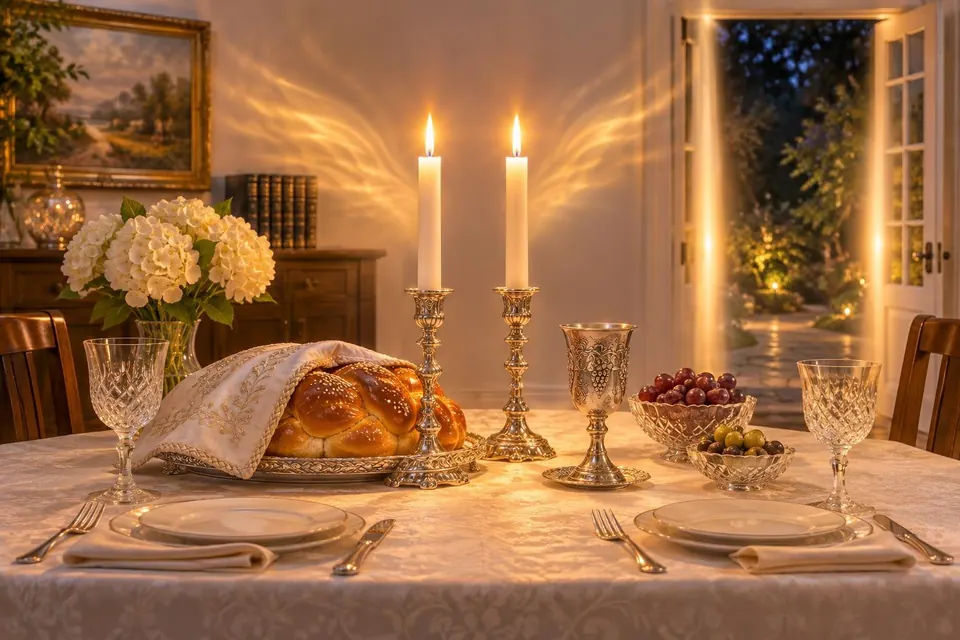
When we leave the synagogue on Friday night, angels accompany us home. We arrive to find the table set and ready for the meal. We stand and say, “Peace to you, ministering angels ... come in peace,” and also, “Bless me with peace.”
Then it is as if we say to them: Dear angels, we are now about to sanctify Shabbat with Kiddush over wine and begin the Shabbat meal, which has the highest level of holiness. At this meal, “no one may be in the Tent of Meeting,” so “go in peace, angels of peace.” You must leave because this is a moment of closeness between God, blessed be He, and His people—and even angels cannot take part in it.
By Rabbi Shimshon Pincus
Keep reading
More →How to Make Havdalah on Wine
A guide to the wine and cup used for Havdalah after Shabbat and holidays.
Keeping Shabbat During the Holocaust: Rabbi Neuwirth’s Story
Guide · ShabbatCan Women Make Havdalah?
- Wine and Women
What Can You Use for Havdalah Without Wine?
Grape juice, raisin broth, and certain other drinks may be used for Havdalah when wine is unavailable.







