Hanukkah Candles: Beit Shammai and Beit Hillel
The debate over Hanukkah candles reveals two approaches to spiritual growth.
In brief
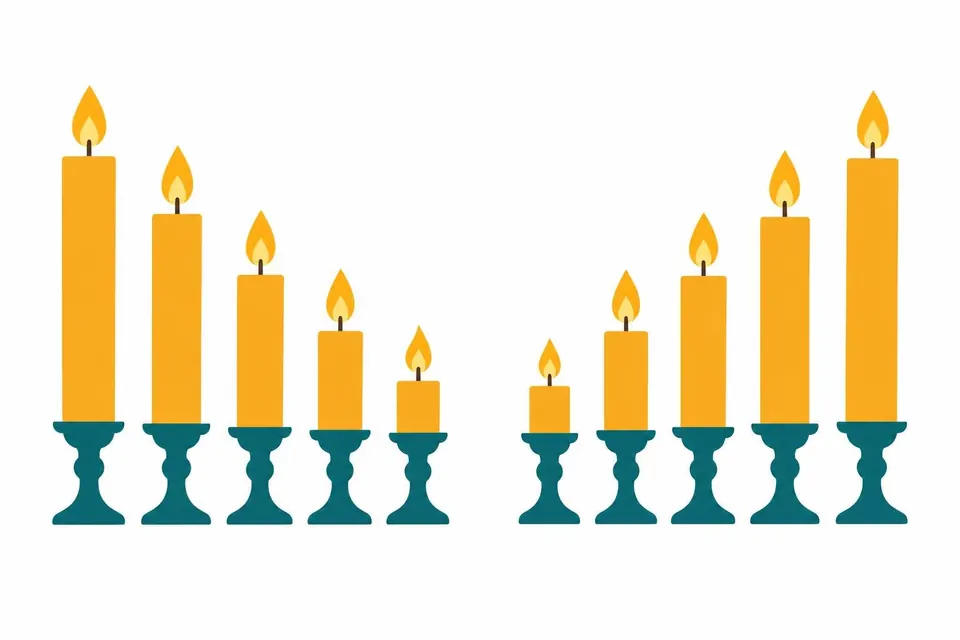
- Beit Shammai says to begin with eight candles and decrease, while Beit Hillel says to begin with one and increase.
- The Talmud offers two explanations for their disagreement.
- The two approaches represent building through addition and refining through reduction.
- In this world, the law follows Beit Hillel, but the author says that in the future it will follow Beit Shammai.
Two Explanations for the Disagreement#
The Talmud says (Shabbat 21b): “Beit Shammai says that on the first day one lights eight candles, and from then on decreases by one each day. Beit Hillel says that on the first day one lights one candle, and from then on increases by one each day.”
Concerning the disagreements between Beit Shammai and Beit Hillel, the Talmud says (Eruvin 13b): “A bat kol (heavenly voice, a form of ruach hakodesh, divine inspiration) came forth and proclaimed: ‘Both are the words of the living God, but the law follows Beit Hillel.’” We do not reject Beit Shammai’s view; the law is simply determined according to Beit Hillel. Moreover, the Vilna Gaon says that in the future the law will follow Beit Shammai.
Let us consider the heart of their disagreement about lighting Hanukkah candles. Why does the law in this world follow Beit Hillel, adding one candle each day, while in the World to Come it will follow Beit Shammai, decreasing by one candle each day?
The Talmud (Shabbat 21b) offers two explanations for their disagreement. According to the first, Beit Shammai rules that the candles correspond to the days of the festival still to come. On the first day, eight candles are lit because eight days lie ahead, and so on. Beit Hillel, meanwhile, says they correspond to the days that have passed.
According to the second explanation, Beit Shammai’s view follows the pattern of the offerings on Sukkot. On Sukkot, 70 bulls were offered, corresponding to the 70 nations of the world. Each day, one fewer bull was offered: 13 on the first day, 12 on the second, and so on, until seven were offered on the seventh day. The number decreased each day because the nations of the world, too, pass from the scene over time. Beit Hillel’s view, meanwhile, follows the principle that holiness may be increased but not diminished.
Spiritual Growth: Building and Refining#
A profound idea lies beneath this disagreement. Spiritual growth rests on two foundations: building, or adding, and refining, or reducing. Adding is based on a person’s natural desire to grow and rise: another page of Talmud, another good deed, and so on.
But there is another aspect to working on ourselves: reduction. This means clarifying the details, penetrating to the essence of our soul’s existence, refining, and purifying. For example, a person may study a page of Talmud in two hours the first time, an hour and a half the second time, and then an hour. The clearer the Talmud’s words become, the less time they need to study that page. They examine their questions, resolve them, and arrive at a clear understanding of the heart of the problem. The problem itself becomes smaller as their understanding of the Talmud grows. Quantity becomes quality.
This is what our Sages meant.
The Talmud says (Yevamot 49b): “The teaching of Rabbi Eliezer ben Jacob is a clean kav.” A kav is a small measure of volume. Rashi explains: “A kav is a small measure: Rabbi Eliezer ben Jacob’s name is mentioned relatively rarely in the Mishnah. Clean means that in all those places the law follows his opinion.”
The Sages are praising Rabbi Eliezer ben Jacob. But how is it praise to say that his name is mentioned rarely? The rarity of his appearances and the fact that the law follows his opinion are two complementary aspects of his service of God, each arising from the other. A talmid chacham (Torah scholar) who speaks at length on every subject and at every opportunity will not merit being called “clean”—perfect, able to grasp the precise essence of the law. “A person should always teach a student in the most concise way” (Pesachim 3b). A central part of serving God is to reduce: to clarify what we study in our minds, discard secondary details, and focus on what matters most.
“Days in Which There Is No Benefit”#
We can now understand why the law will follow Beit Shammai in the World to Come. Maimonides (the Rambam) describes the World to Come as follows:
“The prophets and Sages did not long for the days of the Messiah so that they could rule the world, govern other nations, be exalted by the nations, or eat, drink, and rejoice. They longed for those days only so that they could be free to devote themselves to Torah and its wisdom, without anything to hinder them, and thereby merit life in the World to Come.” [Maimonides, Laws of Kings and Their Wars 12:4]
We need to explain how, in the days of the Messiah, people will be able to merit the World to Come. Our Sages comment on the verse from Ecclesiastes: “Remember your Creator in the days of your youth, before the days of trouble come and the years arrive when you will say, ‘I find no pleasure in them’” (Ecclesiastes 12:1). The Talmud says: “‘The years when you will say, I find no pleasure in them’—these are the days of the Messiah, in which there is neither reward nor punishment” (Shabbat 151b).
When the Messiah comes, our period of building will end. What, then, does Maimonides mean when he says that in the days of the Messiah the Sages will study Torah in order to merit life in the World to Come?
We could say that Maimonides saw two conflicting statements and ruled in accordance with one of them. Nevertheless, let us try to resolve the contradiction.
The story is told that the Baal Shem Tov, through ruach hakodesh, asked the Arizal why he had left behind so many inaccessible teachings, without bringing them down to a level at which they could be used. The Arizal answered, “What could I do? I ran out of time…” He died at a young age.
His words need explanation, since the Arizal taught the hidden Torah to Rabbi Chaim Vital even after his death. What did he mean by “I ran out of time” if he could convey after death what he had not managed to convey during his lifetime?
After death, a person cannot discover anything new. They can only study more deeply what they have already learned.
For this reason, the Chafetz Chaim taught that every Jew should study the entire Talmud at least once during their lifetime, even if only on a surface level (Kitvei Aba Mari, p. 122). A Jew who has never studied the tractate Yevamot will not be able to learn it in the World to Come, because there is no opportunity to learn something new there. But someone who has studied Yevamot, even superficially, will be able to reach a deeper understanding of it in the World to Come.
This is what the Arizal meant by “I ran out of time.” He could not discover anything new; he could only add a new level of understanding to what he had discovered in this world.
This also explains Maimonides’ words. The days of the Messiah are “days in which there is no benefit,” when there is no opportunity to build. Diligent students will remain diligent, but slackers will not be able to become diligent students. At that time there will be no yetzer hara (evil inclination), and no opportunity to make a new start and build—only to refine what already exists. A diligent student will be able to continue studying the entire Talmud diligently and thereby merit the World to Come: “The prophets and Sages longed for the days of the Messiah only so that they could be free to devote themselves to Torah and its wisdom and merit life in the World to Come.”
Building in This World, Refining in the World to Come#
According to Beit Hillel, serving God means adding, building spiritually without interruption. That is our task in this world. According to Beit Shammai, service means reducing: refining and deepening what already exists. That is the reality of the World to Come.
The law follows Beit Hillel because this world is a world of building. In truth, we should always remember Beit Shammai’s view as well: we must refine ourselves and advance in quality as well as quantity. But our main work in this world is adding. In the future, the law will follow Beit Shammai. Then there will no longer be an opportunity to build, only to cultivate and refine what exists, reducing and turning eight candles into one clean, perfect candle.
According to Beit Hillel, the essence of service is increasing holiness. According to Beit Shammai, service should correspond to the offerings on Sukkot. A person should remember that there were 70 nations in the world, and that they gradually lost their greatness. In the same way, their service should diminish and purify everything non-Jewish within them. Take less interest in what is happening around you, read fewer newspapers… In this way, the influence on the soul of everything non-Jewish within a person will gradually diminish.
“Days to Come” and “Days That Have Passed”#
The Talmud offers another explanation of the disagreement between Beit Shammai and Beit Hillel. Beit Shammai says to light candles corresponding to the days of the festival still to come, while Beit Hillel says to light them corresponding to the days that have passed.
This offers another perspective. Beit Hillel’s view is guidance for most people: recognize and value every step forward in serving God. When we finish studying a tractate, we should feel: “Thank God, I finished Berakhot—I lit one candle. I finished Shabbat—I lit a second candle. I finished Eruvin—I lit a third candle,” and so on, corresponding to the days that have passed. Beit Shammai, by contrast, offers advice to a select few: look for further opportunities to advance in serving God. When a Jew finishes another tractate, they should think: “True, I finished one tractate, but I still have many others to learn…” This corresponds to the days still to come.
In this world, the law follows Beit Hillel. We should encourage ourselves by looking at what we have already managed to accomplish in our lives, and so continue building our spiritual world. But in the future, the law will follow Beit Shammai: Heaven will remind you of what you did not manage to do. “You finished this tractate, but there are others you still need to finish.”
By training ourselves to see events according to Beit Hillel’s view, in terms of the days that have passed, we fill ourselves with enthusiasm and the desire to continue studying the holy Torah and serving God, blessed be He.
Keep reading
More →Hanukkah: Never Lose Hope
Hanukkah teaches that even in spiritual darkness, it is possible to turn to God and find light.
Guide · HanukkahWhen Should You Light Hanukkah Candles?
Jewish authorities differ on whether Hanukkah candles should be lit at sunset or after nightfall.
HanukkahWhy Is Hanukkah the Last Holiday?
Hanukkah reveals how the darkness of forgetting can lead to a flourishing of Torah.
HanukkahTorah and Greek Wisdom: What Does Hanukkah Teach Us?
Hanukkah reflects a struggle over the purpose of wisdom and the influence of the world around us.







