Hanukkah and the Jewish Home
The Hanukkah lights connect the miracle of the Temple menorah with Torah study and the unity of the Jewish home.
In brief
- The Hanukkah miracle revealed the spiritual light associated with the Temple menorah.
- The menorah symbolizes the Oral Torah, whose study flourished during the Second Temple period.
- The Shechinah is present in places of Torah study and can also be present in Jewish homes.
- Building family unity is part of bringing the light of Hanukkah into the home.
The holidays of our people are more than dates on a calendar. Each year, on these days, we are granted anew the great light from Above that accompanied the original event and was the spiritual source of the holiday. In a sense, our people relive these events from our great history each year. What was this great light in the days of Hanukkah? Despite the military victory, it was, above all, the miracle of the menorah’s lights.
The Menorah and the Shechinah#
At first glance, there was nothing new about this miracle. The Talmud says that in good times, a miracle involving the menorah took place daily in the Temple (Shabbat 22b). The so-called “western lamp” was a reminder that the Shechinah (Divine Presence) was among our people. The same amount of oil was poured into every lamp, but the western lamp alone burned not only at night but also during the day, and the other lamps were lit from it.
The miracle was thus practically constant. It could cease when the Creator hid His face because of sin, but in good times it continued. The Hanukkah miracle was, in effect, a revelation of that ongoing miracle.
Rabbi Moshe Chaim Luzzatto (the Ramchal) writes about several levels at which the higher spiritual world influences our material world. A more elevated level of influence is visible when events belonging to the spiritual world occur in our world. These are miracles. The highest level of the Shechinah’s presence among our people is a manifestation of the higher spiritual world, accompanied by miracles.
A well-known Mishnah describes ten miracles in the Temple in Jerusalem (Mishnah Avot 5:5). Other Temple miracles are mentioned at the end of the first chapter of Yoma (Yoma 21a–b). The Temple was a place of the Shechinah’s presence, where the material and spiritual worlds met. The Vilna Gaon goes further, writing that the Hanukkah miracle was not especially surprising: it took place in the Land of Israel, when the Temple was still standing. The Purim miracle, which happened in exile, was a truly great miracle.
Today we have neither the Temple nor the menorah. What remains is a remnant of that former greatness, the so-called “Shechinah in exile,” Shechinta begaluta. This itself is a great gift from God. Places where Torah is studied are places of the Shechinah’s presence. Even when one person sits and studies Torah, the Shechinah is present [Mishnah Avot 3:6]. In light of this, Torah study during Hanukkah has a special status.
The Menorah and the Oral Torah#
Rabbi Naftali Tzvi Yehuda Berlin of Volozhin, known as the Netziv, asks why there were two objects in the Temple associated with the Torah. The Ark, which held the Torah scroll and the Tablets of the Covenant, was one; the menorah, outside the Holy of Holies, was the other. The Netziv writes that the Written Torah was kept in the Holy of Holies, while the menorah symbolizes the Oral Torah.
Nachmanides (the Ramban), in his commentary on the portion of Behaalotecha, writes that lighting the menorah was a consolation for Aaron, who had no share in the offerings brought by the tribal leaders (Nachmanides on Numbers 8:2). Nachmanides explains that this refers not only to lighting the menorah in the Temple but also to the events of Hanukkah.
At first, this seems to refer only to the mitzvah of lighting the menorah. But why should that be more significant than all the offerings brought in the Temple? What is more, today the kohanim (priests) have no special role in lighting the Hanukkah menorah.
It seems we should understand it this way: The priests’ devotion to Torah study was the reason they were granted the privilege of rededicating the Temple, relighting the menorah, and witnessing the miracle of the oil that burned for eight days. Because the menorah symbolized the Oral Torah, this led to the great flourishing of its study during the Second Temple period. The Oral Torah was revealed during that period, although we had, of course, received it at Mount Sinai.
This raises a major question: Should we not study even more Torah during Hanukkah? Yet people generally study less. I asked this question of Rabbi Yitzchak Darzi, a close student of Rabbi Yosef Shalom Elyashiv. He told me that he had asked Rabbi Elyashiv and Rabbi Shlomo Zalman Auerbach the same question many times: Why can a wife not light the Hanukkah menorah while her husband stays and studies undisturbed in the kollel (a program for advanced Torah study)?
Nevertheless, this is not the usual practice among our people. Fathers leave their studies and their work and literally run to light the Hanukkah candles. Why?
Rabbi Darzi gave the following answer in Rabbi Elyashiv’s name. Maimonides (the Rambam) says that lighting the Hanukkah candles is “a very beloved mitzvah” (Maimonides, Laws of Hanukkah 4:12). By performing it, we attach ourselves to the Torah itself. And attaching ourselves to the Torah is more important than studying it. But for the mitzvah truly to become beloved, it cannot be performed through an agent.
The Light of the Jewish Home#
The Sages say that a person who is diligent in lighting candles—both Shabbat and Hanukkah candles—will merit that they and their children become Torah scholars [Shabbat 23b]. Of course, to make this possible, one must also study. But there is a problem: Thousands of Jews fulfill this mitzvah and, unfortunately, do not merit becoming scholars.
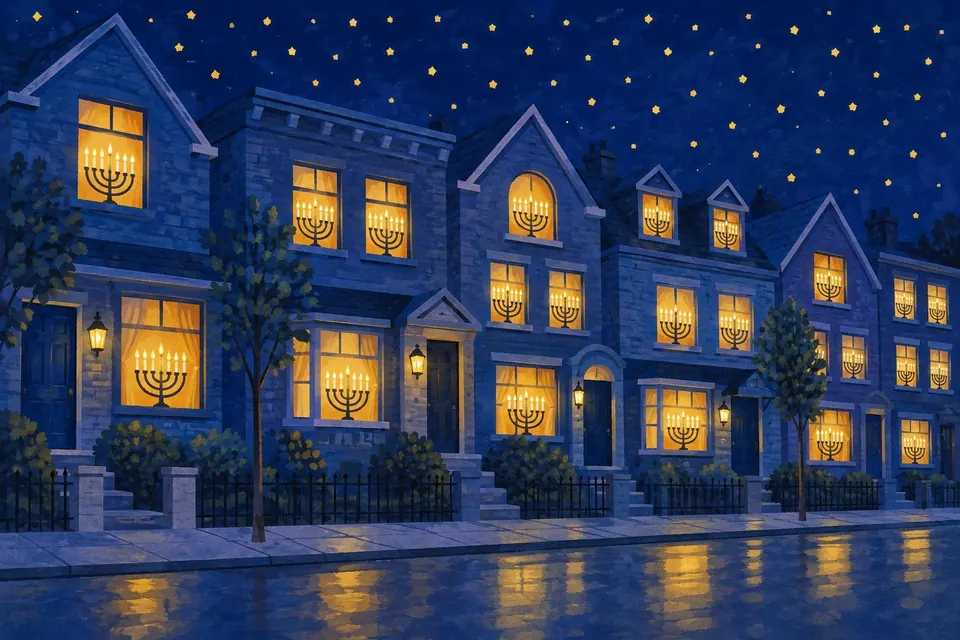
The Talmud says of the Hanukkah lights: “A light for a person and their household” (Shabbat 21b). “Their household” means both the family and the physical home where the candles are lit. It is important to remember that, besides the Temple and places of Torah study, there is another place of the Shechinah’s presence among our people: our Jewish homes.
The first place in the Torah described as a place of the Shechinah’s presence was the tent of our matriarch Sarah. We are told of a cloud over her tent [Bereishit Rabbah 60:16]. We also know that when a man and woman merit it, their home becomes a place of the Shechinah’s presence [Sotah 17a].
Someone once came to Rabbi Moshe Feinstein with a question: When we say that a man and woman have merited the presence of the Shechinah, surely we mean great righteous people and scholars, like the Chafetz Chaim. Can it apply to ordinary people?
Rabbi Feinstein was very displeased. “Don’t drive the Shechinah out of Jewish homes!” he replied. Every Jew, not only a great Torah scholar, can merit the Shechinah’s presence at home.
The Sages say that a man who has no wife has no Torah [Yevamot 62b]. This sounds very strange. Look at the remarkable young yeshiva students. Do they have no Torah? We would all do well to study as they do. Why, then, do they “have no Torah”?
There is a level of understanding Torah that a man can reach only together with his wife. A woman is associated with binah (understanding), and a man with daat (wisdom). Pirkei Avot (Ethics of the Fathers) says that without binah there is no daat: without understanding and insight, there is no wisdom (Mishnah Avot 3:17). These two aspects of the mind come together when a Jewish family is formed.
Returning to the Talmud’s words, “A light for a person and their household,” we can see that fully fulfilling the mitzvah of lighting candles requires genuine unity within the family—a truly strong Jewish home. That is why Hanukkah is a time of joy in the home. The light of Hanukkah is the light of the Jewish home, the light of a united Jewish family. This light brings the Shechinah into our homes.
For us to attain a full understanding of Torah, our homes must become places of the Shechinah’s presence. Where there is no family unity and no joy in the home, there can be no full understanding of Torah. Only when there is genuine family unity can we speak of fully fulfilling the mitzvah of lighting Hanukkah candles. This can help explain Rabbi Elyashiv’s answer to the question of why people study less during Hanukkah, when it would seem that they should study more.
The Struggle for a Jewish Home#
One of the prohibitions the Greeks imposed on our people was a ban on kiddush hachodesh, the sanctification of the new month. A well-known comment by Rashi says that the Torah should have begun with this mitzvah (Rashi on Genesis 1:1). The Talmud says that sanctifying the month affects a person’s physical condition. In other words, a person is affected not only by the laws of nature but also by how the Sanhedrin in Jerusalem sanctifies the month.
The fact that Jews could influence the physical nature of this world did more than merely trouble the Greeks. It contradicted their entire worldview, and this is the first thing they set out to fight.
There is another important detail in the struggle between Greek culture and the Torah that does not always receive attention. The Greeks violated the daughters of Israel through the so-called “right of the first night.” This revealed the Greeks’ evil design even more clearly than the ban on sanctifying the month. To strike at and defile the bond between husband and wife is to undermine the foundation of the Shechinah’s presence among our people.
We are also told that the Greeks forbade husbands and wives from being alone together. Homes had to be kept open. If a home was locked, its inhabitants faced death. Such was the Greeks’ plan: to destroy everything that unites Jews and brings our people into unity with the Creator.
That is why, besides studying Torah on Hanukkah, we have another great responsibility: to unite our whole family. Most of us did not grow up in the homes of great righteous people and scholars. Many grew up in single-parent families. So how can we know what a true Jewish family is? They do not teach this in yeshiva either. A bride and groom are blessed that they should build a binyan adei ad—an “everlasting edifice.” But how do they build it?
Rabbi Shimshon Pincus offered an illustration of the events of Hanukkah: Imagine a handful of yeshiva students taking knives from the dining hall and going off to war. But the Hasmoneans were not crazy. What they did was not the act of madmen.
On Hanukkah, we speak in prayer of the “mighty” (giborim) and the “weak” (chalashim). In terms of physical strength, the mighty were clearly the Greeks, and the weak were the handful of Jews who went to war against them. But when it came to strength of spirit, the opposite was true.
The same applies to our question: How do we build a Jewish family? Let us remember how many obstacles and problems each of us faced on the path to Torah. How much did we have to overcome to do teshuvah (repentance)? Yet each of us found that “drop of pure olive oil” within ourselves. And from that drop—not through our own merit, but with help from Above—we lit our lamp of Torah and faith.
One expression of our life force is struggle. That is why on Hanukkah we thank the Creator al hamilchamot, “for the wars.” Wars are not only physical struggles against an enemy. They are also the constant battle we wage against the yetzer hara (evil inclination) within us and the impurity of the world around us.
Deep down, we understand that God helps us despite everything. On the one hand, we have many problems. It is hard to build a family according to the Torah while carrying the baggage of our past lives, as each of us does. But here we need to follow the Hasmoneans’ example and “go to war” against all the impurity and difficulties, relying on the Creator’s great help.
We need to know that God gives us the strength to swim against the current and overcome our evil inclination. God has already performed many miracles for each of us, guiding us along the path of teshuvah. From this we should learn that, in building a Jewish home too, great help from Above awaits us—provided that we undertake significant spiritual work ourselves.
May we all merit having our homes filled with joy and the light of Torah, and may our children want to follow the path of serving the Creator. Have a happy and bright Hanukkah.
By Rabbi Yigal Polishchuk
Keep reading
More →Hanukkah: Never Lose Hope
Hanukkah teaches that even in spiritual darkness, it is possible to turn to God and find light.
Guide · HanukkahWhen Should You Light Hanukkah Candles?
Jewish authorities differ on whether Hanukkah candles should be lit at sunset or after nightfall.
HanukkahWhy Is Hanukkah the Last Holiday?
Hanukkah reveals how the darkness of forgetting can lead to a flourishing of Torah.
HanukkahTorah and Greek Wisdom: What Does Hanukkah Teach Us?
Hanukkah reflects a struggle over the purpose of wisdom and the influence of the world around us.







