Hanukkah: Never Lose Hope
Hanukkah teaches that even in spiritual darkness, it is possible to turn to God and find light.
In brief
- Hanukkah is not mentioned in the Hebrew Bible and has no separate section devoted to it in the Oral Torah.
- Unlike other historical Jewish holidays, Hanukkah falls in winter, near the end of the lunar month.
- Rabbi Chaim Friedlander sees a hint that the Hanukkah miracle had no place prepared for it in Heaven.
- The holiday teaches that even in darkness, a person can turn to the Creator.
Hanukkah differs from all other holidays in that it is not mentioned at all in the Hebrew Bible. What is more, even in the Oral Torah, no separate section is devoted to it. Hanukkah is mentioned only in passing in a few places in the Mishnah. In the Talmud, the story and laws of Hanukkah appear in a discussion of lighting Shabbat candles, which also touches on lighting Hanukkah candles.
All Jewish holidays connected with historical events fall in the middle of the lunar month, around the full moon, a time designated by Heaven for Divine influence. They also fall during the transitional seasons of fall and spring. Hanukkah is different: it is celebrated in winter, when the nights are longest. It also falls at the end of the month, when the moon is barely visible.
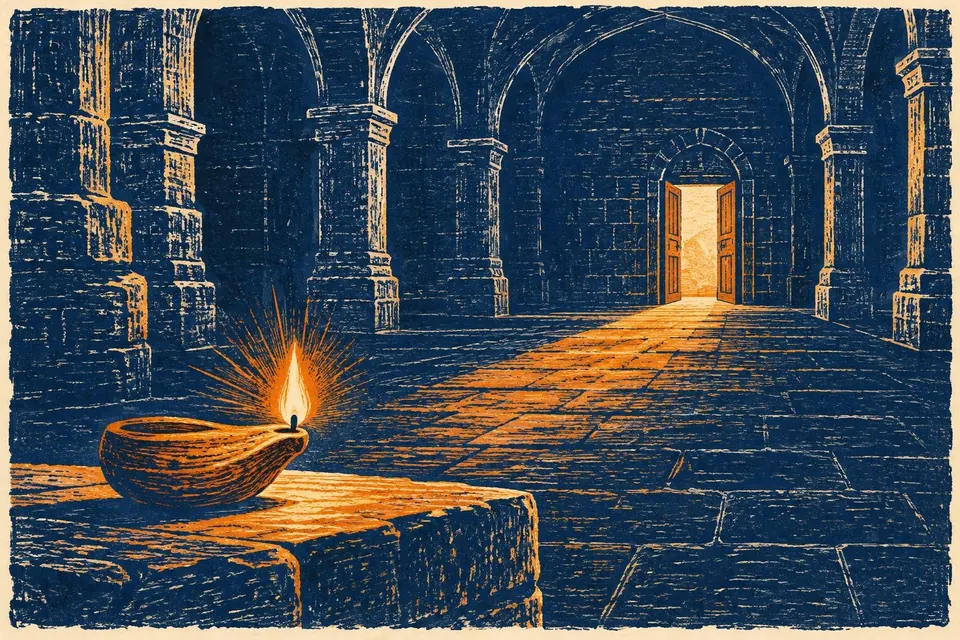
The events of Hanukkah did not take place at a time designated from Above for Divine influence. It was a time of deep spiritual darkness, from which there seemed to be no escape. Yet even at a time not “prepared” for Divine influence, people can awaken. Then, despite everything, the Creator will perform a miracle and light up the darkness of the night, as He did when a small amount of oil lasted eight days in the lamps of the Temple.
This is why there is no “place” for Hanukkah in the books of the Hebrew Bible, which reflect Divine influence initiated from Above. For the same reason, Hanukkah is mentioned in the Talmud in passing.
Rabbi Chaim Friedlander writes in Siftei Chaim that the Sages hint at this in the Talmud (Yoma 29a), when they say that Purim was the last “time” when miracles occurred. The Talmud asks: How can that be, when Hanukkah came after Purim and miracles occurred then too? It answers that Purim was the last of the holidays that Heaven made it possible to record in writing. Rabbi Chaim says that the Talmud is hinting that the miracle of Hanukkah was one for which, so to speak, no place had been prepared in Heaven.
This teaches us never to despair. Even when a person is surrounded by darkness, if they awaken and turn to the Creator, God will light their way.
Laws of Hallel#
- When reciting Hallel (psalms of praise), one may not change the order of the psalms, verses, or words. If the order was changed, the person has not fulfilled the obligation to recite Hallel.
- Women are not obligated to recite the “partial” Hallel. However, they may recite it if they wish. In most Ashkenazic communities, women also customarily say the blessing for reciting this Hallel.
- According to many poskim (halachic authorities), women are not obligated to recite Hallel at all, either on Hanukkah or on Yom Tov (a festival). Therefore, according to Rabbi Ovadia Yosef, Sephardic women who recite Hallel should not say the blessing over it.
Practical law. This page reports a ruling given for a specific question. For your own situation, ask a rabbi who knows you.
Keep reading
More →When Should You Light Hanukkah Candles?
Jewish authorities differ on whether Hanukkah candles should be lit at sunset or after nightfall.
HanukkahWhy Is Hanukkah the Last Holiday?
Hanukkah reveals how the darkness of forgetting can lead to a flourishing of Torah.
HanukkahTorah and Greek Wisdom: What Does Hanukkah Teach Us?
Hanukkah reflects a struggle over the purpose of wisdom and the influence of the world around us.
HanukkahHanukkah and the Temptation of Greek Wisdom
The struggle between Greek wisdom and Torah continues in the way Jews study and translate their sacred texts.







