Hanukkah Candle Lighting and Prayers
A guide to Hanukkah candle materials, lighting away from home, and the holiday prayers and Torah readings.
In brief
- Hanukkah candles may be made from various materials, though pure olive oil is preferred.
- The rules for lighting away from home depend on where a person stays and whether someone lights for them at home.
- The light of the Hanukkah candles may not be used, particularly for ordinary tasks; strictly speaking it is permitted only after half an hour has passed since nightfall.
- Hanukkah prayers include Al Hanisim and Hallel, and the Torah is read publicly each day.
Materials for Hanukkah Candles#
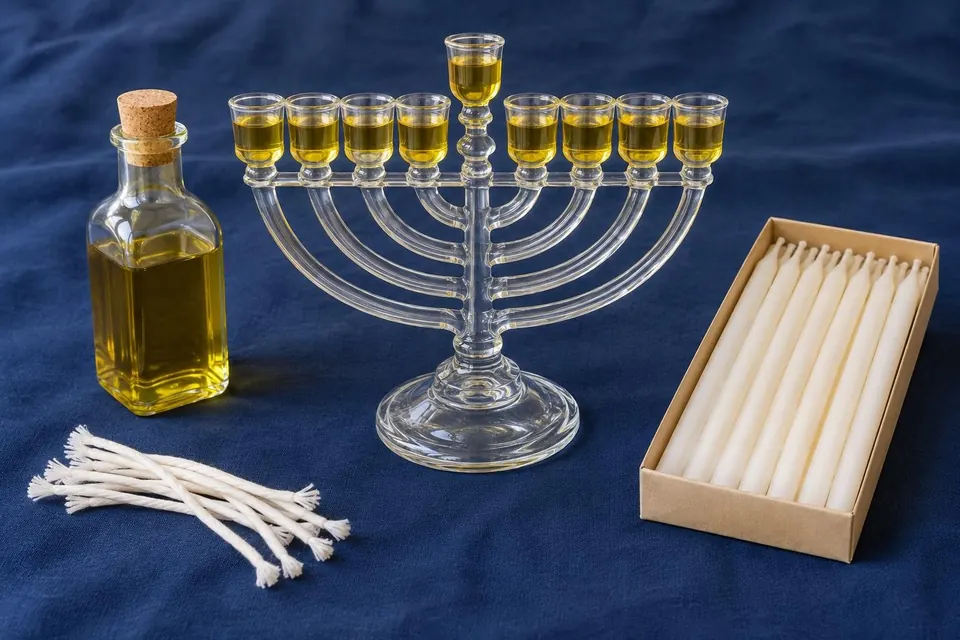
Stearin, paraffin, beeswax, and any other candles may be used for Hanukkah. If lighting oil lamps, any combustible oil may be used. However, someone who wants to perform the mitzvah in the best way uses pure olive oil. It gives the cleanest and brightest light, is readily absorbed by the wick, and was used in the Temple service. The miracles of Hanukkah are also associated with olive oil.
Electric lights and gas flames cannot serve as Hanukkah candles.
Oil whose use is prohibited by Torah law or by the Sages may not be used for Hanukkah candles. Examples include a product of cooking meat with milk; orlah (produce from a tree's first three years), such as oil from olives harvested during that period; and tevel (produce from which the required gifts and tithes have not been separated), such as oil from olives from which terumot and maasrot—the required gifts and tithes—have not been separated. Stolen oil is, of course, strictly forbidden. Ideally, oil with the sanctity of the seventh year is not used for Hanukkah candles, but it may be used if nothing else is available.
Wicks may be made from any suitable material, though cotton or linen is preferable.
The law does not require replacing wicks as long as they can still be used. Some people, however, replace them every day as a way of showing special respect for the mitzvah.
A beautiful Hanukkah menorah and beautiful, clean oil cups should be used.
Oil cups designated specifically for Hanukkah candles do not have to be immersed in a mikveh.
The Hanukkah candles must be arranged evenly in a single row. The wicks must be at least a thumb's width apart, but they must not be too far apart. The candles must resemble one another in appearance and height.
Lighting Away From Home#
It is preferable to light Hanukkah candles yourself, just as it is preferable to perform any other mitzvah yourself rather than through someone else. It is therefore important to try to be home at lighting time so that you can light them yourself. If a person cannot be home at the designated time, even if they light Hanukkah candles elsewhere, they must ask their wife, mother, or another family member to light at home. If they live alone, they must appoint an agent to light there. The agent may be someone who has already fulfilled the mitzvah of lighting Hanukkah candles. However, the agent may recite the blessings only if the person on whose behalf they are lighting is present.
Even if a person expects to return home after lighting time, they must ask someone else to light at home on time. If the head of the household usually lights on time but is delayed for a while, the household customarily waits and does not light without them.
A person who must leave home one hour before sunset and has no one to ask to light at home on their behalf lights the candles themselves and recites the appropriate blessings.
People who leave home even for just one day, and leave no one there who is obligated in the mitzvah of Hanukkah candles, do not need to arrange for candles to be lit in their home.
At vacation facilities, on college campuses, and on military bases, people often sleep in one place and eat in another. According to one opinion, they light where they sleep; according to another, where they eat. Those who light outside and follow the opinion that they should light where they eat must also light where they sleep, but without blessings.
People who live with their parents, whether permanently or while visiting on vacation, and whether married or unmarried, fulfill the mitzvah when the head of the household lights, provided their parents support them. As mentioned above, an Ashkenazi young man who also lights his own candles fulfills the practice of mehadrin (a preferred way of performing the mitzvah). The same applies to anyone who lives as a long-term guest in another person's home and is supported by the host, even if they are not a family member.
A person who lives in someone else's home but is not supported by the host—that is, they pay for their own food—must light candles themselves.
A temporary guest for whom no one lights at their permanent home must contribute to the cost of the host's Hanukkah candles so that the host's lighting counts for them too. An Ashkenazi guest should preferably light their own candles separately. This applies whether or not the guest is supported by the host. But if someone lights for the guest at their permanent home, the guest need not light at the host's home or contribute to the cost of the host's candles. If the guest is given a separate apartment, or even a room with its own outside entrance, they must light separately. If someone lights for them at their permanent home, they do not recite a blessing when lighting as a guest.
A person who comes home after lighting time and discovers that candles were lit without them must light Hanukkah candles as well, because they did not expect anyone to light on their behalf. They do not recite the blessings.
A person staying overnight in a hotel must light Hanukkah candles at the entrance to their room or in its window, provided this does not conflict with safety rules or hotel policy. If lighting candles is not possible, it would be appropriate to turn on electric flashlights as a reminder of the mitzvah. Since the mitzvah itself is not fulfilled with electricity, no blessings are recited over lighting the flashlights. The same applies to people traveling by train, ship, or airplane, except that even if they use actual candles in these places, they do not recite the Hanukkah candle-lighting blessings.
A Bride and Groom on Their Wedding Day#
A bride and groom who marry during Hanukkah and leave home for the celebration after candle-lighting time follow their usual practice. The bride fulfills the mitzvah when her father lights Hanukkah candles. The same law applies to a Sephardic groom. An Ashkenazi groom, as well as a bride or Sephardic groom who lives apart from their parents, lights at the place from which they leave for the celebration.
If they must leave earlier for the wedding venue, they light Hanukkah candles somewhat before the designated time, but no earlier than one hour before sunset. If the chuppah (wedding ceremony) is held early, or the venue is far away, and as a result they have to leave home earlier than one hour before sunset, the bride and groom light in their new home. If circumstances differ from those described here, a rabbi should be consulted about what to do in each case.
Using the Hanukkah Lights#
It is forbidden to use the light of the Hanukkah candles, even for a minor task or for so great a mitzvah as studying Torah. It is permitted to walk by their light.
It is customary to light an additional candle called a shamash (helper candle) and place it at some distance from the Hanukkah candles. The shamash ensures that if people perform activities for which they need light, they are considered to be using the light of this extra candle, which does not have the sanctity of the Hanukkah candles. If the shamash goes out before the Hanukkah candles, it must be relit. Where several Hanukkah menorahs are lit at the same time, a shamash should be lit for each one. A shamash is customarily lit even when the Hanukkah candles are in a very well-lit place. Although there are no restrictions on the materials used for Hanukkah candles, a shamash—which is not itself a Hanukkah candle—lit on Friday before Shabbat must meet the requirements for Shabbat candles.
The Hanukkah candles should be lit without taking a flame from one Hanukkah candle to light another. Instead, use a long wax candle or a match to light all the candles. If it goes out, relight it from an ordinary flame, not from the Hanukkah candles.
Once half an hour has passed after nightfall, the letter of the law permits using the light of the Hanukkah candles. Nevertheless, it is preferable not to do so, particularly for ordinary activities.
Oil left after the Hanukkah candles go out may be used for the next day's Hanukkah candles, but not for other purposes. It is not saved for lighting Hanukkah candles the following year.
Oil and wicks left after the last day of Hanukkah are customarily burned and not used for any purpose.
Hanukkah Prayers and Public Torah Reading#
Throughout the eight days of Hanukkah, a special addition called Al Hanisim (For the Miracles) is recited in the Modim (Thanksgiving) blessing of every Amidah, on weekdays and Shabbat alike. It gives thanks for the miracles God performed for our ancestors in those days. The same addition is made in Grace After Meals, the blessing recited after a meal with bread, in the section beginning Nodeh Lecha (We Thank You). If Al Hanisim is forgotten in the Amidah or Grace After Meals, the prayer need not be repeated. It is preferable, however, to say it at the end of the Amidah after Yihyu Leratzon (May the Words Be Acceptable), or at the end of Grace After Meals among the requests beginning Harachaman (May the Merciful One).
On every day of Hanukkah, men recite the complete Hallel (psalms of praise). Women are not obligated in this mitzvah, but it is customary for them to recite Hallel nevertheless. Ashkenazi women also recite the appropriate blessing before it. A mourner should not recite Hallel. Therefore, when communal prayer is held in a mourner's home during Hanukkah, the mourner customarily leaves the room where the service is taking place until the congregation has finished Hallel.
Talking is forbidden during Hallel. One may answer “Amen” to blessings recited by others only between the individual psalms. Exceptions are the responses to Kadosh (Holy) and Barchu (Bless), which may be said even in the middle of a psalm, as well as “Amen” to the blessings Kel Hakadosh (the Holy God) and Shomea Tefilah (Who Hears Prayer).
During Hanukkah, and at Mincha (the afternoon prayer) on the eve of Hanukkah, Tachanun (supplications) and Lamnatzeach (a psalm beginning “For the conductor”) are omitted. On Hanukkah Shabbat, Tzidkatecha Tzedek (Your Righteousness Is Eternal) and Tziduk Hadin (the prayer affirming God's judgment) are not said. Kel Erech Apayim (God, Slow to Anger) is omitted before the public Torah reading, and Yehi Ratzon (May It Be Your Will) is omitted afterward.
Every day of Hanukkah, the Torah is read publicly during the morning service. On weekdays, three people are called to the Torah in turn, and a passage is read from Parashat Naso in Numbers. It describes how the 12 leaders of the tribes of Israel brought offerings in turn over 12 days at the newly erected Tabernacle. On the first day of Hanukkah, Sephardim begin the public Torah reading with the priestly blessing (Numbers 6:22), while Ashkenazim begin directly with the offerings of the tribal leaders (Numbers 7:1). They read through the words Bayom Hasheni (“On the second day”), through Numbers 7:17 inclusive. From the second through the seventh day of Hanukkah, the passage corresponding to that day is read: “On the second day,” “On the third day,” and so on.
On the eighth day, which is called Zot Hanukkah (This Is Hanukkah) after the Torah passage read that day and is a particularly exalted day of the holiday, the reading begins with the eighth day and continues to the end of the account. The first part of Parashat Behaalotecha is also read, through Numbers 8:4 inclusive.
On Hanukkah Shabbat, two Torah scrolls are taken from the ark. The weekly portion, Miketz, is read from one, and the appropriate passage from Naso is read from the other. The haftarah (reading from the Prophets) is Rani Vesimchi (Sing and Rejoice), from Zechariah 2:14–4:7. It includes the words, “Not by might, nor by power, but by My spirit,” which remind us that the Maccabees' victory came not from military strength but from genuine trust in God. If Hanukkah includes two Shabbatot, Parashat Vayeshev and the haftarah Rani Vesimchi are read on the first Shabbat. On the second, Parashat Miketz is read, and the haftarah is Vayaas Chirom (And Hiram Made), from 1 Kings 7:40–50. Among other things, it describes the making of the lampstand for the First Temple. Sephardim do not recite the chapter Bameh Madlikin (With What May One Light?) before the start of Hanukkah Shabbat; Ashkenazim do.
If the new moon of Tevet falls on Shabbat, three Torah scrolls are taken from the ark. Six people are called for the weekly portion from the first scroll. From the second, the passage normally read when the new moon falls on Shabbat is read (Numbers 28:9–15). From the third, the passage for that day of Hanukkah is read as the maftir (the concluding Torah reading before the haftarah). The haftarah Rani Vesimchi then follows. If the new moon falls on a weekday, two scrolls are taken out. Three people are called for the new-moon reading from one scroll (Numbers 28:1–15), and a fourth member of the congregation is called for the Hanukkah passage corresponding to that day from the other.
At the end of the morning service on Hanukkah, Ashkenazim recite Psalm 30, some in place of the psalm of the day and some in addition to it. The exceptions are Shabbat, when the psalm for Shabbat is recited, and the new moon, when Barchi Nafshi (Bless the Lord, My Soul) is recited.
Practical law. This page reports a ruling given for a specific question. For your own situation, ask a rabbi who knows you.
Keep reading
More →Hanukkah: Never Lose Hope
Hanukkah teaches that even in spiritual darkness, it is possible to turn to God and find light.
Guide · HanukkahWhen Should You Light Hanukkah Candles?
Jewish authorities differ on whether Hanukkah candles should be lit at sunset or after nightfall.
HanukkahWhy Is Hanukkah the Last Holiday?
Hanukkah reveals how the darkness of forgetting can lead to a flourishing of Torah.
HanukkahTorah and Greek Wisdom: What Does Hanukkah Teach Us?
Hanukkah reflects a struggle over the purpose of wisdom and the influence of the world around us.







