Who Is to Blame? Lessons From the Book of Jonah
Jonah’s response to a storm offers a lesson in responsibility for the world around us.
In brief
- The Talmud teaches that one person’s actions can tip the balance for the entire world.
- Jonah fled rather than deliver a prophecy that might bring accusations against Israel.
- When a storm threatened his ship, Jonah recognized his own responsibility.
- The author urges us to pray for others and add Torah study and mitzvot to benefit the world.
“See, I set before you today a blessing and a curse.” (Deuteronomy 11:26)
The Chatam Sofer writes: “This verse begins in the singular—‘See’—and continues in the plural: ‘I set before you.’ There are many explanations for this. One is that it alludes to the teaching in Kiddushin 40b: ‘A person should always see themselves and the whole world as if their sins and merits were evenly balanced. If they are privileged to perform one mitzvah, fortunate are they, for through that mitzvah they have tipped their own balance and the balance of the whole world toward merit. If, God forbid, they do the opposite, the scales tip in the opposite direction.’
“A person should see themselves this way in everything they do, and tell themselves: ‘My actions can destroy or give life to the whole world.’ This command is given to each individual: ‘See.’ You can always say in your mind to the whole world and its inhabitants: ‘Today, through my actions, I set before you a blessing or a curse.’ It all depends on my merits.”
Once, I was invited abroad to give a series of talks to strengthen and inspire people. I went to the great Rabbi Chaim Kanievsky and asked him what I should speak about and what I should emphasize. He told me, “Awaken people so that everyone knows: ‘All the troubles in the world are because of me!’”
It is frightening to think about. But this is stated clearly in an early rabbinic teaching (Kiddushin 40b), and Maimonides (the Rambam) brings it as a commandment (Laws of Repentance 3:4): “A person should always see themselves and the whole world as if their sins and merits were evenly balanced. If they are privileged to perform one mitzvah, fortunate are they, for through that mitzvah they have tipped their own balance and the balance of the whole world toward merit. But if they commit one sin, woe to them, for they have tipped their own balance and the balance of the whole world toward guilt.”
A similar teaching appears in Yoma 86b: If one person does teshuvah, Heaven forgives that person and, because of them, the entire world.
How serious, then, is the charge against someone who does not repent but continues to add sin upon sin!
Rabbi Chaim added: “Of course, the troubles and disasters did not happen directly because of that person; their responsibility is only indirect. But Bava Kamma 55b and 119a teach that someone who indirectly causes another person harm is exempt from judgment by a human court, but is judged by the Heavenly Court.”
The Chafetz Chaim writes about a person who speaks maliciously: “Who knows how many people have been ruined because of him, and how many have died because of him?” (Shemirat Halashon, Part 2, Chapter 4).
Now we can understand one of the most important lessons of the book of Jonah.
The prophet Jonah was commanded to go to Nineveh and deliver a prophecy, warning its people that if they did not mend their ways, they would be destroyed. Jonah decided to withhold the prophecy and flee so that he would not bring accusations from Heaven against the people of Israel. He knew that non-Jews repent easily, though they also return to sin very easily. In fact, Nineveh’s repentance lasted only 40 years; then its people began sinning again and were swallowed up by the lowest level of Gehinnom (see Pirkei deRabbi Eliezer 42). Their repentance would arouse anger from Heaven against the Jews, whom the prophets rebuke from morning to night, yet who do not repent.
So Jonah fled the Land of Israel, knowing that prophecy exists only in the Holy Land. But he did not know that a prophet who first receives prophecy in the Holy Land can continue to receive it in the Diaspora (Moed Katan 25a).
Jonah left by ship. We cannot even imagine what he gave up to avoid bringing accusations against the Jewish people. In those days, all the Jews lived in Israel. He voluntarily gave up prophecy, the Holy Land, Jerusalem, and the Temple. He said goodbye to his family, friends, and students and chose to live in exile, in a foreign land.
And what would happen to Nineveh? There were plenty of prophets! Elisha was alive at the time, and there were many others. Megillah 14a says that the people of Israel had twice as many prophets as the number of people who left Egypt. So the Almighty would give the task to another prophet. No harm done!
Jonah acted wholeheartedly, without any doubts. And the Almighty loves those who defend the people of Israel (Yalkut Shimoni, Shoftim 6), all the more so those who sacrifice themselves to avoid bringing accusations against them.
Recall that Moses our teacher refused to go and save the people of Israel because he feared he would hurt Aaron’s honor. He said to the Almighty, “Please send through a messenger” [Exodus 4:13]—that is, through someone else. We do not see that he was punished for this. How much more so when someone acts to avoid bringing accusations against the Creator’s children!
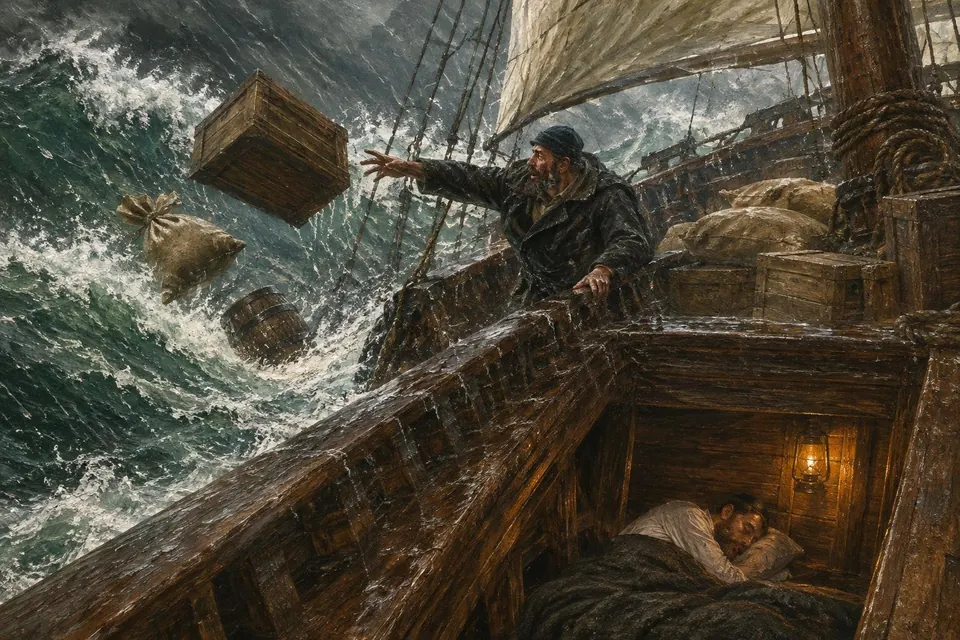
Jonah set out on a ship full of idol worshippers. “The Almighty sent a mighty wind over the sea, and a great storm arose, so that the ship threatened to break apart. The sailors saw this and each began to cry out to his own god. But Jonah had gone down into the hold of the ship, where he lay down and fell asleep” (Jonah 1:4–5).
The book Kad Hakemach says that Jonah lay down “like a person whose heart is completely at peace and who feels no fear.” Rashi explains that Jonah believed the sailors, who worshipped various idols, deserved to perish. But he, who “fears the God of heaven, Who made the sea and the dry land,” deserved to be saved. He trusted completely in the Almighty.
The captain woke him, and they cast lots to find out who had brought the storm upon them. The lot fell on Jonah. He told the sailors his story, and they were overcome with fear. “They asked him, ‘What should we do to you so that the sea will become calm for us?’ Jonah answered, ‘Pick me up and throw me into the sea, and the sea will become calm for you. For I know that this great storm has come upon you because of me’” (Jonah 1:11–12).
Here are the key words: “For I know that this great storm has come upon you because of me.”
Surely Jonah had many mitzvot to his credit—he was a prophet. Even this act had been done with the best intentions, as the Talmud says: “How great is a sin committed for the sake of Heaven!” (Nazir 23b). The sailors, on the other hand, were idol worshippers, a sin punishable by death even for a non-Jew—not to mention their other sins. And yet every person must say: “This great storm has come because of me!”
This is not only about sins that may have tipped the world’s scales toward guilt, God forbid. We are also held accountable if, for example, we could have prayed for the whole world but did not.
Makkot 11a tells us that the mothers of the High Priests supplied food and clothing to those exiled to the cities of refuge, so that the exiles would pray for their sons not to die. A person who killed unintentionally had to remain in a city of refuge only until the High Priest died.
The Talmud asks: If they do not pray, will the High Priest die? What has he done wrong? It answers that he should have prayed for mercy for his generation—that there be no unintentional killers in it—and he did not.
Rabbi Yehoshua ben Levi studied with the prophet Elijah every day. Once, a lion killed a person three parsaot—a unit of distance, about 10 km (6 miles) in this case—from where Rabbi Yehoshua lived. As a punishment, Elijah did not come to him for three days.
And what about the Flood? Heaven held Noah accountable for not praying for his generation. Rabbi Yitzchak of Berdichev explains that Noah lacked faith in himself: He did not believe that his prayer had the power to overturn the decree against his entire generation.
How, then, can we justify ourselves? We might say that our prayers cannot compare to those of the High Priest or Rabbi Yehoshua ben Levi, let alone those of the prophet Noah, a wholly righteous man. But Berakhot 12b says of every person that anyone who can pray for mercy for a friend and does not do so is called a sinner. And Nedarim 40a says that someone who does not pray for mercy for a sick person brings about that person’s death. God forbid!
In general, a person should feel, “This great storm has come because of me!” They should fear that their misdeeds may have harmed others. And since they do not know for certain, they should act like the person who “stole and does not know from whom: Let him use the money for public needs” (Beitzah 29a). For us, there is no greater public need than to add Torah study and mitzvot. In this way, we can tip the scales toward merit for ourselves and the whole world.
Keep reading
More →How to Do Teshuvah: Practical Steps
A practical approach to making lasting commitments as part of teshuvah.
Yom KippurWhy Do We Fast on Yom Kippur?
The Yom Kippur fast invites repentance and offers a mitzvah that lasts throughout the day.

Rabbi Shalom Schwadron's Stories of Repentance and Prayer
Yom KippurWhy Is Yom Kippur a Joyful Day?
Yom Kippur brings the joy of forgiveness, renewal, and a return to Torah.







