Why Do We Fast on Yom Kippur?
The Yom Kippur fast invites repentance and offers a mitzvah that lasts throughout the day.
In brief
- We cannot fully understand the reasons for mitzvot, but we can grasp some of their meaning.
- One meaning of the Yom Kippur fast is repentance.
- Fasting is a mitzvah that continues throughout the day.
- Yom Kippur is a time to make use of every minute.
We cannot fully understand the true meaning of the mitzvot, but we can grasp some of it ourselves. As the teaching says, “Wherever you can find a reason, find one.” The Sages said that King Solomon understood most of the reasons for all the laws of the Torah. In the future, all the meanings of the mitzvot will be revealed to us.
The deepest meaning of the Yom Kippur fast is, of course, beyond our reach. It is no small matter that someone who violates it incurs karet (the cutting off of the soul; see Maimonides, Laws of Repentance 8:1). One meaning of the fast is repentance, as it says: “Even now, declares God, return to Me with all your heart, with fasting…” (Joel 2:12). Fasting is also one of the ways we are like angels on Yom Kippur.
A Mitzvah Throughout the Day#
But there is more.
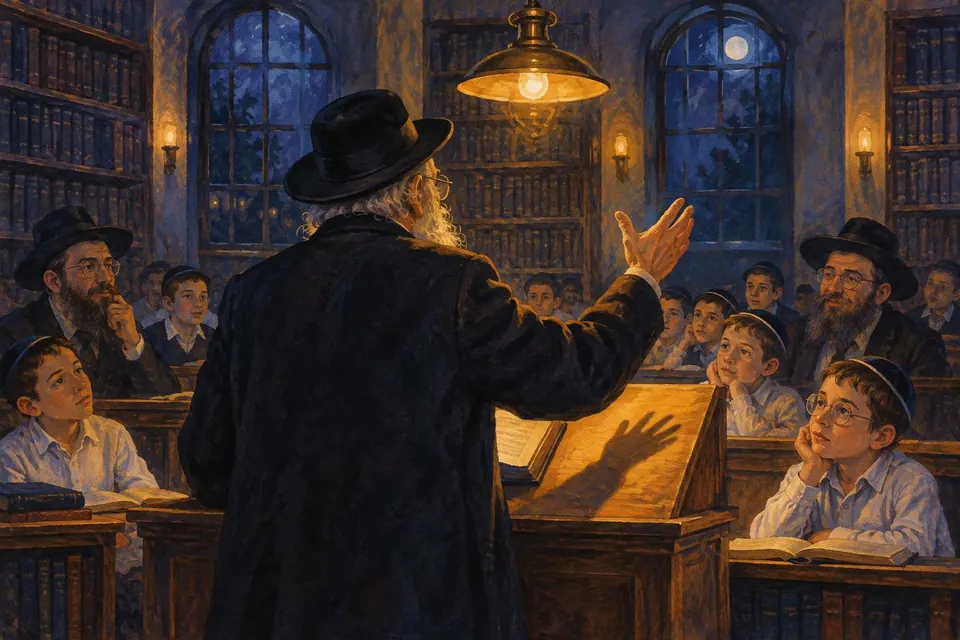
It happened during the years of hunger after the War of Independence in 5708 (1948). The yeshivas suffered from a terrible shortage of funds. Their students did not have enough bread, let alone anything else. The heads of the yeshivas decided to gather wealthy Jews and try to move them to donate toward the support of the yeshivas and their Torah students. They chose the Rabbi of Ponevezh, whose powers of persuasion were unmatched, to speak on their behalf.
The wealthy guests gathered, and the heads of the yeshivas filled the places of honor along the eastern wall. It was a magnificent sight. The Rabbi of Ponevezh rose to the podium.
“My dear brothers,” he began, “you surely think how fortunate you are to have plenty of bread and meat, and you feel terribly sorry for the yeshiva students who are starving! But the truth is just the opposite! They are the fortunate ones, and their lot is wonderful! For ‘a mitzvah is a candle, and the Torah is light’ [Proverbs 6:23]. They live in a world of light and radiance. For ‘with You is the source of life; in Your light we see light’ [Psalms 36:10]. God, the Torah, and the people of Israel are one! And it is said, ‘But you who cling to the Lord your God are all alive today’ [Deuteronomy 4:4]. Ah, how sweet is every subject in the Talmud, every insight of the Rashba, every precise distinction of Rabbi Chaim Soloveitchik, every principle of Rabbi Shimon Shkop, and every definition of Rabbi Baruch Ber Leibowitz!”
For a full hour, the Rabbi of Ponevezh spoke with admiration and delight about the radiant world of a yeshiva student. Who in the world could compare to him?
His listeners shared his admiration and delight. When he finished, the rabbi kissed the curtain behind which the Torah scrolls were kept and stepped down from the podium, leaving a powerful impression.
As he walked back to his seat, Rabbi Ezekiel Sarna, head of the Hebron Yeshiva, said to him, “Rabbi, you should have spoken about what the students lack, not what they have! About the fact that they have no food, not that they have Torah!”
The Rabbi of Ponevezh was startled. “What are you saying? They study for 16 hours and eat for only one hour a day! So which should I have spoken about?”
Rabbi Ezekiel replied, “True, they eat for only one hour. And they study for 16 hours. But they fast for 24 hours!”
How wonderful! There is a mitzvah to eat on Shabbat and the festivals. How long does one fulfill that mitzvah? One hour a day. But the Yom Kippur fast is a mitzvah that lasts for 24 hours straight. How great is its reward!
Making Use of Every Minute#
Another meaning of the fast can be found in the following story.
The city of Petah Tikva was built by God-fearing Jews who were students of Rabbi Maharil Diskin, the Rabbi of Brisk. There were very few of them, but the settlement covered a very large area. The city still covers a large area today. This is how it came about: At the time, land was purchased from Arabs, and there were no maps with marked boundaries as there are today.
A purchase worked like this: The seller and buyer agreed on a price, and the buyer would set out to walk around the fields. All the land he managed to cover before sunset became his.
In this case, the buyer was Rabbi Yehoshua Stampfer.
He rose before dawn, prayed at daybreak, and began his walk when the sun came up. He walked on foot, with an Arab man riding a donkey beside him. Rabbi Yehoshua walked quickly. There were no roads there, not even paths. He walked over stones, stumbled over obstacles, climbed hills, and descended again. The sun rose high, and sweat poured from him. Yet Rabbi Yehoshua did not slow down or stop for a drink or a bite to eat. Passersby wanted to exchange a few words with him, but he did not even answer their greetings. The Arab accompanying him also grew tired and asked him to stop for just a minute so he could have a drink. The rabbi did not answer him either.
He walked on, breathing heavily. He was no longer a young man, but he stubbornly pushed himself from west to east and then north. As the sun began to set, the rabbi gathered his last strength and ran. He ran until the sun had completely set, and then he fainted.
But the entire vast area he had managed to walk around became his—and therefore belonged to all the settlers.
That is Yom Kippur: making use of every minute!
Keep reading
More →How to Do Teshuvah: Practical Steps
A practical approach to making lasting commitments as part of teshuvah.
Rabbi Shalom Schwadron's Stories of Repentance and Prayer
Yom KippurWhy Is Yom Kippur a Joyful Day?
Yom Kippur brings the joy of forgiveness, renewal, and a return to Torah.
Yom KippurFor the Sin We Committed Before You Through Envy
A closer look at another person’s life can change the way we see what they have.







