What Is the Yom Kippur Morning Haftarah About?
Isaiah’s call for a fast joined with justice and compassion is read on Yom Kippur morning.
In brief
- Isaiah challenges those who fast while continuing to oppress others.
- The commentators see his words as a call to submit our desires to God.
- Rabbi Akiva Eiger understood Isaiah’s words as a reminder to care for relatives.
- A Midrash about a couple’s generosity asks us to consider how we use what God entrusts to us.
Many of us are familiar with the haftarah, the reading from the Prophets, from the Book of Jonah that we read at the afternoon service on Yom Kippur. We are less familiar with the haftarah from Isaiah that we read at the morning service.
“Cry out with a full voice, do not hold back. Raise your voice like a shofar, and declare to My people their wrongdoing, and to the house of Jacob their sins” (Isaiah 58:1).
The Fast God Desires#
Isaiah speaks about Jews who afflict themselves and spend the whole day in prayer, yet see that God does not answer them. They are puzzled: “Why have we fasted, and You have not seen? Why have we afflicted ourselves, and You have not taken notice?” [Isaiah 58:3]. That is, why have You not responded?
The prophet points to the reasons God does not listen to their prayers. These problems were not unique to that generation; they are relevant in every age:
“On your fast day you pursue your own interests and oppress all your workers. You fast amid quarrels and strife, striking with a wicked fist. You cannot fast as you do today and make your voice heard on high. Is this the fast I have chosen, a day for a person to afflict themselves? Is it for bowing one’s head like a reed and spreading out sackcloth and ashes? Do you call this a fast, a day acceptable to the Lord? Is this not the fast I have chosen: to loosen the chains of wickedness, untie the bonds of the yoke, set the oppressed free, and break every yoke?” [Isaiah 58:3–6].
The people fast, but they continue to sin. They own Jewish slaves and keep them in improper conditions, even though the law says that one who acquires a Jewish slave is like one who acquires a master. The law also permits a master to use a slave’s labor for only six years, after which the master must set him free.
Yet already at the beginning of the First Temple period, the prophet Jeremiah testified that Jews were unlawfully enslaving their fellow Jews. The Book of Ezra describes the same practice during the Second Temple period. With these and many other violations, the people stand before God on a fast day and then wonder why He does not “hear” them.
Is going without food for one day all that is required of us? If a person performs only outward acts without changing themselves, they are like a reed that bends in the wind but then straightens up and returns to its former position.
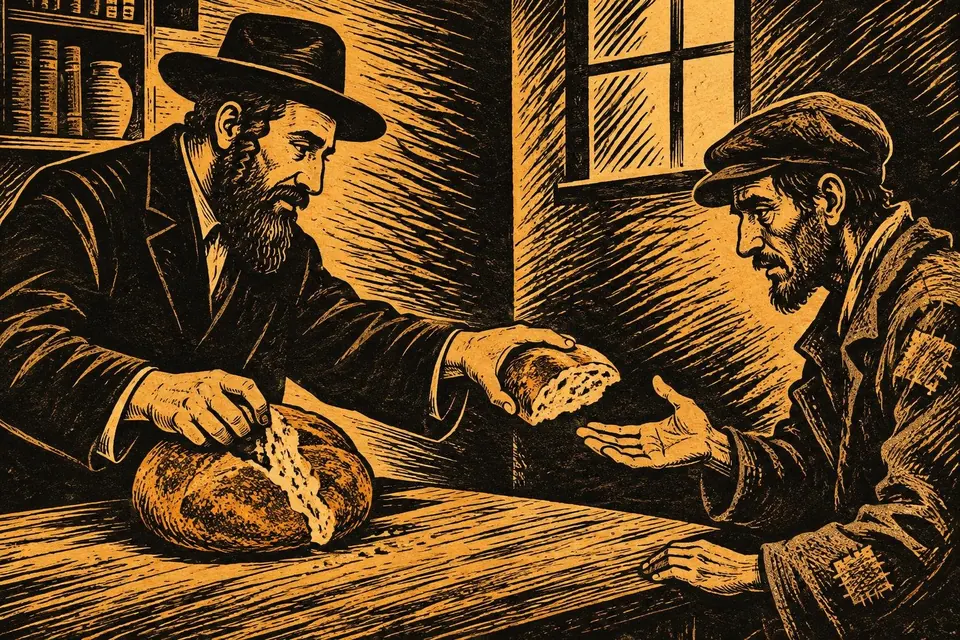
The commentators explain that this is why the passage was chosen as the haftarah for Yom Kippur. It contains a hidden call to give up our own desires and submit them completely to God, which is our central task on this day. When you share your bread with the hungry, bring homeless wanderers into your home, clothe the naked, and do not refuse to help a relative:
“Then your light will break through like the dawn, and your healing will quickly appear. Your righteousness will go before you, and the glory of the Lord will follow behind you” [Isaiah 58:8].
Caring for Relatives#
“Do not turn away from your own flesh” (Isaiah 58:7).
In Parashat Ki Teitzei, the Torah says: “If you see your brother’s ox or lamb going astray, will you (veitalamta) pass them by? Return them to your brother” (Deuteronomy 22:1). Besides the basic law forbidding us to disregard another person’s lost property, the Sages derive another detail from this verse.
The word veitalamta means “and you pass by.” The verse can also be read without a question mark, which hints that there are circumstances in which a Jew may “pass by” a loss. This is permitted when the person is someone of standing for whom it would be beneath their dignity to chase someone else’s young goat down the street—and who would not chase their own goat either.
A story is told about Rabbi Akiva Eiger, the greatest Torah sage of his generation, who once visited Warsaw. Everyone who could came out to welcome him. As the crowd began to disperse, Rabbi Akiva Eiger asked to be taken to a particular address to visit an ordinary Jew.
Everyone was surprised by the request. Perhaps, they thought, a hidden righteous person lived there, someone whose greatness was not yet known. But the sage put their speculation to rest when he explained to his companions that a relative lived at that address.
“This is my relative,” Rabbi Akiva Eiger said. “In the Torah’s command to return lost property, it says veitalamta, ‘and you pass by.’ From this we learn that sometimes you may pass by if attending to the mitzvah is beneath your dignity. That is how the Torah instructs us to deal with another person’s property. But about relatives, Isaiah said, umibesarcha lo titalem—‘do not turn away from your own flesh.’ This is family, and I must visit them.”
What We Are Entrusted With#
“Then you will delight in the Lord, and I will raise you above the heights of the earth and nourish you with the inheritance of your father Jacob, for the mouth of the Lord has spoken” (Isaiah 58:14).
Yalkut Shimoni on the Book of Ruth (4) tells of a Jewish man who had been wealthy but lost everything. Of all he had owned, only his kosher wife remained with him. To earn a living, he became a hired worker.
One day, in the field, he met the prophet Elijah, who appeared as a nomad. Elijah said to him, “I know that Heaven has decided to give you six years of prosperity. You only have to decide when you want them: now or at the end of your days.”
The man thought the stranger was a fortune-teller trying to make money from him, so he sent the “nomad” away. But the stranger returned again and again with the same question, and the man decided to consult his kosher wife. She told him that if it was true, he should ask for the six years of prosperity right away.
The man returned to the nomad with her answer. “Go home,” the stranger told him. “Before you enter your house, you will see that a blessing has spread over it.”
By the time he arrived home, his children, who had been playing in the dirt near the house, had found a huge treasure, enough to live on for six years. His worthy wife said to him, “Since Heaven has had mercy on us, let’s use this opportunity to show kindness. Perhaps God will give us more than six years.”
What did they do? They wrote down all the money they gave to the poor. One day Elijah came and told the man that the six promised years were over. The man replied that he had accepted those years with his wife’s agreement, and that he would answer after consulting her.
His wife told him to reply: “If you find people more trustworthy than we are, then give them the wealth entrusted to us.” God saw their good deeds and decided to grant them further prosperity, as it says: “The work of righteousness will be peace” (Isaiah 32:17).
It is not without reason that the Sages told us the story of this resourceful woman. Nor is it without reason that they emphasize twice that the man’s wife was kosher. There is a hint here that our lives do not belong to us; they are given to us for a time. We can choose how to use them. But on Rosh Hashanah, each of us will be asked how well we have used what was entrusted to us, and whether we can be entrusted with another year of life.
Keep reading
More →How to Do Teshuvah: Practical Steps
A practical approach to making lasting commitments as part of teshuvah.
Yom KippurWhy Do We Fast on Yom Kippur?
The Yom Kippur fast invites repentance and offers a mitzvah that lasts throughout the day.
Rabbi Shalom Schwadron's Stories of Repentance and Prayer
Yom KippurWhy Is Yom Kippur a Joyful Day?
Yom Kippur brings the joy of forgiveness, renewal, and a return to Torah.







