Rabbi Yisrael Salanter and the Angels of Yom Kippur
Stories of white clothing, angels, and attention to another person's needs.

In brief
- Some people wear white on Yom Kippur to resemble ministering angels.
- Rabbi Yisrael Salanter challenged people whose religious focus left them inattentive to others.
- Rabbi Chaim of Sanz used Rashi's comments on two angels to teach a wealthy merchant that spiritual devotion must not make us indifferent to others.
Dressed Like Angels#
The Rema writes in his additions to the Shulchan Aruch: “Some write that on Yom Kippur one should wear clean white clothing to resemble the ministering angels” [Shulchan Aruch, Orach Chaim 610:4].
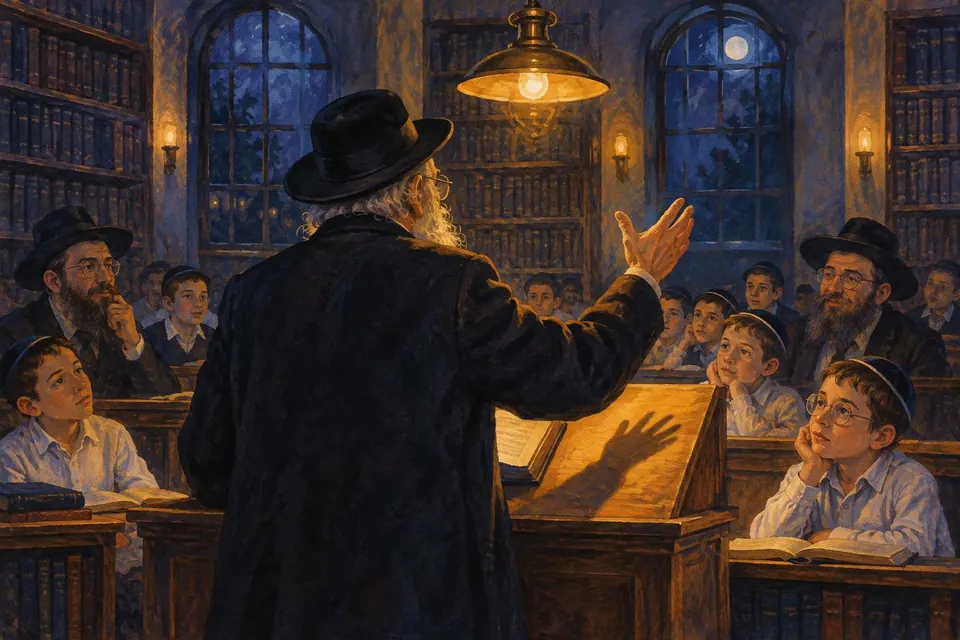
There is a well-known story about Rabbi Yisrael Salanter. He came to the synagogue before Kol Nidrei, the opening prayer of Yom Kippur, and met a young married Torah student hurrying to his place. The man was dressed in white, with a tallit, or prayer shawl, over his shoulders, like an angel of the Almighty. His face was pale, his eyes were burning, and his whole being trembled before the approaching judgment. He had spent the entire month of Elul preparing and reciting Selichot, the penitential prayers. Rosh Hashanah and the Ten Days of Awe had passed, and now the holiest day had arrived.
Rabbi Yisrael Salanter asked him, “Tell me, how is so-and-so?” The man he asked about was the student's neighbor, who was lying at death's door.
The student did not answer. Why should he concern himself with that neighbor? He had been summoned before the court himself, and his life was hanging in the balance.
Rabbi Yisrael then said the famous words that became one of the slogans of the mussar movement, the movement of ethical teaching: “Tell me, what did I do wrong that you are so God-fearing?”
I asked you a question—you should answer me.
In another story, Rabbi Yisrael came to a synagogue packed to the doors. Everyone was pouring out their hearts in Tefilah Zakah, a prayer recited before Kol Nidrei, and waiting in awe for Kol Nidrei. Suddenly, a Jewish man dressed in white and wrapped in a tallit appeared and began pushing his way through the worshippers. He shoved people aside and stepped on their bare feet.
Rabbi Yisrael followed him with his eyes and shook his head. “He's dressed in white—a perfect angel, no doubt. But a destroying angel!”
Carrying Out a Mission#
Our Sages say that in the World to Come, God will take the evil inclination and slaughter it. The evil inclination is Satan, who is also the angel of death. In the World to Come, none of them will remain. There will be neither an evil inclination nor death. But we need to understand why: after all, they carried out their mission. And we have seen how devotedly and faithfully they did it.
The answer is this: Moses, too, was sent to carry out a mission that God assigned him, and he refused. Why? Because Aaron was prophesying in Egypt, and it might hurt him if Moses came and, in a sense, stood above him. Moses would not agree until God promised him: “When he sees you, he will rejoice in his heart” [Exodus 4:14].
Jonah refused to carry out God's mission because he feared that, as a result, the people of Israel would be accused of not repenting for their sins. And the prophet Jeremiah begged not to be sent to prophesy the destruction of the Temple.
I am not saying that one should refuse, God forbid, but one should not go willingly and joyfully. This is precisely the charge against Satan and the yetzer hara, the evil inclination.
And let me tell you another story.
The Merchant and the Teacher#
A wealthy merchant came to Rabbi Chaim of Sanz to ask for a blessing.
“Where are you from?” Rabbi Chaim asked him.
“From Lemberg,” the man replied. “Lviv.”
The rabbi was delighted. “Perhaps you can give me some good news. How is the teacher? Did everything work out?”
The merchant did not understand. What teacher? What was supposed to have worked out?
The rabbi explained: “There is a teacher of young children in Lemberg, Rabbi Zelig. He came to see me about a month ago. He told me that his daughter was engaged and that he had promised to provide a dowry. The wedding is approaching, but he can't fulfill his promise. The groom's parents are threatening to break off the engagement, and he is in despair. I helped him as much as I could and wrote a letter to the community. So I'd like to know whether they managed to raise the necessary sum.”
The wealthy man replied, “Yes, now I remember. People came to me too, asking for money for him. But whether things worked out, I have no idea.”
“How can that be?” Rabbi Chaim asked in surprise. “You heard that he was in a difficult situation. How could you not ask whether he managed to raise the whole sum and make peace with the groom's parents?”
“You see, Rabbi,” the man replied, “I'm busy with my business all day. And when I have free time, I sit and study. A person has to look after their World to Come, not just this world. So I don't have time to inquire into other people's affairs. It would be a shame to waste it on idle chatter.”
He was sure the rabbi would be filled with respect for the way he used his time. And indeed, the rabbi turned to him with a smile. “Well, if that's so, you're a Torah scholar! Perhaps you can explain Rashi's words to me.”
The man apologized. Of course he knew something, but it had never occurred to him that he might know something the Rebbe did not.
“Still, the Torah was given to the whole people of Israel. Listen carefully. When Jacob was left alone and ‘a man wrestled with him until daybreak’ [Genesis 32:25], Rashi explains that the man was Esau's angel [Rashi on Genesis 32:25]. And when Joseph lost his way in the field, ‘a man found him and asked him, “What are you looking for?”’ [Genesis 37:15]. There, Rashi explains that it was the angel Gabriel [Rashi on Genesis 37:15]. I don't understand: in both places it says ‘a man.’ How did Rashi know that in Joseph's case it was a holy angel, while in Jacob's case it was Esau's angel, the chief of all the forces of evil?”
The wealthy man was embarrassed and said nothing.
The rabbi answered, “It's very simple. Joseph had lost his way and didn't know where to go. Suddenly, a ‘man’ came over, took an interest, asked what he needed, and showed him the way. That means he was a holy angel. But when the angel was sent to wrestle with Jacob, he carried out his assignment and wrestled until morning. Then Jacob asked him for a blessing, and he answered that he had no time. His hour had come to sing a song to God.
“So a person who thinks only about their own spiritual growth, and because of that does not answer a fellow Jew's request, is Esau's angel.”
On Yom Kippur, when we resemble the ministering angels, let us decide which angels we resemble.
Keep reading
More →How to Do Teshuvah: Practical Steps
A practical approach to making lasting commitments as part of teshuvah.
Yom KippurWhy Do We Fast on Yom Kippur?
The Yom Kippur fast invites repentance and offers a mitzvah that lasts throughout the day.
Rabbi Shalom Schwadron's Stories of Repentance and Prayer
Yom KippurWhy Is Yom Kippur a Joyful Day?
Yom Kippur brings the joy of forgiveness, renewal, and a return to Torah.







