Rabbi Shalom Schwadron's Stories of Repentance and Prayer
Two stories told by Rabbi Shalom Schwadron explore the power of mitzvot, repentance, and prayer.
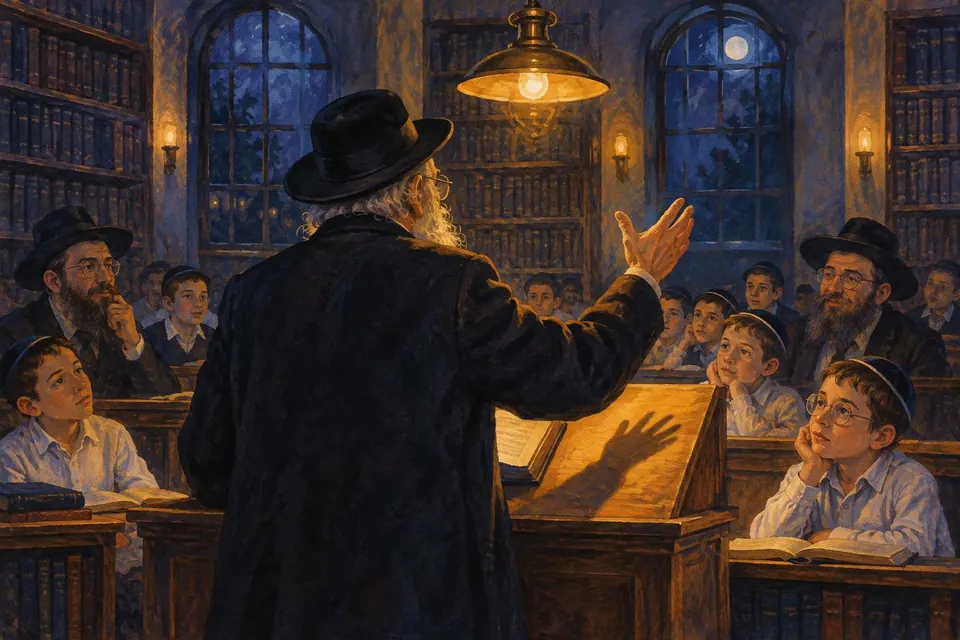
In brief
- A Holocaust survivor receives a frightening warning from his deceased father.
- The Chazon Ish connects the warning to a dangerous act of kindness the man performed during the war.
- A Jewish officer in the tsarist army is court-martialed after he is found praying.
- His recitation of Psalms leads to his release from the army.
Dear readers, as Yom Kippur approaches, we will say in our prayers that teshuvah (repentance), prayer, and good deeds can overturn a harsh decree. We offer you two stories connected to these themes, told by our teacher Rabbi Shalom Schwadron, a sage and righteous man.
A Mitzvah's Merit Leads to Repentance#
A man who had survived World War II and all the horrors of the death camps in his youth afterward stopped observing the mitzvot, the Jewish commandments, to the point that he no longer even fasted on Yom Kippur.
Once, after Yom Kippur, he dreamed of his father, who had died. Beside his father stood a boy of about 13. His father said to him, “My son, you've strayed so far that you don't even fast on Yom Kippur. Know that the penalty for this is karet (the cutting off of the soul). If you don't do teshuvah, you won't live to see the end of this year!”
When the son woke up, he paid no attention to the dream. But it returned the next night, and the third night too. The young man decided that the dreams were caused by the nervous strain he had been under lately and that he should stay somewhere else for a while. He went to sleep at a friend's home, and there he did not have the dreams. After a week, he decided that the strain had passed and that he could go home.
As he approached his house, he noticed a light burning in the window. He was surprised: as far as he remembered, he had turned everything off before leaving. He opened the door and, to his horror, saw his father in the room with the same boy.
His father said sternly, “This is the last time I'm coming. If you do teshuvah, all will be well. If you don't, you'll die!” Then they disappeared.
The vision shook and frightened the son. By then, following Ben-Gurion's famous visit to the Chazon Ish, the Chazon Ish had become widely known, and many people sought to meet him. The young man decided to ask him for advice. The next day, he traveled to Bnei Brak.
As soon as the Chazon Ish saw him, he said, “Ah, you're the one who ate on Yom Kippur? Your father has already come to me.” The young man burst into tears and could only say, “I'll do teshuvah!”
The Chazon Ish asked, “What special merit earned you such a warning?”
The young man thought for a moment and replied, “I give a lot of money to poor people and help them.” But the Chazon Ish did not consider that enough. He suggested that the young man try to remember whether he had ever done something exceptional. The young man thought for a long time, and suddenly he remembered.
It had happened at the beginning of the Nazi occupation of their small town. The Jews had not yet been forced into the ghetto, but everyone was afraid to leave their homes: it was deadly dangerous. The young man's sister lived in a small village nearby. Around that time, her child died.
There was no Jewish cemetery in the village, and the young man's father insisted that his grandchild be buried according to Jewish law. Despite the danger, the father asked his son to go to his sister's home at night, take the child's body, and bring it to the cemetery. The father would dig a grave there while he was gone.
“I obeyed my father,” the young man continued, “and set out, trembling with fear. Every gust of wind, every movement of a branch frightened me, and I thought I was about to die. But I kept going, reminding myself that I was performing an important mitzvah: burying the dead and honoring my father. I reached my sister's home, took the child's body, and came to the cemetery, where my father was waiting for me. We buried the child according to Jewish law.”
After hearing the story, the Chazon Ish said, “That child is the boy who came with your father. It was because of the merit of that mitzvah that your father came to warn you and make you do teshuvah!”
Saved by Reciting Psalms#
Rabbi Baruch Yadler told this story to Rabbi Schwadron after hearing it firsthand.
As a young man during World War I, the man who told the story had been drafted into the tsar's army and had risen to the rank of officer. On the eve of a terrible, decisive battle, after which no more than 10 percent of the soldiers were expected to survive, everyone awaited the arrival of the general. He was to address the soldiers before they went into battle.
While they waited, the time came for the afternoon prayer. Facing such danger, the man decided he should pray with all his heart. He went off to find a quiet spot and began to pray aloud, with deep feeling.
Just then, the general arrived and saw him praying. Furious, the general immediately ordered the Jew to be court-martialed for leaving his unit.
When the trial began, the man thought: What can I say to prove my innocence? And who will listen to me anyway? A wartime trial is short, and there is only one punishment for “desertion”: death. If it made no difference what he said, he had nothing to lose. So he decided to recite Psalms.
During the trial, he answered every question with lines from Psalms. After questioning him for 15 minutes, they decided he had lost his mind and sent him to a psychiatric hospital. He spent several weeks there until a doctor examined him, concluded that he was well, and discharged him—home.
Through prayer and the recitation of Psalms, the Jewish soldier was freed from both army service and the military trial.
Keep reading
More →How to Do Teshuvah: Practical Steps
A practical approach to making lasting commitments as part of teshuvah.
Yom KippurWhy Do We Fast on Yom Kippur?
The Yom Kippur fast invites repentance and offers a mitzvah that lasts throughout the day.
Yom KippurWhy Is Yom Kippur a Joyful Day?
Yom Kippur brings the joy of forgiveness, renewal, and a return to Torah.
Yom KippurFor the Sin We Committed Before You Through Envy
A closer look at another person’s life can change the way we see what they have.







