Is Hospitality Greater Than Greeting the Shechinah?
Abraham’s rush to welcome travelers offers a window into the greatness of hospitality.
In brief
- The mitzvah of hospitality centers on caring for a traveler who lacks food or lodging.
- The Talmud says that welcoming guests is greater than receiving the Shechinah.
- Abraham ran to welcome his guests even though he was ill.
- Abraham’s kindness was not only a mitzvah but a way of life.
Parashat Vayera#
A common mistake has taken root. When people invite a relative or friend for Shabbat, they say they have guests for Shabbat. But the essence of the mitzvah of hospitality, or hachnasat orchim, is caring for a traveler who has no food or lodging, or who has similar needs.
The Rema (Rabbi Moshe Isserles), citing Terumat Hadeshen, ruled that if a guest has food and a place to sleep, and the meal is held simply because the people involved want to eat together, it is a meal among friends. It is not the fulfillment of the mitzvah of hospitality about which the Sages said that welcoming guests is greater than receiving the Shechinah (the Divine Presence) (Orach Chaim 333).
The mitzvah of hospitality also allows certain leniencies in some other areas of Jewish law, in keeping with the principle that a person engaged in one mitzvah is exempt from others. This has no bearing on a meal among friends. Several friends have told me that, according to what I said, perhaps they have never once had the privilege of fulfilling the mitzvah of hospitality.
Let us explore the greatness of this mitzvah and what we can learn about it from our weekly Torah portion.
The Talmud teaches that welcoming guests is greater than receiving the Shechinah [Shabbat 127a]. This teaching is based on verses in our portion that tell us, as Rashi explains, that Abraham asked the Holy One, blessed be He, to wait while he ran to welcome his guests [Rashi on Genesis 18:3].
My brilliant and saintly father-in-law, Rabbi Yitzchak Zilber, asked why this proves the point. Torah study is equal in value to all the other mitzvot combined. Yet if a person studying Torah has an opportunity to perform even a seemingly minor mitzvah that no one else can perform, they must interrupt their study while they carry it out. Could the same logic not apply here? Receiving the Shechinah may well be greater, but since no one else could welcome Abraham’s guests, he had to interrupt.
Rabbi Zilber answered his question by pointing to a law about prayer. After praying, a person may not run away, because this looks as though they want to be rid of the burden of the mitzvah. But someone going to a Torah class may run, because Torah study is greater than prayer.
What if someone is going from one prayer service to another, or from one Torah class to another? Rabbi Zilber said that they should walk calmly for the first part of the way and then run toward the next prayer service or class.
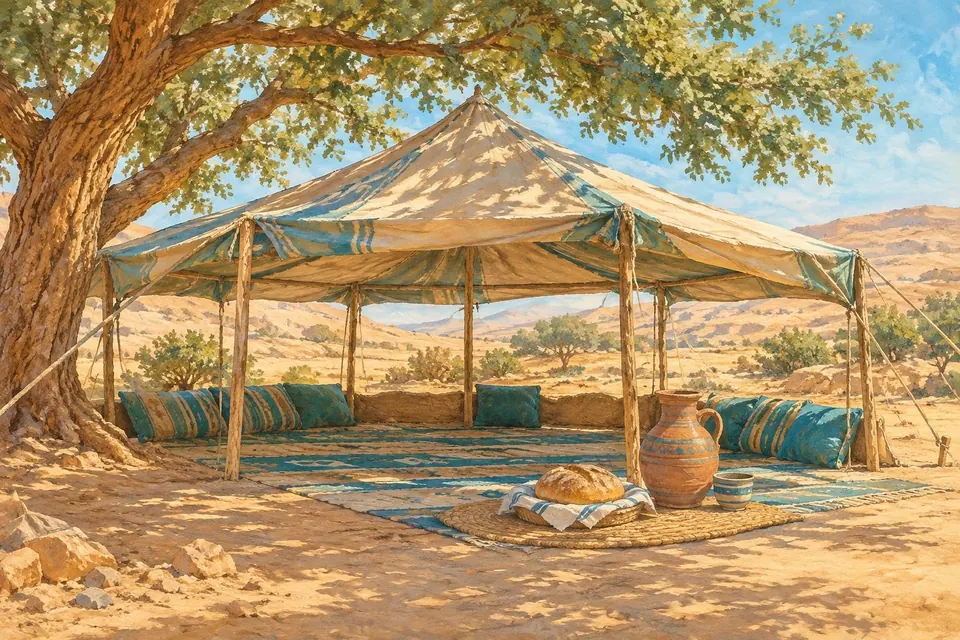
The first verse of our portion tells us that Abraham was sitting at the entrance to his tent (Genesis 18:1). Why, then, does the next verse say that he “ran from the entrance of the tent to meet them” (Genesis 18:2)? We already know where he was sitting, so surely we know where he ran from. The answer is that the verse teaches us that he began running at once. This shows that welcoming guests is greater than receiving the Shechinah; otherwise, Abraham would not have been permitted to run immediately.
A gifted young scholar at the Mir Yeshiva, Rabbi Chaim Akiva from the United States, offered another answer. Abraham was exempt from the obligation to welcome guests because he was ill. He did so only because hospitality is a great mitzvah. From this we see that welcoming guests is greater than receiving the Shechinah.
My teacher, Rabbi Gedaliah Eisemann, spoke often about how Abraham dared to go out to meet his guests on such a hot day. The Holy One, blessed be He, had “taken the sun out of its sheath,” in the Sages’ expression, precisely so that Abraham would not be troubled by guests [Bava Metzia 86b]. God had thus made Abraham free from this mitzvah. Why, then, did Abraham go out to meet his guests despite the reasonable concern that doing so might be dangerous?
My teacher answered that, for Abraham, doing good was not simply fulfilling a mitzvah. It was his life. Was he supposed not to live that day? Anyone who knew my saintly father-in-law, Rabbi Yitzchak Zilber, even a little could see these qualities in him.
The Torah tells us that Abraham bowed to the ground before his guests, meaning that he devoted himself entirely to their needs. It is no wonder, then, that the merit of Abraham’s hospitality has protected us for thousands of years and will continue to protect us, as Midrash Rabbah explains.
At the end of tractate Chagigah, the Talmud says that when we had the Temple, our sacrifices atoned for our sins. Now that there is no Temple, a person’s table—that is, the fulfillment of the mitzvah of hospitality—atones for them [Chagigah 27a]. This is difficult to understand. Acts of kindness and sacrifices are two fundamentally different forces. How is welcoming guests like offering a sacrifice?
As a partial answer, we might quote the book of Hosea: “For I desire kindness, not sacrifice” (Hosea 6:6). However, it seems right that a guest’s behavior can sometimes cause a host inconvenience. In such a case, the host must be patient and give something up—and that is what makes hospitality like a sacrifice.
May we all have a peaceful Shabbat, and may we all be blessed with such prosperity that we never have the opportunity to fulfill the mitzvah of hospitality. May we all be so well provided for that we can invite one another only for friendly meals together.
By Rabbi Avraham Kuperman
Practical law. This page reports a ruling given for a specific question. For your own situation, ask a rabbi who knows you.
Keep reading
More →Matot-Masei: Children or Money?
Moses challenges two tribes to reconsider what comes first: their property or their children.
ParashaDevarim: Knowing When to Say No
The story of the spies offers a lesson about when children are ready to hear a refusal.
FamilyHow Much Must You Honor Your Parents?
Parashat Vaetchanan and a Talmudic story reveal the depth of the mitzvah to honor parents.
FamilyChovat Hatalmidim: Revealing a Child’s Soul
The Piaseczner Rebbe explains how education can nurture each child’s individual nature and spiritual potential.







