Why Do Children Rebel? Parents Set the Example
Parashat Ki Teitzei shows how a parent's example can shape a child's choices.
In brief
- The Torah places the passage about a rebellious son after that of a man who marries a beautiful captive.
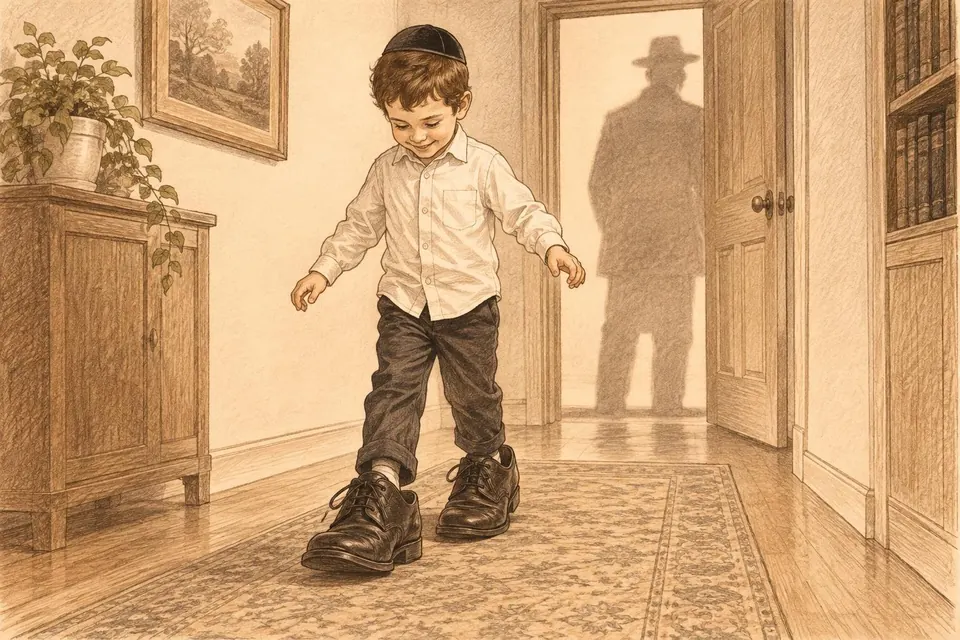
- A parent who did not listen to his own parents may struggle to demand obedience from his child.
- Children learn from what their parents do, including how they value Torah study and prayer.
- A rabbi's appeal on behalf of a man's children helped bring him back to the synagogue.
Parashat Ki Teitzei#
In our weekly Torah portion, we read about a man who goes to war, sees a beautiful woman, and desires her. The Torah permits him to marry her: “You may take her as a wife for yourself” [Deuteronomy 21:11]. Rashi explains that the Torah permitted this only because the yetzer hara (the evil inclination) is so strong in this case. Had God not permitted it, the man would have married her anyway, even though it was forbidden [Rashi on Deuteronomy 21:11].
But if he marries her, he will eventually come to hate her. As the Torah goes on to say: “If a man has two wives, one loved and the other hated” [Deuteronomy 21:15]. It will end with their having a rebellious son, as the Torah says: “If a man has a stubborn and rebellious son who does not listen to his father or his mother, and they discipline him, but he still does not listen to them” [Deuteronomy 21:18].
His refusal to listen to his parents is the root of his corruption. It is the gateway to every kind of evil. Who knows how far he will fall? Better that he die before he commits sins.
Why, though, does he really refuse to listen to his parents?
Because he says to his father, “Did you listen to your parents when you married the beautiful captive?”
When Samson asked his parents to arrange his marriage to a Philistine woman—Maimonides (the Rambam) writes that, of course, she converted [Maimonides, Laws of Forbidden Intercourse 13:14]—what did they say to him? “His father and mother said to him, ‘Is there no woman among the daughters of your brothers, or among all our people, that you must take a wife from the uncircumcised Philistines?’” [Judges 14:3]. Surely all parents said the same to sons who wanted to marry a beautiful captive, who would also convert, as required.
And the son says to his father, “You didn't listen to your parents, and now you expect me to obey you?” What can the father say? He has no answer.
In the Shema, we say, “Teach them to your children and speak of them when you sit at home, when you walk on the road, when you lie down, and when you rise” [Deuteronomy 6:7]. It might seem that the verse should have said, “Teach them to your children, and they will speak of them.” But there is an essential condition: How can you teach your children? Only if you study yourself, consistently—sitting at home, walking on the road, lying down, and rising. If the father sets a personal example, his son will absorb it and study, until the words of Torah become a constant part of his life too, and he knows them well. But if the father shirks his studies and prefers other ways to spend his time, how can he demand that his son study diligently?
There is a well-known story that really happened. A teacher in a cheder (a traditional Jewish elementary school) asked the children, “Tell me, children, isn't it good to study Torah?”
“Yes!” they all shouted. After all, Psalms says that the words of Torah are “more desirable than much gold and sweeter than honey” [Psalms 19:11].
“Tell me,” the enthusiastic teacher continued, “is there anything better than Torah?”
As expected, the children shouted, “No!” All except one. One boy said, “Yes!”
“And what is that?” the teacher asked.
“Cholent!” the child answered, naming the slow-cooked Shabbat stew. The whole class burst out laughing, but the teacher sensed that the boy had not meant to amuse his friends. He had shouted the word “cholent” with pain and anger.
So the teacher did not get angry. Instead, he asked, “Why do you think so?”
“Because... because when Dad asks me on Shabbat what I've learned, I start telling him. But when they bring out the cholent, he stops listening to me and gets caught up in eating!”
What can we expect of a child when, in response to a parent's demands, they can fairly say, “You do the same thing yourself”?
This reminds me of a story. Once, I traveled to Mexico again to raise money for Torah institutions. I arrived at a very difficult time. Financially, I did not even cover my travel expenses. The local currency had plummeted, many businesses had collapsed, and millionaires had gone completely bankrupt. I was saddened by the situation, but I was glad I had come. They needed someone to be with them in their distress, to support them and give them hope, and to speak about faith and trust in the Creator.
I learned that one of the wealthiest men in the community had gone bankrupt and was full of grievances against God for taking away his fortune. He was so angry that he had completely cut himself off from the community and would not even come to pray.
Well, if he would not come to the synagogue, I would go to him.
I came to his home. He opened the door and invited me in. He seated me at the table and sat down beside me. In silence. I began by saying that we do not know the Creator's calculations. I told him a story from the Midrash about an elderly couple who had welcomed the prophet Elijah and Rabbi Yehoshua ben Levi so warmly, without knowing who they were. Their entire livelihood depended on a milk cow they owned. When the guests arrived, the couple put milk and a wheel of cheese on the table and shared their meager meal with them. When the guests left, Rabbi Yehoshua ben Levi heard Elijah pray, “Master of the Universe, please kill their cow!” They had not gone far when they heard the sorrowful cries of the kind couple, who had found the animal that sustained them dead.
Rabbi Yehoshua ben Levi was astonished. “Is this the reward for the hospitality they showed us?”
Elijah answered him, “Know that in Heaven it had been decreed that the woman's time had come to die. I asked that her grief over the cow's death serve as an atonement, so that she would remain alive.”
“And you,” I said to the man, “have such wonderful children who study at a Talmud Torah (a Jewish school). You have a wonderful wife. Thank God—you don't know what He has saved you from!”
No, he was not ready to listen. There was no one to talk to.
So I decided to take a drastic step. “Well, I can't influence you. But I do have influence with the administration of the Talmud Torah. Starting tomorrow, your children will no longer study there!”
“Why?” he demanded indignantly. Aha, the ice had broken. “What have they done wrong?”
“Understand, the community invests in children who have a chance of continuing to be raised in the spirit of Torah. But if you yourself don't pray, how will your children pray? If you are no longer connected to the Master of the Universe, how will they behave?”
He smiled, relenting. Then he said, “When I heard that you, Rabbi, had come to Mexico, I knew right away that you would bring me back to the synagogue. I was just curious to see how...”
By Rabbi Yaakov Galinsky
Keep reading
More →Matot-Masei: Children or Money?
Moses challenges two tribes to reconsider what comes first: their property or their children.
ParashaDevarim: Knowing When to Say No
The story of the spies offers a lesson about when children are ready to hear a refusal.
FamilyHow Much Must You Honor Your Parents?
Parashat Vaetchanan and a Talmudic story reveal the depth of the mitzvah to honor parents.
FamilyIs Hospitality Greater Than Greeting the Shechinah?
Abraham’s rush to welcome travelers offers a window into the greatness of hospitality.







