How Does Giving Create Love in Marriage?
Love between spouses grows through giving, listening, and learning to forgive.
In brief
- Giving to a spouse creates a connection that can grow into love.
- True giving means understanding what the other person needs and how they need to receive it.
- Listening can be a meaningful act of giving.
- Love takes continual work and helps spouses forgive each other's mistakes.
Editor's note: In response to many requests from readers, we are beginning to publish new articles based on the lessons of Rabbi Baruch Fruchter.
Created to Give#
The Or HaChaim asks a question about the verse in Genesis: “It is not good for the human being to be alone” [Genesis 2:18]. We are told that Adam was created as both male and female, joined together in one body. The Holy One, blessed be He, says that it is not good for the human being to be alone—as one body. The two parts need to be separated. The Or HaChaim asks: Why is this not good? Why must they be separated?
To understand the question more deeply, let us ask another: Why does a man need a wife at all? For two things: to bear his children and, so to speak, “to sew on buttons”—to do whatever he needs. But as soon as the first human being was created, God commanded them to “be fruitful and multiply” [Genesis 1:28]. So reproduction must already have been possible without separating man and woman.
As for everyday needs, we are told that angels served Adam wine and prepared his food in the Garden of Eden. Adam did not need a woman to help him with household tasks. Now we can understand the commentator's question: What was so bad about the first human being's being alone?
The Or HaChaim answers that if man and woman had remained one, he could not have given her anything. The verse says, “I will make him a helper opposite him”—outside of him. Then he would have the opportunity to give her something.
The essence and purpose of married life is to give to another person. Ultimately, God creates a person in a way that makes it possible to give to a spouse. That is where family life begins. In the first volume of Michtav MeEliyahu, Rabbi Eliyahu Dessler says that the very act of giving creates the possibility of love. By giving, a person awakens the capacity to love their spouse. The connection formed by giving to another leads to love between husband and wife.
Song of Songs speaks about the love between God and the Jewish people. Why is this love described specifically as love between husband and wife, rather than, for example, as the love of parents for their children? What is the difference between these two kinds of love? Sefer HaChinuch says that love between parents and children is natural. God created people to love their children—not because the children are talented, good, successful, or anything else. We love our children because they are our children. Love between husband and wife is something quite different.
No man is born loving his wife. Even at the beginning of their life together, it is too early to speak of genuine love. What connects them at that stage is attraction and desire. Love is something they still have to work on and create.
The same is true of love between God and the Jewish people. It does not come naturally; it is something we have to work on. This explains what is distinctive about Song of Songs. A person does not automatically acquire love for God; it takes work. But even before a person is privileged to acquire love for the Creator, they must develop the ability to love the person closest to them—their spouse. That does not happen by itself.
Love between husband and wife begins with mutual giving from the very first moment of married life. There are two stages in this relationship. The first is built on obligations: he provides food, she takes care of the home and children, and so on. Each has things they must do for the other. These are not freely chosen acts, but legal obligations. In the second stage, giving is no longer an obligation, but we must do it anyway.
These two kinds of giving are the glue, the bond that joins a man and woman and makes them one being. Of course, mutual giving is not the only thing that builds a connection between husband and wife. But it is the most powerful tool for building what we call love.
Giving What the Other Person Needs#
Let us look more closely at what it means to give to another person and how to do it properly.
We often feel that whatever we give must be important. But to give properly is not to give what matters to us; it is to give what the other person needs. The measure is not what I would like to give, but what the other person wants to receive from me.
We often make mistakes and, in effect, manage to give nothing at all. For example, you buy something expensive and important in your eyes, perhaps a clothes dryer. You put a great deal of effort into it and spent a lot of money, but your wife received nothing. Why? Because she did not need that dryer. To give properly, you first have to find out what the other person needs. People often make this mistake: they give without first checking what matters to their spouse and what their spouse needs. That is not true giving.
To begin giving genuinely, we need to answer two questions: First, what does my spouse need? Second, how will my spouse receive what they need?
Suppose it is a wife's birthday. Her husband buys her a gift, doing what appears to be the right thing. He puts it on the table without saying a word to her. He does not even write a note. He feels that he has done something important: he has given something. He spent a lot of money, searched, found the gift, and brought it home.
But what is happening for his wife? She feels that she has received nothing. There was no emotional connection, no expression of feeling from her husband—just an object called a gift lying on the table. His mistake was that he did not know or find out what his wife needed and how to present it to her.
Take the first example. A woman says she loves the smell of laundry dried in the sun and does not want to use a dryer. But her husband thinks a dryer might help her in some way, so he buys one. Then he says, “Say thank you. I bought you a gift.” But she did not want that gift. She does not like it and never dreamed of having it. To give properly, you have to understand what the other person wants to receive. That is the first condition.
One qualification is important here. The word “giving” applies to every area of life, including the emotional and spiritual. In fact, these are the main areas in which we can give to another person: pay attention to them and hear them.
Everyone needs to be listened to and given the opportunity to share what they are experiencing. Suppose a wife comes home from work and starts talking. There are two employees, one named Rebecca and the other Chaya. They had an argument: one said this, the other answered that. Her husband listens and thinks, “Why should I care about Rebecca or Chaya? What does any of this have to do with me?” But his wife really needs to share it. It matters to her, and she is upset.
Sometimes a person is telling a story and can see from the expression on the listener's face that the listener is not only uninterested but finds it unpleasant to listen. That is a serious problem.
To show what our attitude in such a situation should be, let us consider a few examples. Suppose someone travels abroad to raise money for charity from wealthy people there. One wealthy person starts telling the visitor all kinds of stories, not always interesting ones. How will the fundraiser behave? They will show in every way that they find the stories fascinating.
The same is true when someone goes to an office seeking something from the official sitting there. To achieve their goal, they are even willing to pretend to be interested in what the official has to say.
The point is that in such a situation, a person has a personal interest. That is why they are willing to listen to things that do not matter to them at all.
We also have an interest in the relationship between husband and wife. When my wife tells me something, she is doing something she deeply needs to do and that matters greatly to her. She is not telling me in order to inform me; she does not want me actually to know what happened there. She simply needs to share how her day went and what happened today. Therefore, we are obligated to listen to a woman in order to fulfill the mitzvah of being on good terms with another person. Someone who listens to his wife is truly giving.
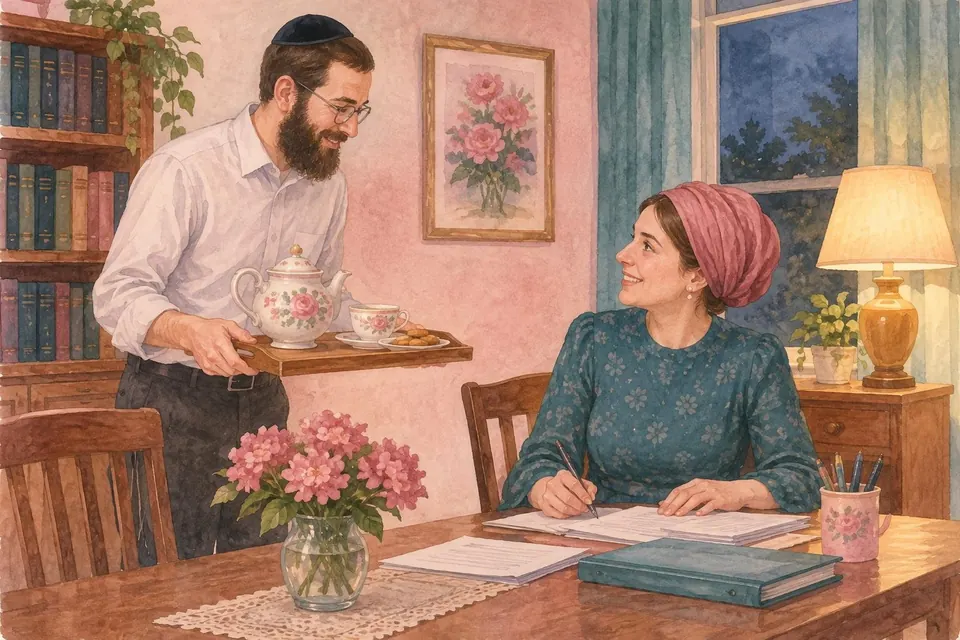
More than that, listening itself is a mitzvah in this case. I am giving my wife what she really needs. And what have I received? I have created a foundation for the bond called love. When a person listens to his wife, he creates an emotional connection with her that will last a lifetime. You build that connection, and she builds it in return. You give to her, and she gives to you. The conversation itself creates an emotional connection between two people.
Developing the Capacity to Love#
Now let us turn to love. What is the love we are building? Love is a capacity and a power of the soul. But we are not born with the ability to love. Love for parents and children is built into us. Yet the fact that we can love them is not even called love. These are natural qualities built into us, not a quality of the soul. The proof? All animals show “love” for their offspring and care for them. But that is nature—an instinct implanted by the Creator. Love is something else entirely. It is a quality we can and must develop within ourselves.
The book Reishit Chochmah says that a person who has never loved a woman will never reach the level of loving God. Why? Because he has not developed the capacity to love. We need to understand that the love we show another person is not only the right way to relate to them; it is also the right way to relate to ourselves. A person cannot build and perfect their soul without developing the quality of love for another. And the closest person is one's wife or husband. Thus, there is no other path to loving God except through loving one's own spouse.
The Torah says that when a man takes a wife, he must not go to war for a full year [Deuteronomy 24:5]. Why is it so important for him to stay at home and not leave for long periods? Sefer HaChinuch says that the Torah does not want adultery in the world. A man must be faithful to his wife. But simply telling him, “You are forbidden to be with other women,” is not enough.
The Torah commands: During the first year after marriage, stay close to your wife and cling to her. Do not leave home even for one day; stay by her side all the time. Even if there is a war, it is much more important to be at home. Sefer HaChinuch continues: The purpose of the husband's staying home is for his wife to take up a lasting place in his heart. Over the course of a year, a man firmly roots his wife in his heart.
What happens after the first year? He already loves his wife; she already has a secure place in his heart, and it is not so easy to lead him astray. We see that an emotional connection between husband and wife does not come automatically. It takes time and work for him to love his wife and grow accustomed to her, so that a strong bond can be established between them.
Love and Forgiveness#
Why is love so important? First, it builds the human soul and makes a person whole. But beyond that, we all grew up in different circumstances, with different families, habits, and upbringings. Suddenly, two very different people marry, and naturally there are major differences between them. Even if they come from the same city, their upbringings were still different, and each has their own character.
These differences can get in the way. We must train ourselves so that when something bothers us in such a situation, we learn to forgive immediately and let it go. More than that, we need to make this ability automatic. Where there is love, the ability to forgive also develops, along with the understanding that everything can be forgiven. But where there is no love, every little thing irritates us, and the situation can become dangerous for the family. The ability to forgive grows only from the feeling of love. The closer the bond and the greater the love, the sooner we forgive mistakes and the differences between us.
Sometimes young men who are dating through a shidduch (a proposed match) come to me and say, “I met a young woman who is very smart, cultured, and interesting, but her appearance bothers me. She isn't beautiful, but that's her only shortcoming. Everything else is fine. What should I do?”
I tell the young man to meet her again. After the second meeting, I ask him, “Tell me, did her appearance bother you just as much, or less?” If he answers, “Even more,” I tell him to stop pursuing the match. If it bothered him less than it did the first time, I tell him to continue seeing her.
Interestingly, after a while they say, “She's beautiful!” Why does this happen? He has come to respect her for certain undeniable strengths. If I respect someone, I scarcely notice their shortcomings; I forgive them in advance. This young woman has a shortcoming, but because of her undeniable strengths, I do not notice it. Conversely, if a man marries a very beautiful woman for her beauty and they then have an unhappy life together, she becomes very unattractive in his eyes.
When a person feels love, they automatically overlook shortcomings and forgive mistakes and missteps, and these things no longer stand in the way. All of this flows from the ability to love. Where there is love, most relationship problems resolve themselves.
So where should married life begin—with giving or with forgiveness?
One of the things that is forbidden is to marry a woman you do not value and respect. The same applies to women. Respect and a positive attitude toward a life partner are conditions for creating a family. Respect must be present before the wedding. If we suddenly feel that respect is disappearing, then we need to draw on love. When there is an emotional connection built on love, there is also the ability to forgive.
We need to invest in love at every age and in every situation. A person cannot expect love to remain static and constant. It is not something stable; it requires continual work. Love must be awakened again and again. How do we awaken love in our hearts? By giving something to another person, listening to them, and bringing them joy—and each day brings something new.
Keep reading
More →Matot-Masei: Children or Money?
Moses challenges two tribes to reconsider what comes first: their property or their children.
ParashaDevarim: Knowing When to Say No
The story of the spies offers a lesson about when children are ready to hear a refusal.
FamilyHow Much Must You Honor Your Parents?
Parashat Vaetchanan and a Talmudic story reveal the depth of the mitzvah to honor parents.
FamilyIs Hospitality Greater Than Greeting the Shechinah?
Abraham’s rush to welcome travelers offers a window into the greatness of hospitality.







