Devarim: Knowing When to Say No
The story of the spies offers a lesson about when children are ready to hear a refusal.
In brief
- God allowed the Israelites to send spies, even though He knew the mission would lead to disaster.
- The author suggests that the people were not ready to accept a refusal.
- Parents and teachers sometimes need to give way when children are unable to hear no.
- The editorial note cautions that what the Torah forbids cannot be permitted.
Parashat Devarim#
“And the thing was good in my eyes” (Deuteronomy 1:23).
Parashat Devarim begins with Moses recounting the major events of the 39 years since the Jewish people received the Torah. Recalling their demand to send spies to scout the Land of Israel before entering it, Moses rebukes the people, but concludes, “And the thing was good in my eyes.”
The Talmud (Sotah 34b) draws a lesson from Moses’ words: Sending the spies seemed like a good idea to him, but God was not pleased with it. God knew that it would inevitably bring disaster, so He did not want anyone sent into the Land of Israel before the entire people entered.
This is hard to understand. If God knew that the spies would ultimately tarnish the people’s view of the Land of Israel and change their intention to go there, why did He agree to send them? God could have told Moses, “Tell the people of Israel that I, the Lord, oppose this and say a firm ‘no.’”
A Lesson for Parents#
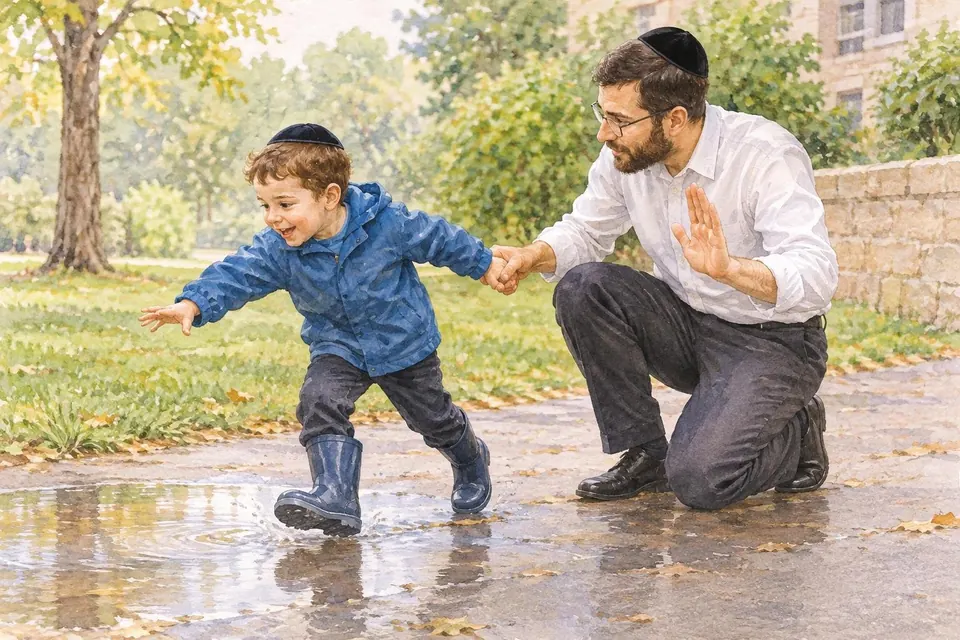
The way God handled this situation can teach us an important principle about raising children. Sometimes children want to do something that seems entirely unacceptable to their parents. Our parental instinct tells us to protect our children from mistakes and do everything possible to make them abandon their plans. We tell ourselves that our duty in this world is to educate them, and that doing so sometimes requires us to say “no.”
But is it always right to forbid something? The episode of the spies teaches us that in some cases we should give way, even when we know for certain that our children are on the wrong path.
God saw that the people were simply not ready to accept His refusal. If Moses had returned with a negative answer, they would have challenged him: How can we go to war without first sending spies? Everyone knows that you cannot go to war without scouting the terrain and the enemy.
If the people of Israel had been on a high enough spiritual level to accept God’s refusal, He would certainly have said “no.” But He saw that they could not accept a refusal wholeheartedly and with complete faith, so He did not refuse them.
Raising children consists, for the most part, not of giving instructions but of making concessions. Sometimes our children are ready to hear “no.” At other times, they are so determined to do what they have planned that they are simply unable to hear and accept a refusal.
The Talmud expresses this idea clearly: “Just as it is a mitzvah to say something that will be heeded, so too it is a mitzvah to refrain from saying something that will not be heeded” (Yevamot 65b).
The following story illustrates how this principle works.
The Boxing Broadcast#
Once, some young men came to the head of their yeshiva and asked him to change their study schedule for just one night. They wanted to recite the evening prayer earlier than usual. When the head of the yeshiva asked why they wanted to pray before the scheduled time, they explained that an important boxing match would be broadcast on the radio that evening (the story took place in America 70 years ago), and they wanted to listen to the entire broadcast. If they prayed at the usual time, they would miss half of it.
The request was clearly inappropriate: Listening to a boxing broadcast was not a fitting activity for a yeshiva student.
The head of the yeshiva later recalled: “I realized that if I refused, they simply wouldn’t understand why I had treated them so harshly. They had grown up in America, where they were used to seeing the most respected and distinguished people travel from all over the country just to attend these matches. In the modern American society in which these young men grew up, watching or listening to a live broadcast of two grown men beating each other in a ring was a perfectly normal pastime—a form of cultural entertainment. So I decided that until the young men understood for themselves why I could and should have refused their request, it would be better to let them pray early and listen to the broadcast.
“How could such a thing happen in the world of Torah, you might ask? You have to understand the realities in which this conversation took place. America, with its tolerance of everyone and everything, has made many things that are clear to us completely confusing. The young men had come to the yeshiva from all over the country and from many different communities. Many had previously attended secular schools. Torah had not yet filled them so completely that there was no room left for anything foreign or foolish.”
Of course, in many cases the right thing for parents and teachers to do is to say “no.” But in the case described above, the head of the yeshiva learned a lesson from the greatest Teacher. If God allowed the people of Israel to do something He considered wrong because they would not accept a refusal, then the head of a yeshiva must also find the wisdom to do the same at the right moment.
[Editor’s note: The parenting question discussed here is subtle and profound. What the Torah forbids certainly cannot be permitted. Our general advice is to seek ongoing guidance from a rabbi competent in these matters.]
By Rabbi Yissocher Frand
Keep reading
More →Matot-Masei: Children or Money?
Moses challenges two tribes to reconsider what comes first: their property or their children.
FamilyHow Much Must You Honor Your Parents?
Parashat Vaetchanan and a Talmudic story reveal the depth of the mitzvah to honor parents.
FamilyIs Hospitality Greater Than Greeting the Shechinah?
Abraham’s rush to welcome travelers offers a window into the greatness of hospitality.
FamilyChovat Hatalmidim: Revealing a Child’s Soul
The Piaseczner Rebbe explains how education can nurture each child’s individual nature and spiritual potential.







