Chayei Sarah: What Makes Money Kosher?
Abraham’s coin offers a lesson in both generosity and honesty.
In brief
- Abraham’s coin alludes to both kindness and fear of God.
- Giving to charity does not make up for dishonest business practices or unpaid debts.
- The Vilna Gaon taught that keeping property that does not belong to us can affect our Torah study.
- A story about Rabbi Chaim of Volozhin illustrates the seriousness of an unpaid debt.
Parashat Chayei Sarah#
“Abraham was old…” (Genesis 24:1).
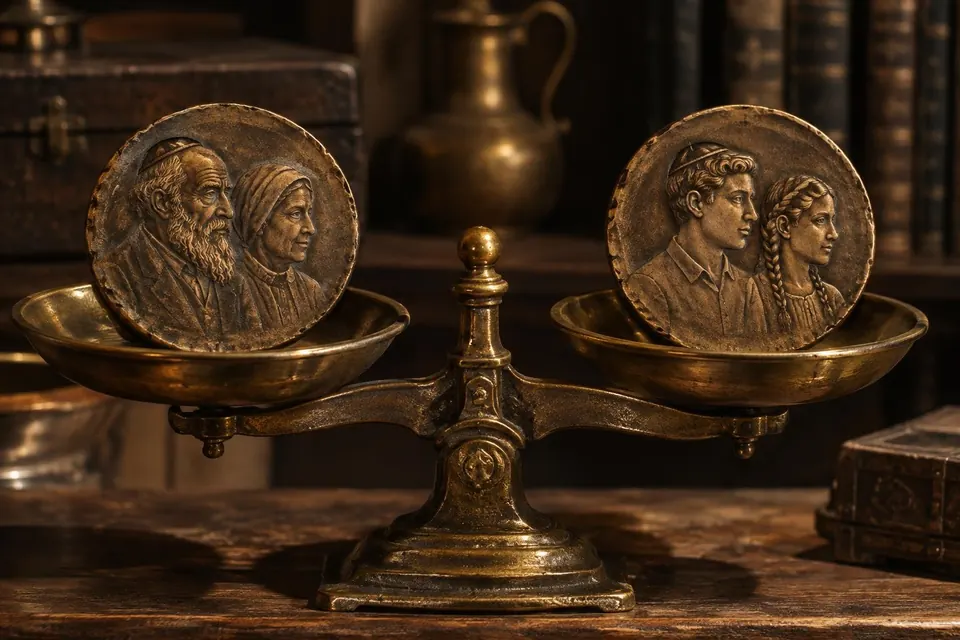
Our holy Sages ask: “What did the coin minted by our forefather Abraham look like? On one side were an old man and an old woman; on the other, a young man and a young woman” (Bava Kamma 97b). The straightforward explanation is that Abraham was a king, and kings customarily minted coins bearing the royal stamp. One side of Abraham’s coin bore images of an old man and woman, Abraham and Sarah. The other bore a young man and woman, Isaac and Rebecca.
Beyond this straightforward explanation, there is also a hint. Abraham apparently wanted to teach people what “kosher” wealth is. Abraham was known above all for his kindness, as we learn from the story of the angels he welcomed as guests. Isaac, by contrast, was known for his fear of God, as the verse says, “the Fear of Isaac” [Genesis 31:42].
This is the hint: On one side are the old man and woman. Money is given to us so that we can use it to show kindness and help others. But doing good deeds and mitzvot with our wealth is not enough. On the other side of the coin are the young man and woman. They hint that we also need fear of God in business: Our wealth must be free of sin, especially theft and robbery (gezel). Only such a “kosher” coin is the coin of our forefather Abraham.
Many people make a mistake about this. They think that if they give money to charity, to the synagogue, and so on, it is not so bad if their business dealings are not entirely aboveboard. Or they think it is not such a serious offense to pay small debts late, or even to forget about them altogether. But Abraham teaches us that a coin can be kosher only if it is accompanied by Isaac’s quality as well: fear of God and fear of sin.
This applies to every one of us, including those who have been privileged to spend several hours a day in the beit midrash (study hall).
The Vilna Gaon said that someone who studies Torah will see no blessing in their study if their home contains even one nail that does not rightfully belong to them under Torah law. How frightening these words are.
A story from the time of the great Rabbi Chaim of Volozhin gives us some sense of how serious the prohibition against gezel is. One of the yeshiva students became gravely ill and traveled home. On the way, he stopped for the night at a small inn. In the morning, when it was time to pay the innkeeper, the young man discovered that he was seven kopecks short of the amount the innkeeper asked for. He promised to repay the small debt at the first opportunity, and the innkeeper agreed.
When he arrived home, the young man gave the seven kopecks to a friend, also a student at the Volozhin yeshiva, to pay the innkeeper on his way back to the yeshiva. But the friend forgot to do so.
A short time later, the sick young man died. One night, after midnight, Rabbi Chaim was walking down a corridor in the yeshiva when he suddenly saw the deceased young man coming toward him. Rabbi Chaim greeted him and asked, “What judgment were you given?”
The young man replied that when he came before the heavenly court, he was found to be completely free of sin, and it was decreed that he would go to the Garden of Eden. But when he reached its gates, Satan blocked his way and would not let him enter, because he had violated the prohibition against gezel: He had not repaid the seven kopecks to the innkeeper. It did not matter whether he was at fault; in the end, the debt had not been paid.
The heavenly court had therefore granted him exceptional permission to descend to this world in the form of a living person and ask the rabbi to arrange payment of the debt, so that he could enter his place of rest. That same morning, Rabbi Chaim summoned the friend and instructed him to travel immediately and pay the debt. After that, the young man did not appear again.
By Rabbi Shimshon Pincus
Keep reading
More →Why Was the Manna a Test?
In Parashat Eikev, the manna reveals that abundance can be a test as well as a blessing.
Guide · Work and MoneyWhen Must You Pay a Worker Under Jewish Law?
- Basic Principles
- The Payment Deadline
- Work Ordered From a Craftsperson
Is Wealth a Harder Test Than Poverty?
The story of Abraham and Lot offers a lesson about the spiritual challenges of poverty and wealth.
Work and MoneyWhy Did Abraham Stay at the Same Inns?
Abraham’s return journey offers a lesson about wealth and the comforts we choose.







