Behar: Do Not Hurt One Another
Stories of great rabbis show how carefully they guarded the feelings of others.
In brief
- The Torah forbids causing another person pain through words or actions.
- The Sages sometimes gave up a benefit to avoid causing someone distress indirectly.
- Several rabbis were careful not to disturb another person's sleep, even for the sake of a mitzvah.
- Maimonides writes that the prohibition applies to children as well as adults.
Parashat Behar#
“Do not wrong one another” (Leviticus 25:17).
A Letter Left Unsent#
There is a well-known story about Rabbi Baruch Ber Leibowitz of Kamenetz. He once asked a student at his yeshiva to send a letter to his disciple Rabbi Yonah Karpilov of Minsk, author of Yonat Elem, who was studying at the Mir yeshiva. The letter was to ask Rabbi Yonah to come and help Rabbi Baruch Ber write down his lectures and prepare them for publication. Rabbi Yonah was the most qualified person for the task.
Rabbi Yonah was one of Rabbi Baruch Ber’s closest disciples and one of the few who fully understood his profound lectures. He had gone to study at Mir, where he and the great Rabbi Aryeh Leib Malin were among the outstanding students. Later, the two went to Brisk to study with the rabbi of Brisk, then returned to the yeshiva to spread his approach to Torah study.
Now Rabbi Baruch Ber had asked Rabbi Yonah to come to Kamenetz to help publish his book. Rabbi Baruch Ber based his Torah insights on very subtle concepts, and he delivered his lectures in Yiddish, the everyday language. It took a special literary talent to convey his ideas accurately without missing what was essential.
The next day, Rabbi Baruch Ber called the student and asked whether he had sent the letter. The student apologized: he had written it, but had not yet sent it. Rabbi Baruch Ber smiled with relief, as though a weight had been lifted from his shoulders. “If you haven’t sent it yet, don’t send it.”
“Why?” the student asked in surprise.
“Honestly,” the head of the yeshiva replied, “there is no one like Rabbi Yonah when it comes to preparing the book. It would be a great benefit to many people, helping them understand the lectures in depth. But if people see that I asked someone from the Mir yeshiva to come, several of our best students will be upset. They’ll think, ‘Are we so incapable of writing down the lectures that he needs to call a student from Mir?’ So I decided not to invite him.”
You might think this was an example of Rabbi Baruch Ber’s extraordinary righteousness. But it is actually Torah law. Had he not acted this way, he would have violated a Torah prohibition: “Do not wrong one another” (Leviticus 25:17). It is forbidden to cause anyone distress, whether by words or by actions (see Rabbeinu Yonah, Iggeret Hateshuvah). Sefer HaChinuch says: “Do not cause people pain in any way, and do not do anything that will make them ashamed” (mitzvah 338).
But we need to examine this. Where do we find that a person must give up a great benefit to many—and the opportunity to bring merit to them—merely to avoid causing another person even a little distress, when that distress is not intended but is only a side effect of the action?
Giving Up a Benefit to Avoid Causing Pain#
We see that Rabbi Baruch Ber did just that. Where did he find a source for this conduct? In the Talmud, in Berakhot 27b.
The Sages decided to remove Rabban Gamliel from his position because of his dispute with Rabbi Yehoshua. And remember, “the Sages of the earlier generations are like angels” [Shabbat 112b]; we have no idea what their disputes were like. The question arose: Who would be appointed in his place as nasi, the head of the Sanhedrin?
“Whom shall we appoint? Rabbi Yehoshua? But he is a baal hamaase,” a person involved in the incident. In other words, Rabban Gamliel had been removed because of what happened with him. Rashi comments: “If Rabbi Yehoshua is appointed, Rabban Gamliel will suffer even greater distress.”
The Meiri writes: “Even when it becomes necessary to remove a respected person from a position because of a dispute or the like, it is improper to appoint the person who was the cause of his removal, even if that person is worthy of the position. For the person who was removed will then be deeply distressed. That is why it says here: ‘Whom shall we appoint? Rabbi Yehoshua? But he is a person involved in the incident.’”
We find something similar in the story of Korach: “Tell Eleazar, son of Aaron the priest, to take the fire pans out of the fire, and scatter the coals away” [Numbers 17:2]. God did not wish to say this to Aaron himself, in order to teach him how to behave ethically in such a situation.
At first glance, there is a difference. In the case of the fire pans, the relatives of the families who disputed Aaron would be distressed if Aaron himself took them out. Yet it made no particular difference whether Aaron or Eleazar took them. But the question of who would be nasi was different.
Rabbi Yehoshua was the greatest sage of his generation at the time. He headed Rabban Gamliel’s rabbinical court, and Rabban Gamliel himself was amazed by his extraordinary wisdom. Rabbi Yehoshua was great in both the revealed and the hidden aspects of Torah. He had also been a disciple of Rabban Yochanan ben Zakkai in the days of the Temple and had served there as one of the Levite singers. All these facts appear in various Talmudic tractates. What a loss it would be for the entire people of Israel to elect a nasi who was less knowledgeable and wise in Torah than Rabbi Yehoshua.
Nevertheless, it was worth giving up all this great benefit and appointing Rabbi Elazar ben Azariah, who was a generation younger than Rabbi Yehoshua (see Tosafot on Shabbat 54b), so as not to hurt Rabban Gamliel’s feelings indirectly.
Berakhot 50a tells us that our teachers ate with the rosh hagolah, the head of the Diaspora community, and recited a separate zimun, the invitation to join in the blessing after a meal, as a group of three. Why did they not recite a separate zimun as a group of 10? Because a separate zimun of 10 would have upset the head of the Diaspora community.
The Rashba writes: “Since it would be unpleasant for him, there is an element of disrespect in doing it. And respect for a person is so important that it takes precedence even over a rabbinic mitzvah (Berakhot 19b), and a zimun of 10 is a rabbinic mitzvah.”
Here, too, it was worth forgoing a zimun that includes the Creator’s name so as not to distress a person, even indirectly.
Protecting Another Person’s Sleep#
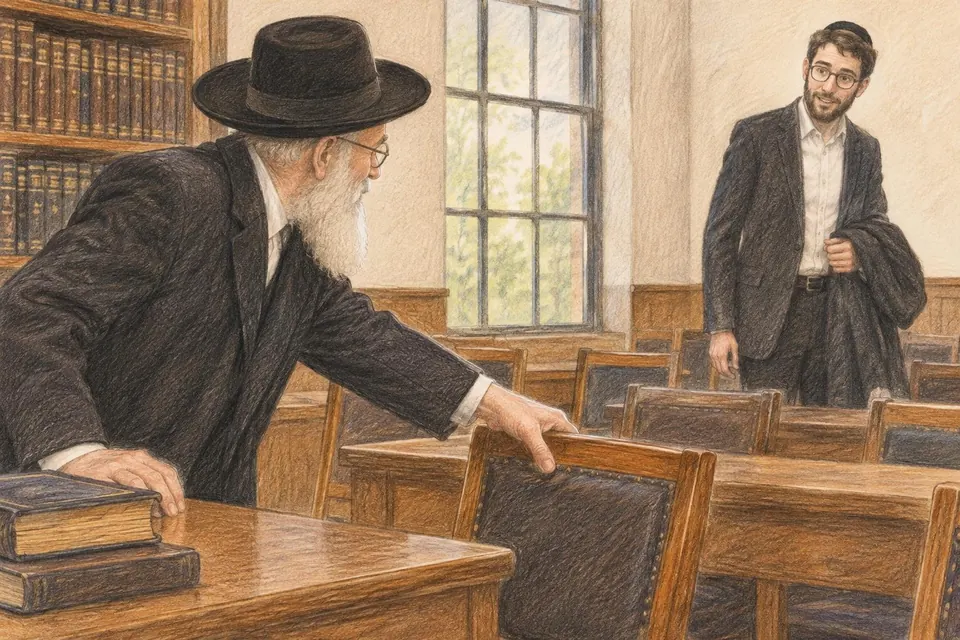
A married yeshiva student once told me that, as a young man, he had the privilege of spending the night in the room of Rabbi Yehudah Segal, the head of the Manchester yeshiva. He had prepared a cup and basin beside his bed for washing his hands in the morning. He was surprised when Rabbi Segal rose before him and left the room to wash his hands.
When he asked about it, Rabbi Yehudah explained: “The author of Shevut Yaakov rules that, in a case of great need, one may regard the entire house as though it were within four cubits and walk to the bathroom. But ‘stealing’ a person’s sleep is a Torah prohibition. How can I be stringent? That would be performing a mitzvah through a sin.”
Rabbi Chaim Kanievsky did say that the idea of “stealing sleep” is a new concept from mussar, Jewish ethical teaching. But disturbing a person’s sleep certainly causes distress. Rabbi Yisrael Salanter once told his disciple Rabbi Naftali Zilberberg that one should postpone washing one’s hands in the morning, a rabbinic mitzvah, if it will disturb someone else’s sleep, because disturbing him violates a Torah prohibition.
There is another well-known story. One Sukkot, Rabbi Naftali Berlin of Volozhin noticed that his grandson, Rabbi Chaim of Brisk, was not saying the blessing over the etrog as he did every year. When the rabbi asked his grandson about it, Rabbi Chaim explained that the etrog was from the Land of Israel and had been brought out at the end of the seventh year, whereas it is forbidden to take seventh-year produce out of the Holy Land (Mishnah Sheviit 6:5).
“If so,” Rabbi Naftali said, “there is a question about my etrog too.” And he went home.
Toward morning, someone knocked on the door of Rabbi Chaim’s sukkah. “Your grandfather is calling for you.” Alarmed, Rabbi Chaim jumped up, washed his hands, and ran to Rabbi Naftali’s sukkah. He found his grandfather bent over his books.
When Rabbi Naftali saw him, he announced, “I’ve found a sound way to explain how this etrog can be kosher and the blessing can be said over it,” and began sharing his insights. Rabbi Chaim apologized and interrupted him, saying that he first had to say the blessings over Torah study.
He began to recite them and suddenly noticed that his grandfather was weeping bitterly. “What happened?” he asked anxiously.
Rabbi Naftali replied, “If I had known you were asleep, I would never have sent for you and woken you. But I couldn’t imagine that at four in the morning you would still be asleep.”
Children’s Feelings Matter Too#
Maimonides (the Rambam) stresses that the prohibition against causing distress to a Jew applies “to both the young and the old” (Maimonides, Laws of Character Traits 6:8). He puts “the young” first, unlike the usual order, because young children cannot grant forgiveness. (Translator’s note: Under Torah law, one can ask for and receive forgiveness only from someone who has reached the age of legal adulthood.)
Rabbi Moshe Aharon Stern, the spiritual mentor of the Kamenetz yeshiva, once prayed on Shabbat with the minyan, the prayer quorum, at Rabbi Chaim of Brisk’s home. Rabbi Stern’s five-year-old son fell asleep on Rabbi Chaim’s bed.
At the end of the prayers, Rabbi Stern went over to wake the boy, but the rabbi told him, “Don’t wake him.”
Rabbi Stern explained, “I don’t carry things in the street”—apparently, he did not rely on the existing eruv, an arrangement that permits carrying in an enclosed area on Shabbat—“and my son carries the handkerchiefs for both of us.”
Rabbi Chaim looked at him reproachfully. “Because you want to be stringent, should a child have to be woken from his sleep?”
By Rabbi Yaakov Galinsky
Keep reading
More →Vaera: The Soccer Player and the Magician
A story about a soccer player helps explain why seeing something can affect us more deeply than knowing it.
CharacterLashon Hara and Free Speech: Life and Death in the Tongue
Jewish teachings on the power of speech challenge us to consider how we use our words.
ParashaBehaalotecha: What Makes a Response to Tragedy Cruel?
Maimonides calls it cruel to dismiss communal tragedy as simply part of life.
ParashaKorach: Who Wins an Argument?
Moses’ response to a painful accusation offers a lesson in walking away from conflict.







