Chukat: Appreciate Your Loved Ones
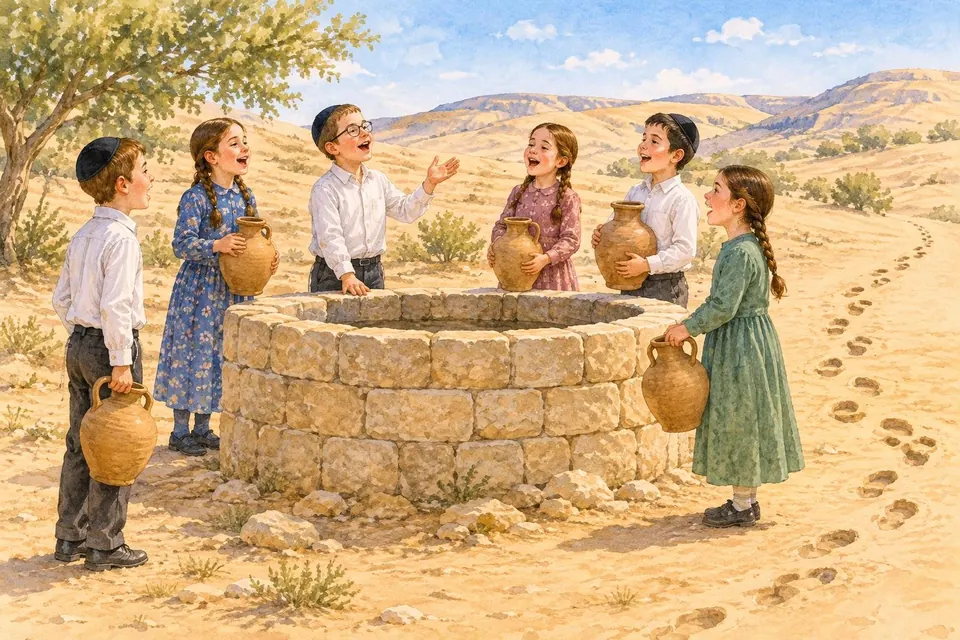
The Song of the Well offers a lesson about recognizing the people we take for granted.
In brief
- The Israelites sang about the well near the end of their journey through the wilderness.
- The well had provided water in Miriam's merit and disappeared after her death.
- Moses appreciated Miriam throughout her life, without waiting for the well to disappear.
- We should appreciate our loved ones now, rather than wait until we lose them.
Parashat Chukat#
Our weekly Torah portion contains the Song of the Well. There is something beautiful about the way our people’s journey together in the wilderness begins with a song, in the portion of Beshalach, and essentially ends with a song, in our portion of Chukat. Although we read Chukat only a short time after the portion of Shelach, the events in Chukat actually took place almost 40 years later, at the end of the journey through the wilderness, when the punishment for the sin of the spies was nearly over.
There are two fundamental differences between the song sung after the splitting of the sea and the Song of the Well. The Song of the Sea begins, “Then Moses and the Israelites sang this song” (Exodus 15:1). The Song of the Well begins, “Then Israel sang this song” (Numbers 21:17), without mentioning Moses.
The second difference is in the subject of each song. The well was a miracle that was constantly present in the Israelite camp throughout the Jewish people’s journey in the wilderness, while the splitting of the sea was a one-time event. The Song of the Sea was sung in an outpouring of gratitude to the Creator for an unprecedented miracle. Yet it took 40 long years to recognize the miracle of the well and praise the Creator for it.
To understand both differences, let us look carefully at the Torah portion, which also tells us about Miriam’s death. The Sages say that the well was given to the Jewish people in Miriam’s merit. When Miriam passed away, the well disappeared too, and it took another miracle, performed by God through Moses, for the Israelites to have water again.
Only when the well stopped supplying water and disappeared altogether could the Israelites truly appreciate what Miriam had done for them. We have to acknowledge that taking what we have for granted is part of human nature. When we turn on a faucet, we naturally expect water to flow. We do not stop to think that this is the result of the work of hundreds and thousands of people and a vast infrastructure that draws water and brings it into our homes. It does not seem miraculous to us that water flows from the faucet in every home at any time—all we have to do is turn it on.
Now imagine that the Jews had much the same attitude toward the rock that supplied them with water without interruption, in the middle of the wilderness. We would probably have grown used to it too. And surely our children, who grew up with it, would not even be able to imagine things being any other way. But when Miriam died and the people saw that the source of water had disappeared too, everyone realized what they had lost. Perhaps they even said to one another, “Just think what a great miracle we had in Miriam’s merit all these years!”
We can now understand that the Song of the Well is not so much a song about the well itself as a tribute to Miriam, in whose merit the well existed. People take their loved ones for granted and generally begin to appreciate them only when they lose them.
Human nature is imperfect. In his righteousness and wisdom, Moses appreciated Miriam throughout his life. He did not need to wait for the well to disappear to understand what she had done for the Jewish people all those years. He did not need to wait 40 years to recognize Miriam’s merit. Moses was not suddenly inspired 40 years later. Unfortunately, the same cannot be said for everyone else. The people first decided to sing the Song of the Well when it was gone: “Then Israel sang this song.” It is a very sad fact of human nature that we do not appreciate those close to us until they leave us. Each of us should think about this and start appreciating our loved ones, today and right now.
By Rabbi Yissocher Frand
Keep reading
More →Acharei Mot–Kedoshim: The Advice of a True Doctor
A Torah perspective on medical advice, hope, prayer, and the difficult work of giving and receiving warnings.
ParashaShelach: True Greatness Is Not Arrogance
The spies’ report offers a lesson in self-confidence, dignity, and humility.
ParashaChukat: Transition Periods in Life
Rabbi Yissocher Frand explores why times of change call for special care toward ourselves and our families.
ParashaBalaam and Rabbi Yose ben Kisma: A Lesson About Greed
Three explanations reveal the difference between two seemingly similar responses to wealth.







