Haazinu: Who Is Wise?
Rabbi Yaakov Galinsky explores how small concessions to the evil inclination can grow into a mountain.
In brief
- A wise person looks ahead to the consequences of their actions.
- The evil inclination can grow from something as thin as a hair into a mountain.
- At Jacob’s funeral, Hushim saw the indignity that others had come to accept.
- The Days of Awe invite us to look honestly at where our choices have led us.
Parashat Haazinu
“Is this how you repay God, you vile and unwise people?” (Deuteronomy 32:6).
Rashi explains that they are unwise because they do not foresee the consequences. As the Sages say, “Who is wise? The one who foresees the consequences” [Tamid 32a]. The two qualities are connected: a person who sees the consequences of their actions will not be vile.
This is the difference between a righteous person and a wicked one. The Talmud tells us that in the future, God will bring the yetzer hara (the evil inclination) and “slaughter” it in the presence of both the righteous and the wicked. To the righteous, it will look like a high, steep mountain; to the wicked, it will look like a thin hair (Sukkah 52a).
How can this be? The righteous and the wicked are standing together, looking at the very same yetzer hara. How can one group see it one way and the other see it differently? Which of them is right? What does it really look like?
The Alter of Novardok explained: “It is very simple. It is a mountain—a mountain of hairs.” What an astonishingly precise description.
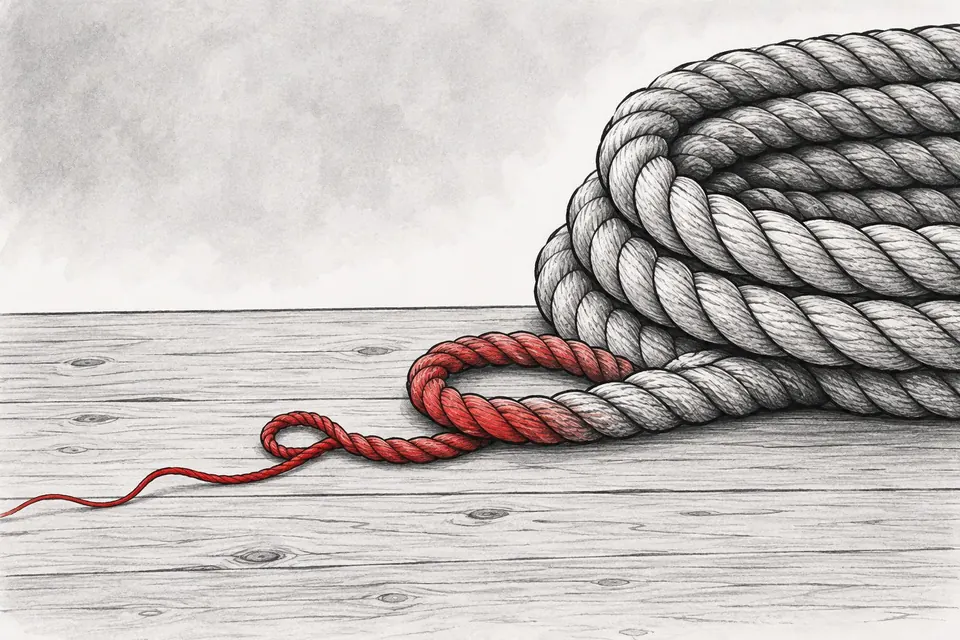
The Talmud says just this: “At first, the yetzer hara is like a spider’s thread, and in the end”—after a person follows it and it grows ever stronger—“it is like the ropes of a wagon, as it is said: ‘Woe to those who draw iniquity with cords of falsehood, and sin as with wagon ropes’” (Sukkah 52a; Isaiah 5:18).
It starts out like a thin strand of straw and ends up like ropes strong enough to pull a loaded wagon. And what are those ropes made of? Many strands woven together.
If a person commits one sin, even the most terrible one, they will hurry to repent. But if they sin once and then a second time, it begins to seem permissible to them (Kiddushin 20a). Then they will not do teshuvah, or repent. After all, who repents for something permitted?
And what if they sin a third time? In Novardok they used to say: Now they feel it is a mitzvah.
That is why “the one who foresees the consequences” is wise. They understand that “this is the way of the evil inclination. Today it tells a person, ‘Do this,’ and tomorrow it says, ‘Do that,’ until it tells them, ‘Now go and worship idols,’ and they go and worship them” (Shabbat 105b).
This, says the Alter of Novardok, is the meaning of the teaching that God “held the mountain over them like an upturned tub” when He gave the Torah. God showed them in the clearest possible way that they must keep all the commandments and avoid all sins. If they yielded to temptation by even a hair’s breadth, they would start down a slippery slope, with no way to imagine where they might end up.
How profound are the words of our Sages: “He said to them: If you accept the Torah, well and good. But if not, there will be your burial place” (Shabbat 88a). There is something puzzling here. Should it not say, “Here will be your burial place”?
But right now it is only a thin hair. Today the evil inclination tells you to move away just a hair’s breadth. Tomorrow it will tell you to move farther, to do this and that, until it becomes an enormous mountain. And there will be your burial place.
Let us recall the story of the funeral of our forefather Jacob (Sotah 13a). When his sons came to bury him in the Cave of Machpelah, they found Esau there, blocking their entry. He said, “Kiryat Arba is Hebron” (Genesis 35:27). This meant that the cave had room for four couples: arba means “four.” Adam and Eve, Abraham and Sarah, and Isaac and Rebecca were already buried there. Two places remained. Jacob had buried Leah in the cave, so the last place, Esau argued, was his.
They replied, “You sold it.”
“I sold my birthright,” Esau said, “but the place belongs to me as Jacob’s brother.”
The brothers answered, “You sold your portion in the Cave of Machpelah, as it is said: ‘Bury me in the grave I acquired for myself in the land of Canaan’” (Genesis 50:5). Rashi explains that Jacob took all the gold and silver he had brought from Laban’s home and said to Esau, “Take all this in exchange for your place in the Cave of Machpelah”.
“Show me the bill of sale,” Esau demanded. But the document had been left in Egypt. Who would go to Egypt to bring it? Naphtali, who could run as fast as a deer.
Naphtali set off, and everyone stayed to wait. Among those accompanying Jacob was Hushim, the son of Dan, who was very hard of hearing. He saw that the funeral was being delayed and asked what was holding it up. They explained that Esau would not let them bury Jacob until he was shown the document recording the sale of his portion of the cave, and that Naphtali had run to fetch it.
“What?” Hushim protested. “Until Naphtali comes back, is my father’s father going to lie here in disgrace?” Without hesitation, he took a club and struck Esau on the head. Now Jacob could be buried. In this way, Rebecca’s prophecy was fulfilled: “Why should I lose both of you in one day?” (Genesis 27:45).
Rabbi Chaim Shmulevitz asks: “Proverbs says, ‘Do not stand in the place of the great’ [Proverbs 25:6]. All the tribes of Israel were present at the funeral—Hushim’s father and his uncles. They all stood there waiting patiently. Why was Hushim alone moved to ask, ‘Until Naphtali comes back, is my grandfather going to lie here in disgrace?’
“This was sheer wickedness. Esau knew perfectly well that he had received a great deal of gold and silver for the plot, had agreed to the sale, and had even signed the document. How brazen of him to hold up the funeral.
“Why did everyone remain silent, while only Hushim protested?
“The answer is that he was deaf.
“If Esau had come and physically blocked the entrance to the cave, they would have swept him aside at once. But he merely raised an objection, and they answered it. He challenged their answer, and they challenged his: You sold your place for the full price. He demanded that they produce the document. Where was it? In Egypt. Well, they would wait until it was brought. They sent Naphtali.
“What was happening? They were negotiating, until they sent Naphtali to Egypt. Meanwhile, our forefather Jacob lay there waiting.
“Hushim was deaf. He had not heard the whole argument. He saw only the result: His grandfather was lying there in disgrace.”
King Solomon said of this: “My son, if sinners entice you, do not give in” (Proverbs 1:10). The holy Alshich comments: Do not even agree to talk with them. The holy Or HaChaim likewise says: Do not negotiate with your temptations (Or HaChaim on Leviticus 18:2). It all begins with a single hair, and then another and another—and you do not know where you will find yourself in the end.
This is the essence of the Days of Awe. What happened to us over the past year? We emerged from the last Yom Kippur as clean as the first snow, and a voice from Heaven proclaimed: “Go, eat your bread with joy and drink your wine with a contented heart, for God has already found favor in your deeds” (Ecclesiastes 9:7). Then we sat in the sukkah, the cloud of faithfulness to the Creator, and rejoiced on Simchat Torah.
So how did we descend to where we are now? How did we find ourselves buried beneath a mountain? Very simply: one hair at a time.
Let us act like Hushim, son of Dan. Let us step away from the chain of justifications and explanations and look objectively at our situation: It is we ourselves who are lying there in disgrace. Let us take a club and smash our own “Esau” to pieces.
By Rabbi Yaakov Galinsky
Keep reading
More →Vaera: The Soccer Player and the Magician
A story about a soccer player helps explain why seeing something can affect us more deeply than knowing it.
CharacterLashon Hara and Free Speech: Life and Death in the Tongue
Jewish teachings on the power of speech challenge us to consider how we use our words.
ParashaBehaalotecha: What Makes a Response to Tragedy Cruel?
Maimonides calls it cruel to dismiss communal tragedy as simply part of life.
ParashaKorach: Who Wins an Argument?
Moses’ response to a painful accusation offers a lesson in walking away from conflict.







