Tetzaveh: Why Is the Jewish Table Like an Altar?
Parashat Tetzaveh connects the holiness of the Tabernacle with the way we eat today.
In brief
- The Tabernacle brought God’s presence to the people of Israel.
- The homes of the patriarchs and matriarchs were also places of divine presence.
- The table is compared to an altar, and food to an offering.
- The way a person says Grace After Meals can reveal the holiness of their meal.
Parashat Tetzaveh#
At the end of the description of the Tabernacle and the garments of the kohanim, the priests, our portion says: “There I will meet with the children of Israel, and it will be sanctified by My glory. I will sanctify the Tent of Meeting and the altar, and I will sanctify Aaron and his sons to serve Me as priests. I will dwell among the children of Israel and be their God” [Exodus 29:43–45]. Through the Tabernacle, the Shechinah (God’s presence) would dwell among all the people of Israel (the Malbim).
Nachmanides (the Ramban), in his introduction to Exodus, the book of exile and Redemption, writes:
Exile does not end until the day everyone returns to their place and to the spiritual level of their ancestors.
When they left Egypt, although they had left the house of slavery, they were still considered to be in exile. They were in a foreign land, wandering in the wilderness.
But when they came to Mount Sinai, built the Tabernacle, and God once again brought His Shechinah down upon them, they returned to the spiritual level of their ancestors. The divine mystery rested over their tents, and they themselves were chariots for the Shechinah. Only then were they considered redeemed. That is why this book ends with the construction of the Tabernacle and the glory of God filling it at all times.
This is astounding!
Our Sages tell us that in the tent of our matriarchs, a candle burned from one Shabbat eve to the next, the dough was blessed—that is, it grew out of proportion to the amount of flour—and a cloud hung over the tent (Rashi on Genesis 24:67). Shem Mishmuel (Chayei Sarah, 5671) says that this is precisely what Nachmanides meant by “the divine mystery rested over their tents”: their home was like the Tabernacle.
More than that, the presence of the Shechinah in the Tabernacle was like its presence in the tents of the patriarchs: “The lesser attaches itself to the greater” (Taanit 7a; Bava Batra 12a).
The candle that burned from one Shabbat eve to the next was like the western lamp, which did not go out (Bava Kamma 21b). As our portion, Tetzaveh, says, “to kindle a lamp continually” [Exodus 27:20], according to Nachmanides’ commentary (Torat Kohanim, Emor 13). The blessing on the dough was like the blessing on the dough of the showbread: each kohen who ate a kezayit (an olive’s volume) was satisfied, and some were satisfied with even less (Yoma 39a). Through the showbread, satisfaction came down to the world (Nachmanides on Exodus 25:24). That is why the bread was hot when it was taken away (1 Samuel 21:7). Though it had been in the Tabernacle for a week, it was as hot as when it was baked, because its influence was continuous. And the cloud hanging over the tent was the presence of the Shechinah, just as God’s glory filled the Tabernacle.
All this is included in the command and obligation: “Every person—every person!—in Israel is obligated—obligated!—to say: When will my deeds reach the level of the deeds of my ancestors Abraham, Isaac, and Jacob?” (Tanna Devei Eliyahu Rabbah 25). What level? “The divine mystery rested over their tents”!
How Can We Reach Such a Level?#
As we have said, when the Tabernacle and the Temple stood, the Shechinah spread through them to all the people of Israel. But what about today?
Today, the Talmud says explicitly: “When the Temple stood, the altar atoned for a person. Now a person’s table atones for them” (Berakhot 55a; Chagigah 27a).
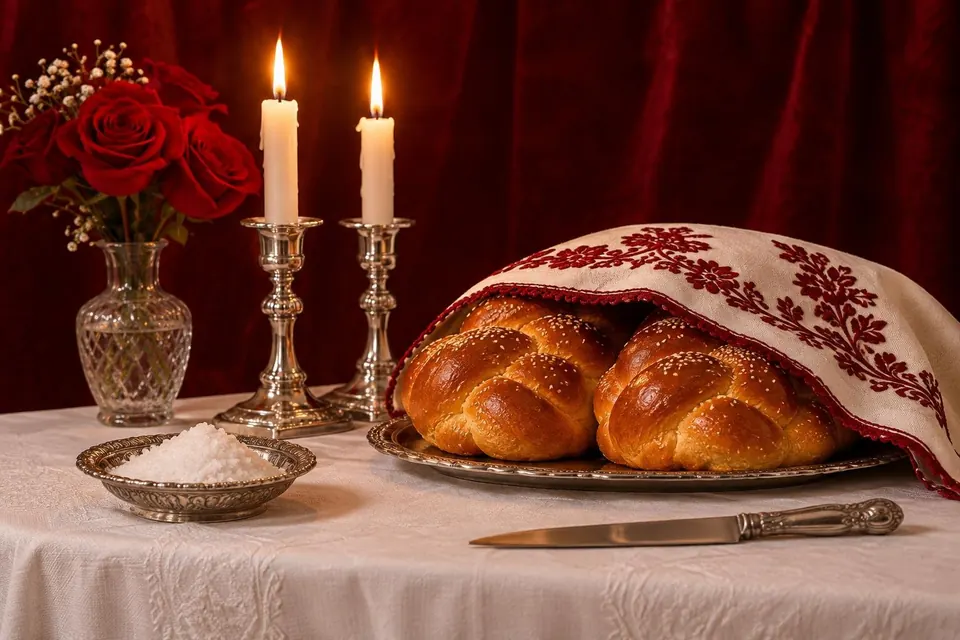
That is why the Rema (Rabbi Moshe Isserles) says: “It is a mitzvah to put salt on every table before cutting the bread, because the table is like an altar and the meal is like an offering, as it says: ‘With every offering, bring salt’” (Shulchan Aruch, Orach Chaim 167; Leviticus 2:13).
That is also why “it is customary to cover the knife during Grace After Meals” (Shulchan Aruch, Orach Chaim 180:5). Iron is forbidden on the altar—its stones may not be worked with iron—and the table is like an altar.
For the same reason, there is a mitzvah to say a blessing over a whole loaf and a full cup, just as it says of the stones of the altar: “Build the altar of the Lord your God of whole stones” (Deuteronomy 27:6).
The table, then, is like an altar, and food, as the Rema writes (Shulchan Aruch, Orach Chaim 167:5), is like an offering.
The Mishnah Berurah (167:31) explains that a person eats to regain strength and, through food, to be healthy and strong enough to serve God. In this way, eating itself becomes part of serving the Creator. This is also the meaning of the statement that non-Jews bring only burnt offerings, while Jews also bring peace offerings, from which those who bring the offering eat in holiness (Zevachim 116a). For the ability to eat for the sake of Heaven is the distinctive share of Israel.
Torat Chaim (Sanhedrin 102b) says that because food is like an offering, bread is cut from the place where it first began to bake, just as the first fruits brought as an offering were from the first of the harvest. A piece of bread is cut off and not eaten whole, just as a visible remainder had to be left when setting aside terumah (a portion given to a priest) (Chullin 136b).
If the table is like an altar and food is like an offering, then the person eating is like a kohen serving in the Temple. As the holy author of Shnei Luchot HaBrit wrote (Shaar HaOtiyot, Kedushat HaAchilah), this is why we raise our hands after washing them, just as kohanim raise their hands during the priestly blessing: the person who eats becomes like a kohen performing the Temple service.
The Chatam Sofer writes (Torat Moshe, Vayikra 97) that when the table is like an altar, the food like an offering, and the person eating like a kohen, the whole home is like the Temple.
But how can a person understand the way they eat? How can they make their meal like an offering and their table like an altar? I found a “measuring scale” for this, and a way to achieve it.
We have already mentioned the Shulchan Aruch’s statement that it is customary to cover the knife during Grace After Meals. The reason is that the table is like an altar, and iron may not be brought onto the altar (see Rokeach 332, in the name of Beit Yosef). It is not fitting to bring iron, which shortens human life, onto the altar, which lengthens human life (Mekhilta 11:8).
At first, this is puzzling. If a person’s table is like the altar, which atones for sins, then a knife should not be placed on it during the meal. Why, then, is the knife covered only during Grace After Meals?
Here we discover a remarkable idea: the table is like an altar only because one eats in holiness before God, as it says: “The altar was of wood ... and he said to me: This is the table that is before God” (Ezekiel 41:22).
The Maharsha writes (Berakhot 10b) that the woman of Shunem realized that the prophet Elisha was a holy man when she saw that flies did not approach his table. Similarly, not a single fly was seen in the Temple courtyard. Elisha’s table was like an altar because of the holiness with which he ate.
How, then, can we measure how much holiness a person brought to a meal, and how much their table resembled an altar? By looking at how they say Grace After Meals.
To that same extent, their home will be a dwelling place for the Shechinah.
By Rabbi Yaakov Galinsky
Keep reading
More →How to Make Havdalah on Wine
A guide to the wine and cup used for Havdalah after Shabbat and holidays.

Keeping Shabbat During the Holocaust: Rabbi Neuwirth’s Story
Guide · ShabbatCan Women Make Havdalah?
- Wine and Women
What Can You Use for Havdalah Without Wine?
Grape juice, raisin broth, and certain other drinks may be used for Havdalah when wine is unavailable.







