Hanukkah Laws and Customs: Who Lights, Where, and When
A rabbi walks through the practical laws of Hanukkah: who lights the menorah, where, at what time, and with what kind of candles or oil.
In brief
- On Friday the Hanukkah candles are lit before the Shabbat candles, a few minutes earlier, and they must be able to burn until half an hour after the stars come out: at least an hour and twenty minutes.
- On Hanukkah eulogies and fasting are forbidden, but work is permitted, apart from a half-hour custom that women keep while the candles burn.
- Ashkenazim follow the Rema, with each member of the household adding a candle each night, while among Sephardim the head of the household lights for everyone.
- Where to light depends on the place: at the yard entrance, at a window, or at the building entrance in Israel, and inside the house abroad.
- The candles should burn for half an hour after the stars come out, with special care for Friday and Saturday night.
You can hear why we light candles, and what the Hanukkah lights mean, in other lessons. Here we will talk about the laws of the holiday itself, or rather the half-holiday, because on Hanukkah the situation is not quite festive. Work is permitted, apart from one small matter discussed below. There are very few restrictions on Hanukkah, and yet it is a very important holiday, especially for our times.
The Miracle of Hanukkah and Two Questions About It#
The essence of the holiday is that a miracle once happened, and we celebrate it. I am not touching on the philosophical side, what exactly the miracle consists of. I will only summarize it very briefly. During the war between the Jews and the Greeks, in the middle of the Second Temple era, the Jews managed to recapture the Temple. All the Temple service, the avodah, had been stopped by then, and the first thing the Jews tried to do was restore it. To do that, they had to cleanse the altar, the menorah, and the whole Temple of what had been done to them. One of the services is lighting the menorah. It uses olive oil, and only the purest part of it. The oil for the menorah was kept in the Temple, but during the Greek rule the Greeks made this oil unfit for the menorah. Or perhaps it was still fit, but they wanted the Jews to have to look for other oil. They touched every oil store they found, and so made the oil tamei. Tumah is ritual impurity, a state in which the oil is unfit for the Temple service. At any rate, lechatchilah, ideally, such oil may not be lit.
The Jews searched all the rooms of the Temple and found one small jar, sealed with the seal of the high priest, the kohen gadol, so it was fit for lighting the menorah. But, as the Talmud says, it was enough for only one day, while making new oil required eight days. The Jews poured the oil into the menorah, the seven-branched lamp, and lit it. A miracle happened: the oil burned for the eight days that were needed to make new oil, and the menorah could keep being lit every day, as the law of the Temple service requires.
Two questions arise here. The first: they had a jar of oil for one day, and it burned for eight. We celebrate eight days, but if we subtract the one day the oil would have lasted anyway, the miracle lasted only seven days. Why do we celebrate eight? This is the famous kushya, the difficulty, of the Beit Yosef with regard to the Shulchan Aruch. He is not the first to ask it, though. The Beit Yosef is only copying it from the medieval authorities (Rishonim), the early commentators on the Talmud. The Rosh asks it in tractate Shabbat, and it is discussed by the Meiri. So commentators who lived long before the Beit Yosef were already asking about this.
The second question: why did it take eight days to make the oil at all? Making shemen zayit zach, pure olive oil, takes much less time. I am no great expert in oil production, but you take olives, gather them, put them under a press, and the oil flows. The first drops, which may be few, are 100 percent fit for the menorah. The rest of the oil is also perfectly fit, but the custom was to put the purest in the menorah. In any case, to prepare pure oil, half an hour or an hour of gathering olives is enough, say (and there are plenty of places around Jerusalem where they grow), plus some more time for pressing, depending on the number of people gathering. But clearly, in a single day you could gather and make enough oil to last not eight days but eight months. So where does the need for eight days come from?
Before answering, let us take a question that was asked during the lesson: can non-Jews have tumah? How can a non-Jew make oil impure? It is a very good question, because according to the Torah non-Jews mostly do not have this kind of impurity. But the Sages made a decree, a gezeirah, that any person who does not keep certain laws, including a non-Jew, is in a state of impurity. This impurity is called tumat zav, the impurity of a zav. By rabbinic decree, any non-Jew is in the state of a zav. Perhaps this impurity also had a source in the Torah, but in any case every Greek who took part there was tamei with the impurity of a zav, and any oil he touched became impure.
There is a very interesting philosophical aspect here, and I will only point it out, because there is no time to discuss it. The Greeks did not smash the jars of oil, did not pour out the oil, did not steal it. They specifically made it tamei. This is one of the points of dispute between the Greeks and the Jews, the reason we celebrate Hanukkah. The Greeks denied the very concept of tumah. They had a whole philosophy connected with this, and they wanted to show certain things precisely through this act. But today I cannot get into that subject.
Now the answer to the question of why eight days were needed. They were needed because all the Jews had taken part in the war and touched corpses. That is, they were in the state called tumat met, impurity from the dead. To be cleansed of it, there is the mitzvah of the red heifer (it is translated differently in different translations). You count seven days, and on the third and the seventh days you sprinkle on the person being purified water, called mei chatat, to which ashes of the red heifer have been added. Only on the seventh day were they purified, and only after that could pure oil be made.
Let us return to the first question: why are eight days celebrated if the oil was enough for one day? There are a million answers to it. I will give two or three of the simplest. The first: the miracle was that on the first day the Jews defeated the Greeks. A handful of not especially strong fighters rose against a grandiose empire that had conquered almost the whole world. For a time they managed to win the country back from Greek rule, take the Temple, and cleanse it. The Jewish people saw in this the hand of the Almighty: this was not our skill at war, but the Almighty intervening in history and helping. That is one of the miracles of Hanukkah. The second answer is very close to the first: the miracle is that whatever happens, we will always find a little jar of oil, we will always have a way to keep the mitzvot of the Almighty. The Greeks did not find one of the jars, but the Jews found it and were able to light the menorah on the first day. That too is a miracle of the first day. The third answer: the Jews poured oil into the menorah and lit it, and on the first day, instead of all the oil burning up, only one part out of eight burned. Not eight eighths, as the laws of nature would require, but one eighth of the jar. From the very first moment the oil burned eight times slower than it should have, so we celebrate the first day too: a miracle of burning oil happened on it as well.
These two topics, the questions about the miracle, do not relate directly to the laws of Hanukkah. Now let us turn strictly to the laws.
Hanukkah Prohibitions and Who Lights#
On all the days of Hanukkah, not only while the candles are burning, hesped (eulogies) and fasting are forbidden. If, God forbid, someone's close relative has died and one has to go to the funeral, no eulogies are said on Hanukkah. A person who has a yahrzeit, the anniversary of a parent's death, and who would normally fast, does not fast on Hanukkah. Hanukkah cancels all fasts, with a few exceptions (the fast after a bad dream, taanit chalom, remains), and it cancels mourning for the dead. I mean specifically the hesped, the eulogy. That is the first part of the laws of Hanukkah.
The second, main part is lighting the Hanukkah candles. There are three questions: who lights, when, and where. They are the main ones for keeping the mitzvah of Hanukkah. Let us begin with the first.
The Talmud in tractate Shabbat [Shabbat 21b] says that there is a minimum way to fulfill the mitzvah of Hanukkah: one candle must be lit each day, one on the first day, one on the second, one on the third, and so on. Someone who wants to fulfill the mitzvah in a better, more beautiful way, mehadrin, lights one candle on the first day, two on the second, three on the third, and so on, up to eight on the last day. And someone who wants to fulfill it in the mehadrin min hamehadrin way, "the best of the best," does this: each of the residents of the house, of the apartment, lights one candle, one on the first day and thereafter one each day.
Then a dispute, a machloket, arises between the medieval authorities, Tosafot and Maimonides (the Rambam). Does someone who wants to fulfill the mitzvah in the best way need to combine mehadrin with mehadrin min hamehadrin, or is there only mehadrin min hamehadrin, with no adding of candles? Suppose five people live in the house. Either each of them lights one candle every day, or on the first day each lights one, on the second each lights two, on the third each lights three, and so on. How do we rule by law?
The Taz writes that this is one of the places, literally the only one, where we see this situation: the Sephardim follow Tosafot and the Ashkenazim follow the Rambam. Usually the Rambam is the source of the Shulchan Aruch's ruling and Tosafot is the source of the ruling of the Rema (Rabbi Moshe Isserles). Here, however, the Rema rules according to the Rambam, and the Shulchan Aruch according to Tosafot. The Rema rules [Orach Chaim 671:2] that each person lights one candle on the first night, two on the second, three on the third, adding every day. But the Hanukkah menorahs must be placed so that it is visible that this menorah belongs to one person and that one to another. That way one can tell at once which day of Hanukkah it is, and not think that three people simply live in the house and so three candles are burning. The three candles must be together, in one place, so that it is clear that this is the third day of Hanukkah and how many are lit.
Since most of those listening to me are Ashkenazim, our custom follows the Rema: each day, each resident of the house adds one candle. But when I say "each resident of the house," I do not mean the family. In a family the custom is that the husband lights, and he lights on behalf of his wife, so both fulfill the mitzvah of Hanukkah with the lighting of one menorah. In fact either the wife or the husband may light, and it makes no essential difference, but the custom is that the husband lights, for himself and for his wife. If there are boys in the house, they light too, each with his own menorah. They should be placed so that it is immediately visible how many people have lit menorahs and which day of Hanukkah it is.
Among the Sephardim the custom is that only the head of the household lights. Even if several menorahs are lit, the head of the household lights them. According to the ruling of the Shulchan Aruch, children do not light. Only the father lights, so that it is visible which day of Hanukkah it is, and he lights alone on behalf of everyone.
That is the first halacha lemaaseh, a practical law. The main dispute here is about who lights.
Where to Light#
This topic divides into those who live in the Land of Israel and those who live in the Diaspora, because the law changes a little. First, what is done in the Land of Israel, then what is customary abroad.
In the Land of Israel there are two customs. First, a person who has their own house and yard, a villa or whatever one should call it, lights at the entrance to the yard. If the mezuzah at the entrance to the yard is on the right, they light on the left, opposite the mezuzah, at the entrance. With this kind of lighting there is a dispute about which candle to begin with: the one nearest the entrance or, the other way around, the one farthest from the entrance. There are several customs. It is a dispute between the Taz and the Vilna Gaon. There is no final ruling here, so a person chooses a custom and keeps to it. You can consult a rabbi, or you can choose for yourself. It makes no essential difference.
If a person lives in an apartment building on the first floor, they light at the entrance to the building. That is the custom of most people. Some light outside the door of their own home so that it can be seen. But if it is an apartment building and the person lives on the first, second, or third floor, a dispute arises between the two most recent rabbis who lived in the Land of Israel, the Chazon Ish and Rabbi Elyashiv.
The Chazon Ish says that one may, and should, light at the window or at the balcony door so that everyone can see that a menorah is lit in your home. Passersby going past the window will see the light of the menorah, and the mitzvah of pirsumei nisa, proclaiming the miracle of Hanukkah by lighting the menorah, is fulfilled. This works up to roughly the third or fourth floor, because higher than that the menorah is higher than twenty amot, that is, higher than ten meters (about 33 feet). Simply put, if a person lights a menorah at a window at such a height, passersby do not see its light, and then they must light somewhere else, at a height of no more than twenty amot. Where, we will discuss in a moment. If, however, a person lives opposite another building, and the residents of that building can see the light of their menorah from their windows, and the difference in height between them is less than twenty amot, this counts as a menorah lit in a low place, and according to most poskim (halachic authorities) it is permitted. That is the view of the Chazon Ish.
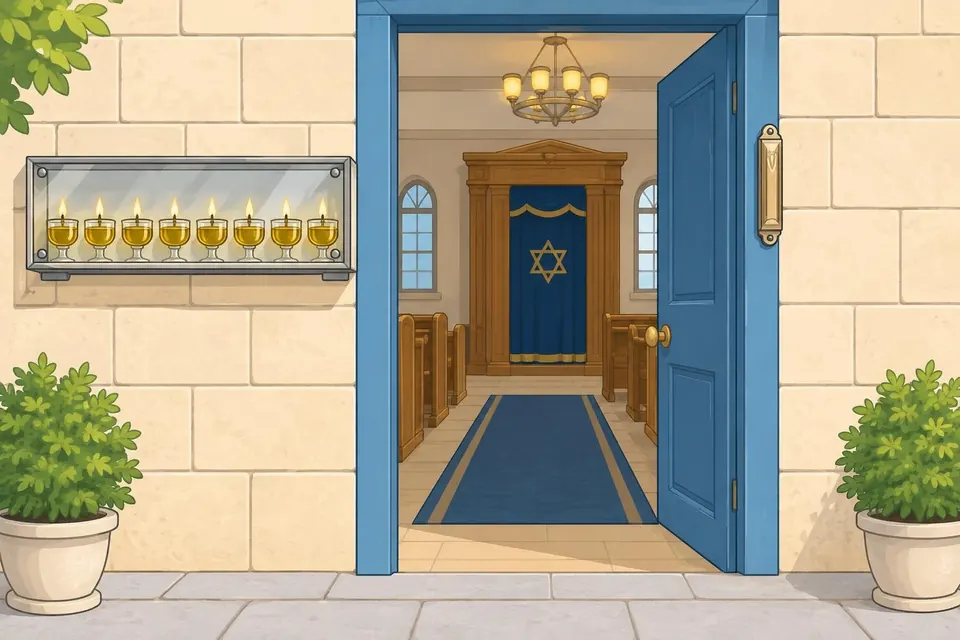
Rabbi Elyashiv is of the view that lighting at a window is possible only for residents of the kind of house described in the time of the Talmud, called an aliyah (an upper room). Today there is no such upper room. We always have a separate entrance, so even residents of a multistory building light at the entrance to the building, at the front door, the stairwell, on the left, opposite the mezuzah, so that people passing by see the menorahs and fulfill the mitzvah. Let me repeat: according to Rabbi Elyashiv we light outside the stairwell, outside the inner door of the stairwell. For this, special glass boxes that look like aquariums are built in Israel, where menorahs are lit, fulfilling the mitzvah according to Rabbi Elyashiv. Since opinions differ, different places do it differently, and everyone follows their own custom. Both have something to rely on.
By Talmudic law, if a person has an exit from the house into a yard, and from the yard there are exits to the street on the left and the right, they must light a menorah at both exits. A passerby on one street does not know that a menorah is lit on the other side, and we need to avoid marit ayin, the appearance that no menorah has been lit. So today we have two customs: to light at the entrance to the yard, and to light at the window. Both are kosher, and both have something to rely on. There are those who light in both places, to satisfy both opinions. In any case, whichever lighting you do, you fulfill the mitzvah according to one of the opinions, so everything is fine.
Now the custom abroad, outside the Land of Israel. There are two reasons it differs from what is written in the Shulchan Aruch. The Rema writes that abroad the custom is to light inside the house, not outside. The first explanation: abroad, lighting outside is sometimes simply dangerous, because it will provoke a negative reaction from the nations, who will say that the Jews are celebrating their holiday, and will want to break the windows, or the face of some Jew standing nearby. Clearly the purpose of Hanukkah is not to provoke such a reaction, so the Rema writes that from the time of sakanah, danger, the custom is to light inside the house.
There is also a second reason. If we had kept living in Jewish towns as we once did, in Zhmerinka or some other tiny town where all around are only Jews, then lighting the Hanukkah lamp in the street, we would fulfill the mitzvah of pirsumei nisa: we proclaim the miracle, and this lighting tells the Jews outside about the miracle of Hanukkah. But when we light where no Jews live around us, we are announcing the miracle to non-Jews. And whether there is a mitzvah to tell non-Jews about the miracle of Hanukkah is, to put it mildly, not at all obvious. So if we lit a menorah, roughly speaking, in Red Square or on the Eiffel Tower, we would not fulfill the mitzvah of Hanukkah: the mitzvah is to tell the Jews around us about this miracle. That is why abroad the main mitzvah of lighting the Hanukkah candles, as the Mishnah Berurah cites in his commentary on the Shulchan Aruch, is to tell the members of the household who are inside the house about the miracle of Hanukkah. So the mitzvah moves inside the house, and by lighting inside we fulfill it completely. That is how the Rema rules in the Shulchan Aruch.
Nevertheless, there remains some point in lighting, even inside the house, opposite the mezuzah, that is, at the entrance to the house on the inside. I am not saying it is obligatory, but I know that many people do so, especially Hasidim. Entering and leaving, you find yourself between two mitzvot, the mitzvah of Hanukkah and the mitzvah of the mezuzah, and for a while you are surrounded by these two mitzvot. So a custom developed: those who light inside the house still light opposite the door. But it is not obligatory. Those who light inside the house may light anywhere and in any way, and the mitzvah is fulfilled.
Hanukkah Food, Women, and a Story from Leningrad#
I will tell a story, just to lighten the dry halacha, although in principle we are continuing the lesson on the laws. But first, while I remember: there is no mitzvah to hold a meal on Hanukkah. On Purim and Passover a meal, a seudah, is a mitzvah. On Hanukkah there is no mitzvah to eat in honor of the holiday, but the Shulchan Aruch writes that there is a mitzvah of ketzat leharbot baseudah, to increase the amount of food a little. Since this is the custom, everyone eats something on Hanukkah, and for women in particular the food of Hanukkah has a certain meaning: they bake sufganiyot, potato pancakes, and eat dairy. The Shulchan Aruch writes that it is customary to eat dairy food in memory of the miracle that happened through Judith. She gave the commander of the Greek army milk to drink and cheese to eat, and when he fell asleep in his gorged state, she killed him and cut off his head. This became one of the moments that began the Hanukkah revolt, and in memory of it we eat dairy. All the other Hanukkah dishes, sufganiyot, fried dough, doughnuts, pastries, and potato pancakes fried in oil, are two customs, both connected with the fact that the miracle of Hanukkah happened with oil, so with our food too we mark the miracle through oil.
Now a question I plan to answer myself: who is obligated to light, only men, or women too? The question is that women are usually exempt from positive commandments tied to time. Such commandments fall on men. That is why women do not have to put on a tallit and tefillin, and in fact are not obligated to hear the shofar, bless the lulav, or sit in the sukkah. Is a woman exempt from lighting the Hanukkah candles? I have already said that if a woman is married, her husband lights and has her in mind, in kavanah, and both fulfill the mitzvah. If it is a girl whose father lights at home, the father has his daughter in mind, and she too fulfills the mitzvah. But it happens that a woman lives neither with her father nor with a husband, but alone, or her husband has gone away to earn a living and is not at home now. Then the woman lights the candles herself, and the question is whether she does it as someone who is not obligated. We know that women do bless the lulav and hear the shofar, although they are not obligated. Does a woman have a mitzvah to light Hanukkah candles?
The answer: yes, a woman is obligated to light the Hanukkah candles, because she too took part in the miracle of Hanukkah, the miracle of the rescue of the Jewish people from the Greek decrees. Moreover, according to one of the answers (terutzim) in Tosafot, most of the miracle happened because of a woman and for a woman. There were certain Greek decrees that concerned only women, and the Hanukkah revolt began with Judith. Since women took part in the miracle, and perhaps ikar hanes hayah al yadan, the main part of the miracle came through them, they too have the mitzvah of lighting the Hanukkah candles. If a woman is married, she fulfills the mitzvah together with her husband, just as the husband fulfills the mitzvah together with his wife when she lights the Shabbat candles. If she is not married, she must light herself, and the laws are exactly the same as for men.
Now the story. It was in Leningrad in 1983. I lived relatively near the synagogue then, and there were very few married families there who kept the mitzvot. I went to the synagogue with two young men to pray Maariv on the first day of Hanukkah, and we met three girls there who had come to find out what a synagogue is and what Hanukkah is. We invited them to our home, held a meal with a talk about what Hanukkah is, and I gave them little menorahs with little candles, which I happened to have. One of the girls said that if she went home now and lit a Hanukkah candle, it would be her final performance: her mother would kill her, and she would not get to light a second candle. Maybe she put it a little differently, but there would be an incredible scandal with her mother. Could she light the candles in the bathroom, pretend she was going to take a shower, go in there and sit for half an hour, even wash, while the candles burned, and her mother would think she was showering and there would be no questions? Would she fulfill the mitzvah that way?
I was not the most learned person then, though even now I leave much to be desired, but I answered yes, on condition that she say the blessing over lighting the candles outside, and then go in and light the candles. The mitzvah would be fulfilled, because according to the Rema, abroad one may light anywhere, and wherever they are lit, you fulfill the mitzvah. The only problem is that blessings may not be said in the bathroom, so it must be said before going in. Everything else can be done, and the mitzvah will be fulfilled. I still take the same view: if there is no other way, this may turn out to be one of the best ways to fulfill the mitzvah of the Hanukkah candles. Today that girl is a religious woman. They already have eight children, and her husband is a rabbi. But such a situation can easily arise, and the story is an old one.
When to Light#
The question "when" contains two elements: the time at which one should ideally, lechatchilah, try to light the candle, and the question of how late one may light if one did not manage to on time.
Let us begin with the ideal time. Lighting Hanukkah candles during the day makes no sense. The Talmud [Shabbat 21b] says: "What does a lamp accomplish at noon?" The sun is shining, the candle illuminates nothing, there is no point. The candle must burn at night, in the dark, when passersby and people see the Hanukkah candle and remember the miracle of Hanukkah. That is how the mitzvah of pirsumei nisa is fulfilled: we announce the miracle. That is the first point: the candle must be lit at night.
There are two main customs here and one more, so to speak, half-custom. The first is the custom of the Shulchan Aruch, which is kept mainly by Hasidim: to light when the stars come out. When the first three stars come out, the next day is considered to have begun (for Jews the day begins at night). At that moment, at tzeit hakochavim, we light the Hanukkah candle and fulfill the mitzvah at once, and after that time, that is, after the stars come out, it must burn for at least half an hour. That fulfills the mitzvah of Hanukkah. Is there any point in its burning longer? In general, no. The Mishnah Berurah rules that perhaps even ideally it is better to put it out, so that it does not look as though I am doing this not for the mitzvah but simply to have light. But that applies to a candle burning in the house, not in the street. According to the custom of Rabbi Elyashiv, and by law, when you light at the entrance to your home, it is obvious that this is only for the mitzvah, and there is no need to put it out after half an hour. At home too, people mostly do not put it out after half an hour, especially since, as we will come to, today it may be right to have the candle burn longer from the start.
The second custom, that of the Vilna Gaon, is to light the Hanukkah candles at shkiah, at sunset. By that time some darkening is already beginning, so there is a point in lighting then. But they must burn not half an hour after lighting but half an hour after the stars come out, after darkness falls. According to the Vilna Gaon, the time from shkiah to tzeit hakochavim is anywhere from eighteen to twenty-four minutes (there are different opinions within the Gaon's own words, and different calculations). Let us take the strictest opinion: twenty-four minutes after sunset is called tzeit hakochavim. Half an hour plus twenty-four minutes makes fifty-four minutes from shkiah that the candle of the menorah must burn, if it is lit at shkiah according to the Gaon's custom.
There is also a little-known custom, let us call it the custom of the Chazon Ish. Nothing is written about it in the writings of the Chazon Ish, but the custom is known, and I follow it. It does not get dark right after shkiah: dusk begins about ten minutes after shkiah, at least in the Land of Israel, and the Chazon Ish lit at exactly that time: it is not yet dark, but already twilight. Right at shkiah, as the Gaon proposed, it is still quite light, and according to the Chazon Ish that is not correct. He was of the view that even according to the Gaon, it is correct to light about ten minutes after sunset.
Once more: whenever I light, and by whatever custom, I need to make sure the candle burns for half an hour after tzeit hakochavim. If it burns less, that is a problem.
Everything here is simple, except for Shabbat. On Shabbat there is a problem going from Friday to Shabbat, and a problem going from Shabbat to Sunday. They are two different problems, though they have something in common.
On Shabbat we may not light, so we light before Shabbat, before lighting the Shabbat candles. To simplify: suppose the Shabbat candles are lit twenty minutes before shkiah (sometimes eighteen). The menorah must be lit a few minutes before them. Let us round it for simplicity: the menorah was lit twenty minutes before shkiah, and it must burn those twenty minutes until shkiah, then the time from shkiah to tzeit hakochavim, say half an hour, and after tzeit hakochavim another half hour. In total you need to prepare candles that can burn for an hour and twenty minutes. These are the candles that are lit before Shabbat.
Now the end of Shabbat, motzei Shabbat. Here a problem begins, tied to the general question: what is the latest time at which the candles may be lit? In the wording of the Talmud (where does the measure of half an hour after tzeit hakochavim come from, while the candles burn?), the candle must burn ad shetichleh regel min hashuk [Shabbat 21b], that is, until people walking in the street have ceased. In the time of the Talmud, people stopped walking in the streets very soon after dark. There was no electricity, and everyone tried to get home as soon as possible, because it is impossible to stroll in total pitch darkness, except perhaps by moonlight, and even that is inconvenient. So half an hour after sunset there were practically no people in the street, and this is considered the last time one can light the menorah: half an hour after tzeit hakochavim. After that, midina degemara, by the law of the Talmud, one may not light the menorah: I do not fulfill the mitzvah of pirsumei nisa, because there is no one to announce it to. And in the time of the Talmud the main part of pirsumei nisa, publicizing the miracle, is for passersby in the street, not for the residents of one's own house.
In our time the situation has changed quite sharply. People are out on the street until midnight, and in some neighborhoods almost until morning. Besides, abroad the main mitzvah of pirsumei nisa is at home, not for passersby. So there is an opinion that the menorah may be lit until late: until the time when passersby in the streets of Israel stop walking, or, abroad, until the household goes to sleep. That time is of course not half an hour after the stars come out but considerably later. But there is also an opinion that although the situation has changed, the takanat Rabbanan, the ordinance issued by the Sages, remained unchanged. So one still needs to light the menorah at most half an hour after the stars come out, and after that the lighting will be improper. There are people who are very careful about this. Followers of the Vilna Gaon try to light the menorah if not at shkiah then at most about twenty minutes after shkiah, and under no circumstances later, and only in a very difficult situation half an hour after tzeit hakochavim. What is this difficult situation? Motzei Shabbat. That is why in the Lithuanian world the custom is to run to light the menorah right after Maariv at the close of Shabbat. On the night after Shabbat, many synagogues, almost all the Lithuanian ones, hold an additional Maariv minyan that prays twenty, twenty-two, or twenty-four minutes after shkiah, that is, very quickly. There are even those who pray eighteen minutes after shkiah, so that right after the prayer they can run to light the menorah. That way they fulfill the mitzvah of mehadrin min hamehadrin. According to the Gaon, after tzeit hakochavim it is already very much a last resort, bedieved, and on motzei Shabbat there is no other way, but at the very least one must not delay or light late.
Against this, there are opinions that all of this applied to the time of the Gaon, when there was no electric light, and today, when people are out bashuk, in the street, until late at night or early in the morning (I do not know how best to put it), there is no point in hurrying to light the menorah, and it is quite all right to light calmly, as usual, after the stars come out. That is why many Lithuanians have the custom of lighting on an ordinary day right after shkiah. On Friday it is clear that one lights earlier, as usual, but having prepared candles that burn long, at least an hour and twenty minutes. And on motzei Shabbat there are those who try to light as early as possible, and those who do not. For example, there are people who calmly wait until Shabbat ends by the time of Rabbeinu Tam, seventy-two minutes after shkiah, since there is an opinion that Shabbat cannot end before that time, but after that they light the menorah as quickly as possible.
On motzei Shabbat there is also a dispute: which comes first, Havdalah or lighting the Hanukkah candles? Those who strive to light as early as possible according to the approach of the Vilna Gaon first light the candles and then make Havdalah. One can calmly stretch out the time with Havdalah, but lighting the candles later is already a whole problem. And those who do not fear this, since regel min hashuk ends very late anyway, calmly light somewhat later in our time.
Connected with this is one more custom: every day to light candles that burn long, really long, not half an hour. According to those authorities who maintain that today, as long as people are out in the street, the mitzvah of the Hanukkah candle continues to exist, this makes sense. That was the view of the Brisker Rav, who lived in Israel. He lit a very long candle, so that it would burn down at around one in the morning, because until one in the morning people are still out in the street, and as long as the candle burns, as long as the light does not go out, we continue to fulfill the mitzvah of pirsumei nisa. That is why such long candles are made.
Which Candles and Which Oil#
Now an important point about the candles. Strictly by law, almost any candle is fit for fulfilling the mitzvah of Hanukkah: wax, paraffin, any kind. But since the miracle of Hanukkah happened with olive oil, the mitzvah in its best form, mehadrin, is to light specifically olive oil. The Maharal of Prague regards this as practically halacha, but we do not rule like the Maharal: by law any candle is kosher. Nevertheless, the best way is to pour olive oil into a little cup and set a wick in it, a cotton wick or one that burns best. Today wicks soaked in wax are sold specially, and they burn very well, better than cotton. The Mishnah Berurah writes that cotton is better. But any wick that burns in oil will do. The amount of oil determines the burning time. In any case, you need to check this.
The thin little Hanukkah candles that are handed out as gifts and sold cheaply are very good for children, and perhaps suitable for a weekday. They most likely burn for half an hour, and if lit at tzeit hakochavim, we fulfill the mitzvah. But on Shabbat, when we light on Friday, we need a candle that burns for at least an hour and twenty minutes, and that is the very minimum. These little candles will of course not last that long, so on Shabbat one must take care to have other candles, ordinary thick ones that burn long. Or, best of all, use olive oil not only on Shabbat but on the other days too.
Women's Work and Latecomers#
Those are the laws of lighting in brief, very brief, as much as I have managed. One more point, which I almost forgot, is the prohibition on women working while the candles burn. For half an hour from tzeit hakochavim, women do not do work. This is not in the sense of Shabbat: they may light candles, cook, and so on, but they do not do laundry, sew, do other serious work, or wash floors. Roughly as on Rosh Chodesh, the new month, women have a custom not to do certain kinds of work, so too it is customary that during these thirty minutes of the Hanukkah candles' burning women do not work. Men have no such custom, and they may work during this time too. But it is exactly half an hour: if the candle burns longer, after half an hour the prohibition ends, and all work is permitted to women too.
The Shulchan Aruch writes that there were communities that did no work all day on Hanukkah. He forbids this and says that those who act this way must be stopped: Hanukkah is a day permitted for asiyat melachah, for work. Hesped, fasting, and eulogies are forbidden on Hanukkah, we are meant to rejoice, but work may be done on Hanukkah, except for this half hour. This is one more reason some people put out the Hanukkah candles after half an hour: so that it is clear that the woman did not work by the light of these candles, and now she is working, and it is no longer those thirty minutes. But once again I will say: many rabbis are of the opinion that today, since regel min hashuk ends very late, one should light ideally so that there is enough oil for long burning, because every minute of burning, even after those thirty minutes, is also a mitzvah of pirsumei nisa.
One more point I forgot. A person was working or was somewhere and could not light at the time meant for it ideally, at shkiah or at tzeit hakochavim. They came home late, say at nine in the evening, when the candles should have been lit at five. May they light now? According to most poskim, since today, as I said, people are out in the street all night, we may light the candles with a blessing until there are no longer people in the street. Abroad, until the members of the household have gone to bed. If they came home at two in the morning and everyone is asleep, there is an unexpected ruling (I do not remember where else in the Shulchan Aruch such rulings are found). The Mishnah Berurah writes that one should wake someone, so as to light the candle with a blessing and thereby fulfill the mitzvah, including pirsumei nisa. If it is impossible to wake anyone, the candles at that time are lit without a blessing. On the first day three blessings are said, which are written in the siddur, and on the other days two.
Questions and Answers#
If a wife lights the Hanukkah candles in her husband's absence, does she thereby fulfill the mitzvah for her husband, and does he need to light when he comes home? If they agreed and she lights for him, he has fulfilled the mitzvah, and when he comes home he does not have to light. The same is true if he went away for one day and is staying in a hotel: his wife lights for him, he has fulfilled the mitzvah, and he is not obligated to light where he is a guest. He may light himself as well; whether he then says a blessing, since his wife has already fulfilled the mitzvah for him, is a matter of differing opinions [Orach Chaim 677:3].
If two women are in the same apartment and are not relatives (neither a daughter nor a wife), must each of them light herself, or may they light together? Just like men, they should both light Hanukkah candles in order to fulfill the mitzvah in the mehadrin min hamehadrin way. If for some reason this is difficult, they can join together, with common oil or a common candle, and light one for the two of them. That is permitted, but it is no longer lechatchilah, not the ideal way. Ideally, like men, each should light her own menorah.
If a wife has gone away and will not return until after Hanukkah, can one light the candles so that she is present online, over the internet? Certainly one can, but it is not even necessary. If she knows that her husband is lighting for her, she fulfills the mitzvah, because the candles must burn in the house. And as for arranging that she hears the blessings and sees the lighting over the internet, that one certainly can do.
From a lesson by Rabbi Eliezer Ksido
Practical law. This page reports a ruling given for a specific question. For your own situation, ask a rabbi who knows you.
Keep reading
More →Hanukkah: Never Lose Hope
Hanukkah teaches that even in spiritual darkness, it is possible to turn to God and find light.
Guide · HanukkahWhen Should You Light Hanukkah Candles?
Jewish authorities differ on whether Hanukkah candles should be lit at sunset or after nightfall.
HanukkahWhy Is Hanukkah the Last Holiday?
Hanukkah reveals how the darkness of forgetting can lead to a flourishing of Torah.
HanukkahTorah and Greek Wisdom: What Does Hanukkah Teach Us?
Hanukkah reflects a struggle over the purpose of wisdom and the influence of the world around us.







