Hanukkah and the Shechinah: The Divine Presence
Hanukkah illuminates the connection between the Divine Presence, the Temple, and the study of Torah.
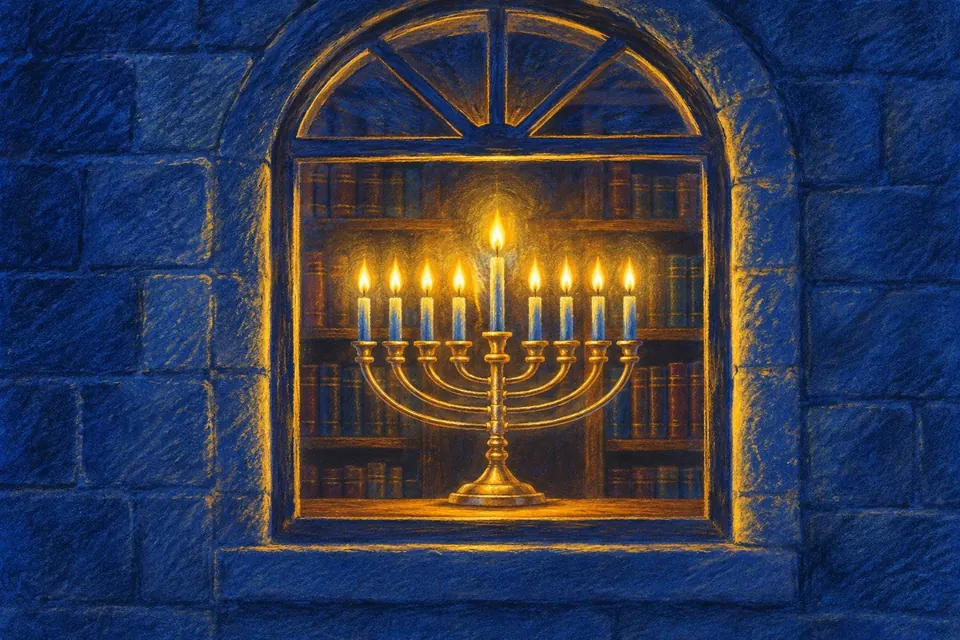
In brief
- The Shechinah was present in the tents of the patriarchs and in the Temple.
- In exile, the yeshiva is a central place of the Divine Presence.
- The Hasmoneans rededicated the Temple after defeating the Greeks.
- The light of the Hanukkah menorah is connected to the light of Torah.
The month of Kislev is the month of Hanukkah. This is an opportunity to discuss an important subject: the presence of the Shechinah, the Divine Presence, among our people.
The Divine Presence Among Our Ancestors#
In Parashat Chayei Sarah, we read how Eliezer devotedly carries out Abraham’s mission and brings Rebecca to Isaac, who marries her: “Isaac brought her into the tent of Sarah his mother, and she became his wife, and he loved her. Isaac was comforted after the loss of his mother” (Genesis 24:67).
Rashi explains:
He brought her into the tent [the meaning here is not Sarah’s tent, but that Rebecca was like Sarah. According to this explanation, the verse can be read: “Isaac brought her into the tent, and she was like Sarah his mother”]. She became like Sarah his mother. In other words, here she was, like Sarah his mother. For as long as Sarah lived, a candle burned from one Shabbat eve to the next, there was a blessing in the dough, and a cloud stood over the tent. When she died, all these things disappeared, and when Rebecca arrived, they returned (Rashi on Genesis 24:67).
The cloud hints at the presence of the Shechinah. The Creator intended to dwell among us when we are worthy. We see the beginning of this presence in Abraham’s tent. It continued with Isaac and Jacob.
In Parashat Terumah, we read: “They shall make Me a sanctuary, and I will dwell among them” (Exodus 25:8). The presence of the Shechinah is the essence of our people’s bond with God. This is what our patriarchs Abraham, Isaac, and Jacob brought into the world. It is also the essence of the Tabernacle, the portable sanctuary, and the Temple in Jerusalem. Both were places where the Shechinah was present in the fullest sense.
Torah Study and the Shechinah#
The tents of Abraham, Isaac, and Jacob were places where the Shechinah rested not only because of the righteousness of our matriarchs, but also because they were places of study. A yeshiva is not just a place to study. It is a special place where the Shechinah is present.
Pirkei Avot (Ethics of the Fathers) teaches that the Shechinah is present even where one person studies Torah (Mishnah Avot 3:6). Why, then, do we speak specifically of a yeshiva as a place of collective study?
Pirkei Avot also says: “Ben Bag Bag said: ‘Turn it over and over, for everything is in it’” (Mishnah Avot 5:21). Our great teacher Rabbi Moshe Chaim Luzzatto (the Ramchal), in his book Derech Etz Chaim (The Way of the Tree of Life), explains this Mishnah as follows:
Those who study Torah must “turn it over and over” until the light blazes like a real fire. And just as a burning flame, as I have said, reveals several complex shades, so too in this light of Torah we find several profound meanings contained within the blazing flame.
A higher Divine light is hidden in the letters of the Torah, but it is not immediately visible. The letters are like smoldering embers. When the embers are fanned, the light hidden in them emerges in many colors. So too, when a person reflects on the words of Torah and returns to them again and again, those words begin to shine with the light hidden within them.
The Midrash on Lamentations says that the light of Torah brings us back to what is better. There are different levels of this light. The glimpses received by someone who studies Torah superficially cannot be compared to the full splendor of the light granted to someone who truly labors over it.
When I was first brought to a class given by our teacher Rabbi Yitzchak Zilber, of blessed memory, I was most impressed by his drush, his interpretive teaching. I felt the light and fire of Torah hidden within it. This light, which illuminates our souls as it is revealed, is what matters most in Torah. And clearly, the yeshiva is the true place to put Ben Bag Bag’s words into practice.
Of course, a person, especially someone great in Torah, can be like an entire yeshiva. The Chazon Ish and Rabbi Elyashiv, for example, often studied alone, outside the walls of a yeshiva. But this is not true of people on a lower level.
Our sacred books teach that God’s highest manifestations are revealed through the Shechinah. The presence of the Shechinah is inherent in the Torah, but its degree depends on the level of study. It depends on more than that, however. It also matters whether the individual is worthy of experiencing the Shechinah’s revelation.
The level of the yeshiva itself is important too. It matters whether people there labor over Torah with all their strength. We should know that today the yeshiva is the principal place of the Shechinah’s presence among our people. In Temple times, its principal place was connected with the sacrifices, and Torah was “nourished” by the light that came from there. That is why the most important halachic decisions were made by the Sanhedrin, which sat in the Temple. In exile, we have nothing but Torah, yet it contains everything, as our great teacher Rabbi Elazar Menachem Shach writes.
Berakhot also teaches that in exile, the place of God’s presence is only the arba amot—the four cubits—of halacha (Berakhot 8a). This does not refer to a physical measurement of length or area. Nor does it mean simply reading the Kitzur Shulchan Aruch, a concise code of Jewish law, or reviewing familiar laws from memory, although these are certainly forms of Torah study too.
The Chafetz Chaim’s 28 years of work on the Mishnah Berurah were, to put it mildly, not quite the same as reviewing a concise summary of the laws. He used every source available to him, from the Five Books of Moses, the Prophets, Midrash, Mishnah, and Talmud to the works of poskim (halachic decisors), the medieval authorities, and the Acharonim (later authorities), including those of recent generations. He studied all of them thoroughly until he reached a legal ruling. The place where the Chafetz Chaim labored over Torah in this way, drawing practical law from his study, is what is called the four cubits of halacha, where the Shechinah is present.
Let me recall a halacha that people today do not always know or remember. The same passage in Berakhot teaches that it is very important to pray in the place where one studies. There is even a view, which we do not follow, that this applies even when there is no minyan, or prayer quorum, in the place of study. The reason is that the best place for prayer is where the Shechinah is present. A place of Torah study is such a place, and it is like the Temple.
A yeshiva is a place of both Torah and prayer. On the one hand, the Shechinah is present where a person studies. On the other, our study of Torah as a gift from God depends on our prayers and on the place of the Shechinah’s presence in which we study.
Prayer with a minyan, too, brings the presence of the Shechinah. The place set aside for it is the synagogue, which Scripture calls a mikdash meat, a “small sanctuary” [Ezekiel 11:16].
When we speak of a yeshiva among the people of Israel, then, we mean not merely a house of study, but a place where the Shechinah is present.
Hanukkah and the Light of Torah#
Let us turn to the events of Hanukkah. The Hasmoneans fought a self-sacrificing war against the Greeks who had defiled the Temple. A handful of priests—Judah Maccabee and his brothers—were physically weak but great in spirit. Through the strength of their spirit and with God’s great help, they defeated the Greeks.
There is, however, an important detail: the Greeks dealt a blow to the holiness of the Temple. They broke through the walls of Jerusalem and the Temple and deliberately defiled all the oil in the Temple, except for one vessel that miraculously remained untouched.
Greek wisdom is entirely opposed to the Torah of Israel. Torah study is not simply an intellectual pursuit; it brings the presence of the Shechinah. The Tur writes in the laws of the morning blessings that the First Temple was destroyed because people did not recite the blessing over Torah study. The Bach, Rabbi Yoel Sirkes’s commentary on the Tur, explains that we study Torah so that we may merit the presence of the Shechinah among us. Those who studied Torah without reciting the blessing were not studying for this purpose. This caused the Shechinah to depart and, consequently, the Temple to be destroyed.
If the essence of the Torah of Israel is to connect the people of Israel with God, Greek wisdom is based on a complete separation of the earthly from the Divine. The Greeks therefore tried in every way to prevent Jews from observing the commandments that express our people’s connection with God.
One example is brit milah, circumcision. The Greeks hated it because God commanded us to perfect ourselves by intervening in the material world He gave us. The commandment to sanctify the new month—the first commandment given to the people of Israel as a whole—was also incompatible with their worldview, because we establish its date, which does not always correspond to the astronomical calendar. The Jerusalem Talmud teaches that this affects natural processes, since nature does not exist independently but is connected to the higher world, which is its source.
The Holiness of the Temple Site#
I want to explain a profound idea. Our tradition has the concepts of the Tabernacle, a portable sanctuary, and the Temple, a permanent sanctuary. They are not quite the same. After the Tabernacle was moved, no holiness remained in its former place. The holiness of the Temple remains on its site even today, when the Temple is completely destroyed. There is a hint here.
When the Tabernacle was built, figures of cherubim, with children’s faces and wings, were placed in it. They stood on the cover of the Ark of the Covenant and were carried along with it. There were cherubim in the Temple as well—four in all. Besides the two on the Ark’s cover, there were another two on the floor of the Temple.
Once, in a conversation with our teacher Rabbi Moshe Shapiro, of blessed memory, I suggested that the cherubim standing on the Temple floor symbolized the holiness of the place. He agreed and said that there is a hint of this in the Torah.
We read it in Parashat Vayetzei. When Jacob leaves Beersheba for Haran, he falls asleep in a certain place and dreams of angels ascending and descending a ladder, and of God blessing him. On waking, Jacob exclaims: “Surely God is present in this place, and I did not know it” (Genesis 28:16).
Rashi explains:
This is Mount Moriah, where Abraham prayed, and it is the same field where Isaac prayed. … This is the gate of heaven, a place for prayer, where prayers ascend to heaven. The interpretation is that the Temple on high stands opposite the Temple below (Rashi on Genesis 28:16–18).
This refers to the lasting holiness of the place where the Temple was later built. The holiness of the Temple site is the source of all the holiness of Jerusalem. The whole of Jerusalem within its historic boundaries was, quite literally, a large Temple courtyard, where the meat of the Passover offering and shelamim, peace offerings, could be eaten. The source of this was the holiness of the place.
An important point needs to be made here. Our sacred books tell us that after Moses our teacher came down from Mount Sinai with the second Tablets of the Covenant, offerings were collected to build and dedicate the Tabernacle. Everything was ready by 25 Kislev. But God told the people of Israel to wait until 25 Adar to build it, because 25 Kislev was reserved for another chanukah, or dedication—the Hanukkah of the Hasmoneans.
On that day, in the liberated Temple, the Maccabees rededicated everything the Greeks had defiled. In memory of this, we hold festive meals on Hanukkah today.
Why was the Hasmoneans’ dedication of the Temple more important than the dedication of the Tabernacle in the wilderness? Because they restored the holiness of the place. But that is not the only reason.
Rashi cites Midrash Tanchuma:
When Aaron saw the tribal leaders’ offerings for the dedication of the altar, he was distressed because neither he nor his tribe had taken part. The Holy One, blessed be He, said to him: “By your life, your share is greater than theirs, for you kindle the lamps morning and evening” (Midrash Tanchuma, Behaalotecha 5).
Nachmanides (the Ramban) explains that the deeper meaning of this teaching is that it hints at the dedication of a new menorah in the Second Temple by Aaron’s descendants—the Hasmonean high priest and his sons—as well as the light of the Hanukkah candles (Nachmanides on Numbers 8:2).
The Oral Torah in Exile#
The Oral Torah consists of two parts. The first is the Oral Torah itself, received at Mount Sinai as a necessary complement to the Written Torah, including the laws given to Moses at Sinai.
The second is a deeper part of the Oral Torah. It includes the full depth of understanding of God’s Torah granted to those who labor over it with real depth: the Sages. Their understanding is an understanding of God’s own Torah. It is not something they simply made up, God forbid. That is why, when Torah sages disagree, “both these and those are the words of the living God” [Eruvin 13b].
Our Sages connect the flourishing of the Oral Torah specifically with the Maccabees’ rededication of the Temple. The great wisdom contained in the Torah began to be revealed more fully precisely because of the victory over the Greeks and Greek wisdom. This revelation is what the words quoted in Avot in the name of Ben Bag Bag refer to.
God’s promise to Aaron that his lamp would burn forever thus referred not only to the Temple menorah itself, but also to the light of Torah associated with it. This light is truly revealed in the yeshiva. It is a great comfort to our people that even in exile, the Shechinah is with us in places of Torah study.
The Ramchal writes in his book Kinat Adonai Tzevaot (The Zeal of the Lord of Hosts) that Noah’s Ark hints at the presence of the Shechinah in exile. In a world swept over by a flood of impurity, there is a place where the Shechinah can find refuge.
I have heard it said in the name of Rabbi Yitzchak Hutner that Noah’s Ark today is the yeshivas and other houses of study. They are surrounded on every side by a flood of impurity, while the Shechinah is within them. This is the situation throughout the Jewish world.
We hope that, through the merit of our yeshivas and with God’s help, we will merit the rebuilding and rededication of the Temple, so that the Shechinah and Torah will return to us in full. And for this, in turn, we need to rebuild the yeshivas.
By Rabbi Yigal Polishchuk
Keep reading
More →Hanukkah: Never Lose Hope
Hanukkah teaches that even in spiritual darkness, it is possible to turn to God and find light.
Guide · HanukkahWhen Should You Light Hanukkah Candles?
Jewish authorities differ on whether Hanukkah candles should be lit at sunset or after nightfall.
HanukkahWhy Is Hanukkah the Last Holiday?
Hanukkah reveals how the darkness of forgetting can lead to a flourishing of Torah.
HanukkahTorah and Greek Wisdom: What Does Hanukkah Teach Us?
Hanukkah reflects a struggle over the purpose of wisdom and the influence of the world around us.







