Srulik and Julius Search for Pure Oil
Two friends join the Maccabees and search for oil to light the Temple menorah.
In brief
- Srulik loves his father's stories about Jacob and the little jugs he went back to retrieve.
- Srulik and his friend Julius rescue Jews imprisoned for studying Torah.
- The boys join the Maccabees on their journey to Jerusalem.
- In the Temple, they help find a hidden jug of pure oil that burns for eight days.
Srulik lived in a little village among the forests. The village was called Kiryat Yearim, or Forest Village. It was small, but very important, because it stood beside the road to Jerusalem, about halfway between the city of Modiin, where the High Priest Mattityahu lived with his sons, and Jerusalem, where the Temple stood. At that time, though, the Greeks were in charge of the Temple.
Srulik's father was a stonecutter. He was a big, very strong man. Every morning, he went out with his older sons, Judah and Abraham, to break rock and cut it into smooth building stones. Srulik's father had paved every street in Forest Village, and all the houses had been built from stones cut by his grandfather Shimon.
Judah and Abraham were tall and strong, too. Their mother sometimes called Abraham Avi, but he would frown and correct her: “Abraham.” He was very proud to be named after the great forefather of the entire Jewish people. Judah, the oldest, was especially strong. Srulik, on the other hand, was still small, thin, and weak. But he was always happy to help with any work around the house.
Srulik also loved listening to the wonderful stories his father told in the evenings when he came home from work. One day, his father told him about Jacob, whom God Himself had given the name Israel, “the one who prevails.” Srulik especially liked hearing that God had named Jacob Israel. That was Srulik's own full name, too.
Jacob and the Little Jugs#
“When Jacob was returning from his uncle Laban,” Father said, “he had two wives, Rachel and Leah, and 11 sons. He also had many sheep and goats, camels and donkeys, and many tents, where he lived with his family and faithful servants. Jacob was returning to his father Isaac in the Land of Israel. Back then, though, the land was called Canaan, after the Canaanites, who had seized it from the descendants of Shem.”
“Like the Greeks seized it from us?” Srulik asked.
“Yes, something like that,” Father said. “Now listen.”
Besides the Canaanites, Jacob's wicked brother Esau was waiting for him in the Holy Land. Esau longed to kill him out of revenge and jealousy over the blessings their father had given the righteous Jacob.
“Can a brother really want to kill his own brother?” Srulik asked, frightened.
“Only if he's wicked, like Esau, or like those Jews who have grown fond of the Greeks and roam the mountains with them, helping them hunt down their brothers who study Torah in secret caves.”
Srulik said nothing. He had long suspected that his father and brothers also went to secret places where righteous Jews studied Torah, hiding from the Greeks. But he wasn't supposed to talk about it, not even in a whisper, not even to his closest friends.
“Yes,” Father continued, “Esau hates Jacob and is always trying to kill him. But that's not so easy. Jacob studies Torah, and someone who studies Torah becomes much stronger than they were at birth.”
Jacob came to the border of the Holy Land, to the Jabbok River. He stopped there to think about how to escape the wicked Esau's revenge. Jacob prepared in three ways. First, he prayed fervently to God, asking to be saved from his wicked brother. Second, he sent Esau rich gifts to win him over. All wicked people like receiving gifts and becoming wealthy without working for it. Third, Jacob prepared for war. He divided his camp in two so that Esau could not possibly destroy all the Jews at once. If Esau attacked one camp, the other would have time to escape.
Around midnight, Jacob got up and woke everyone. He stepped into the Jabbok and carried across it into the Holy Land both his wives, Leah and Rachel; his two concubines, Zilpah and Bilhah; his 11 sons; all the servants and maids; all the sheep and goats, donkeys and camels; the tents, furniture, and chests of clothes and jewelry—absolutely everything he owned.
“Was our forefather Jacob really strong enough to lift a whole camel?” Srulik asked in amazement.
“Jacob never did anything wrong,” Father answered. “He was honest and righteous, faithfully kept all the Creator's commandments, and studied Torah every free minute. That's why God helped him and gave him strength far beyond that of an ordinary person.”
“I'm going to try to become righteous like Jacob, too,” Srulik said.
“Do you want to lift camels?” Father asked with a smile.
“No,” Srulik laughed. “I want God to help us drive the Greeks out of Jerusalem and cleanse our Temple of their defilement. Then we can come again for the festival and see the kohanim, the priests serving in the Temple, and the Levites singing on its steps. I want all the miracles of the Temple to return, and the menorah, the Temple lamp, to shine with a pure flame.”
Father hugged Srulik tightly and kissed him.
“Then,” Father continued, “when Jacob stepped into the Land of Israel, he suddenly remembered that he had left some little jugs on the other bank of the Jabbok. You should know, my son, that righteous people take great care of their possessions. They don't damage them or throw them away, because everything they own comes from hard, honest work. But wicked people, thieves and robbers, don't value what they have. They easily damage, dirty, and break the things they've stolen. They use them without a thought for tomorrow.”
“Like the Greeks who came past our village in a big troop and chopped down all Uncle Issachar's olive trees for firewood,” Srulik said. “I saw Uncle Issachar crying. His grandfather had planted those trees, and he worked so hard taking care of them. His family earned all their money by selling the olives and oil.”
“Yes,” Father said, his face darkening. “One day the Greeks will answer for all the wicked things they've done in our land.”
Jacob decided to go back for the little jugs, even though it was dangerous to be alone at night. But Jacob never felt alone, because God was always with him.
After crossing the Jabbok, Jacob suddenly saw a shadow. It was as though all the darkness of the world's night had gathered in one place, taking the shape of a man. The dark stranger sprang at Jacob. But Jacob wasn't afraid. He gripped the stranger so tightly that he couldn't move his arms and could only try to kick Jacob. Jacob held his dark opponent all night. Their struggle raised dust all the way to heaven.
The stranger was no ordinary man. He was Esau's angel, who had come to challenge the blessings Isaac had given Jacob instead of Esau. But the wicked man's guardian angel could not overcome a truly righteous man. He searched Jacob for the smallest sin he could use to strike a fatal blow, but he found none.
Morning came, the time when all the angels must appear before the Creator and sing a beautiful morning song to God. Esau's angel tried to break free from Jacob's grasp so he could fly up to heaven. But Jacob held him tight and wouldn't let him go. The dark angel struck Jacob painfully on the thigh, injuring the gid hanasheh, the sciatic nerve. That is why Jews never eat this nerve from an animal's thigh.
Seeing that he could neither overcome Jacob nor break free, the angel pleaded, “Let me go.”
“I won't let you go until you bless me,” Jacob answered. He had already understood whom he was fighting, and now he wanted Esau's guardian angel to acknowledge his right to Isaac's blessings.
“What is your name?” the angel asked.
“Jacob,” the righteous man answered.
“You will no longer be called Jacob, ‘the one who supplants,’ but Israel, ‘the one who prevails,’ for you have struggled with people and angels and prevailed.” The angel blessed Jacob, and only then did Jacob let him go.
Srulik listened to the end of Father's story with eyes shining with excitement. For a long time he couldn't fall asleep, thinking about Jacob-Israel and his great feat.
Judah's Story#
The next day, Father and the boys stayed home to prepare for Shabbat. Srulik worked hard to help with everything he could. On Shabbat, he sat close to Judah, whom he loved dearly. He asked whether Judah knew what had happened to the little jugs Jacob had saved from Esau's angel. Judah smiled and said he knew about only one of them.
“Please tell me,” Srulik asked.
Judah hugged his little brother and began.
Long ago, the prophet Elisha lived in the Land of Israel. He was the student and successor of the great prophet Elijah. Elisha performed many miracles for the people of Israel and did many good deeds for the glory of God's name. One day a poor widow came to him, weeping over her troubles.
“My husband,” she sobbed, “was a God-fearing, righteous man, as you know. He fed and sheltered God's prophets despite the persecution of the wicked king who ruled at the time. Now he's dead and has left me alone with two little sons. We have nothing to eat, and the king wants to take my children as slaves because of my late husband's debts. Can it be right for a righteous man's children to go hungry?”
“What can I do for you?” Elisha asked. “Do you have anything at home on which God's blessing can rest?”
“I have nothing in the house except a little jug with a bit of olive oil left at the bottom,” the unhappy widow answered.
“Go,” Elisha said, “and ask your neighbors to lend you as many empty jugs, pots, and buckets as they can. When you get home, shut the door behind you and your sons, and pour from the little jug into the buckets, pots, and jugs until you've filled them all.”
The widow went home and did just as the prophet Elisha had told her. She borrowed many buckets and jugs, pots and cooking vessels from all her neighbors. She went into the house with her sons and shut the door. Then she began pouring from the little jug into the big ones, and what a miracle: The oil in the little jug didn't run out. It filled one vessel after another. Her sons brought her empty buckets and carried the full ones aside. She kept pouring and pouring oil from the little jug. When every pot, cooking vessel, jug, and bucket was full, she said to her sons, “Bring me more.”
“There are no more empty vessels,” her sons answered.
Then the oil stopped flowing from the little jug. The widow went to Elisha to ask what she should do next.
“Go and sell the oil and pay all your debts,” he said. “The money left over from the sale will be enough to support you and your sons for the rest of your lives.”
That's what the widow did. She sold the oil and returned the buckets, jugs, and pots to her neighbors. She paid all her debts, and the money left over supported her and her children for the rest of their lives.
“That was one of the little jugs Jacob went back for,” Judah said, finishing his story.
“What a wonderful ending,” Srulik said. “I wish we could find a little jug like that, too.”
“Do you want us to earn our living selling oil?” Judah asked in surprise.
“Of course not,” Srulik answered. “I want the sacred menorah in the Temple to shine again.”
“I want that very much, too,” Judah admitted. “I believe it will happen soon. We'll drive the Greeks out of our Temple, cleanse it, and find pure oil for the menorah. Have you heard that the High Priest Mattityahu and his sons have already driven the Greeks out of Modiin?”
“Yes. I've seen big Greek troops heading toward Modiin,” Srulik said anxiously.
“Don't worry, little brother. Many Greeks have gone to Modiin, but not one has come back yet. God, the Creator of heaven and earth, is helping us, and there's no power in the world that can defeat Jews who study Torah. That's why the cursed Greeks forbid us to study.”
“I want to study Torah, too,” Srulik said.
“I'll teach you to recite Tehillim, King David's psalms, by heart. Then you can repeat them whenever you have free time. God promised to accept Tehillim as Torah study. In the evenings, Father tells you chapters from the Chumash, the Five Books of Moses. On Shabbat, I'll tell you stories from the books of the Prophets, the ones I've learned myself.”
Srulik didn't ask Judah where he had learned all this. It was obvious, but it was a secret.
Srulik and Julius#
In the courtyard, Srulik met his friend Julius. Julius's father was a farmer. He grew vegetables to sell on narrow terraces along the mountainsides. He had always admired the strength of the Greeks, who had conquered half the world, and their handsome, orderly columns of soldiers marching past Forest Village. He dreamed that his son Julius would become a soldier in a Greek phalanx and bring home rich spoils from distant lands. That was why he had given Julius a Greek-style name.
Julius also liked the soldiers in their armor, shining in the sun, and their helmets with plumes on top. But he didn't want to go to distant lands where he might, God forbid, have to kill peaceful people—farmers like his own father. He wanted to be a farmer, or better yet, a blacksmith. After all, God had made him sturdy and broad, stronger than any of the other boys in Forest Village.
Julius also loved listening to stories, and his friend Srulik knew how to tell them. Thin and short as he was, Srulik was as clever as a grown-up. How did he always know so many amazing stories? Julius loved his friend and always defended him if one of the neighborhood boys picked on him.
“Hi, Julius,” Srulik said.
“Hi, Srulik,” Julius said happily. “What's new?”
“Tell me, Julius, would you come with me to the Jabbok River?”
“With you, I'd go to the ends of the earth. But where's that river?”
“Very far away, on the border of the Land of Israel.”
“Wow. Why do we want to go there?”
“We'll find that precious little jug of oil our forefather Jacob saved from the evil angel.”
“Wow! Please tell me about it.”
Srulik told his friend about Jacob's fight with the dark angel and the miracle of the little jug in the days of the prophet Elisha. Julius promised that he would go with Srulik to the Jabbok as soon as the season of fieldwork was over. He asked Srulik not to leave without him.
A month passed. By now Srulik knew several psalms from Tehillim well enough to recite them by heart, and he repeated them constantly while doing small jobs around the house.
One morning, the Greeks came to Forest Village. They brought several Jews bound in heavy chains. With the Greeks came a Jew who had adopted Greek ways. He had led the enemies along secret mountain paths to the hiding place where Jews were secretly studying Torah.
The Greeks locked the captured Jews in a deep cellar, where Julius's father usually stored vegetables before selling them. The harvest had not yet been gathered, so the cold cellar was empty. The Greeks gave the prisoners neither water nor bread. They said the Jews would soon be executed for breaking King Antiochus's ban on Torah study. Greek soldiers stood guard at the cellar entrance.
The whole village was frightened and upset. The Greeks stayed in Julius's house and forced the family to sleep in the livestock pen. They ate and drank from the supplies Julius's father had set aside for the whole year. In the evenings, they sang strange songs in drunken voices in a foreign language or held contests of strength around a fire they had built right in the middle of the courtyard. Several Jews who had adopted Greek ways feasted with them.
The Cellar Rescue#
Srulik remembered well how his father had built the cellar for Julius's father. He had watched closely as Father laid the stones and listened as he explained the rules of masonry to Abraham, including the keystone that held the roof together. If the even pinah, the keystone, were pulled out, the whole roof would collapse.
But how could they warn the Jews in the cellar so the roof wouldn't fall on their heads? Luckily, there was a tiny window in the back wall to let air in and keep the vegetables from rotting. But who could fit through such a tiny window? Srulik, of course. Pulling out the keystone, though, was probably more than he could do alone. But he had his friend Julius.
As soon as Julius heard Srulik's plan, he agreed. He was furious with the Greeks for eating a year's worth of his father's supplies without paying a penny. He also felt very sorry for the Jews locked in the cold cellar.
“But can we do it all quietly?” Julius worried. “Won't the Greek soldiers catch us before we can let the Jews out of the cellar?”
“Repeat after me,” Srulik said. He began reciting Tehillim word by word. Julius repeated after him, growing calmer and more confident with every word. He even felt as if he had become stronger.
Late that night, the two friends crept across Julius's courtyard to the back wall of the cellar. Without stopping his whispered Tehillim for a moment, Srulik slipped silently through the tiny window. The Creator had made him so thin and small for a reason. He made his way to the Jews locked in the cellar and warned them to lie along the walls and stay away from the middle of the roof.
Then he climbed out and explained to Julius how to remove the keystone. Srulik went around the cellar and approached the Greek soldier without fear.
“Hello,” he said to the surprised Greek. “My name is Antoninus. I want to be strong and handsome like you. I love listening to Greek songs and watching you compete to see who's strongest. I think you're stronger than all the others, and you sing better than anyone.”
The Greek was so pleased with the compliments that he even agreed to sing a long Greek song. While he sang, trying to stretch out the long notes with flourishes, Julius pulled out the keystone. The Greek's own singing was so loud that he didn't hear the soft rustle of stones falling onto last year's vegetable stalks. The cellar roof collapsed.
One by one, the Jews climbed out and quietly followed Julius through the backyards. The soldier had sung 10 songs by the time Srulik politely thanked him and said he was going to bed.
Julius took the Jews to the blacksmith, a good friend of his. The blacksmith quickly broke open their heavy chains and led them along a secret path out of the village. He showed them a place the Greeks and the Jews who had adopted Greek ways didn't know about. Many Jews were hiding there and continuing to study Torah.
Srulik and Julius went with the freed prisoners. The blacksmith told them it was dangerous to return to the village. For three days, Srulik and Julius studied Torah in the cave. They took turns going outside to watch the path so the Greeks couldn't catch the students by surprise.
They also had dreidels, spinning tops used for a game of chance. If the Greeks appeared, a little boy was to pretend he was simply playing with a dreidel and singing a cheerful song about the Greeks: “Yevanim, Yevanim nikbetzu alai!” (“Greeks, Greeks have gathered against me!”). At that signal, the students would hide the Torah scrolls and escape through a secret passage into the next valley.
The Maccabees Arrive#
After three days, Srulik's father came to the cave. He said that the Jews in Forest Village had risen up against the Greeks and driven them out. But they urgently needed help. The Greeks would send a large force to Kiryat Yearim to put down the revolt. Jews from the whole area were gathering in the village to fight them off.
The people in the cave set off for the village at once. The blacksmith handed out crowbars and heavy hammers. On the mountainside above the road, they prepared piles of stones under Srulik's father's direction. A light push on the keystone would bring a whole pile of stones crashing down onto the road.
Before long, a troop of Greek soldiers appeared. With words of Torah and the singing of Tehillim, the Jews fought the Greeks and sent them fleeing.
“Now they'll send an even bigger force,” the blacksmith said thoughtfully.
“We'll get ready,” Srulik's father answered. “And we won't waste time or let anything distract us from studying Torah. In it lies all our strength and hope of victory.”
A few more days passed. One morning, Srulik was the first to notice dust rising above the road. A large force was approaching. But it wasn't coming from Jerusalem. It was coming from the other direction—from Modiin. How could that be? The Greeks had never returned alive from Modiin before.
Soon the soldiers came into view. But they weren't Greek soldiers. They had no shining armor or plumes on their helmets. Instead, a huge banner fluttered high in the wind. On it were written the words “Mi kamocha baelim Hashem”—“Who is like You in might, God?” [Exodus 15:11]. The Creator's name began with the letter yud, and the first letters of the words on the banner made up an acronym: MAKABI.
These were the troops of Judah Maccabee, son of the High Priest Mattityahu.
“Mi laHashem elai! Whoever is for God, come to me!” [Exodus 32:26] shouted the Jewish warrior at the head of the force. It was Judah himself.
All the men of the village, along with those who had been hiding in the mountains, rushed to Judah. Srulik and Julius ran with them.
The boys traveled to Jerusalem with the Maccabees. Father gave Srulik permission to accompany him. Everywhere the Jews went, the Greeks, who had conquered half the world, fled before them. And no wonder: God Himself was helping the righteous with His miracles.
Pure Oil for the Temple#
When the Maccabees entered Jerusalem, the first thing they did was begin restoring and cleansing the Temple. They carried the vile Greek idol out of the Temple. They took apart the defiled altar and built a new one from pure stones.
Father explained to Srulik and Julius that stones for the altar could not be cut with a hammer and chisel like stones for ordinary buildings. He searched the mountains for stones untouched by iron and used them to build the walls of the new altar with remarkable skill. Judah and Abraham helped him with everything.
The young Maccabees Srulik and Julius worked tirelessly, too. Every corner of the Temple had to be cleaned of traces of the Greeks. Most important, they had to find pure oil for the menorah. All the vessels of oil had been broken and defiled by the Greeks.
With his thin, sensitive fingers, Srulik felt every crack between the stones. Perhaps he would find a hiding place. He climbed into narrow pishpeshim, service passages between the Temple halls, and went down to the lower levels of the taim, the chambers. He squeezed through the lulaot, windows between floors, and peered closely at the marvelous stone floors of the lishkot, Temple rooms used for various purposes.
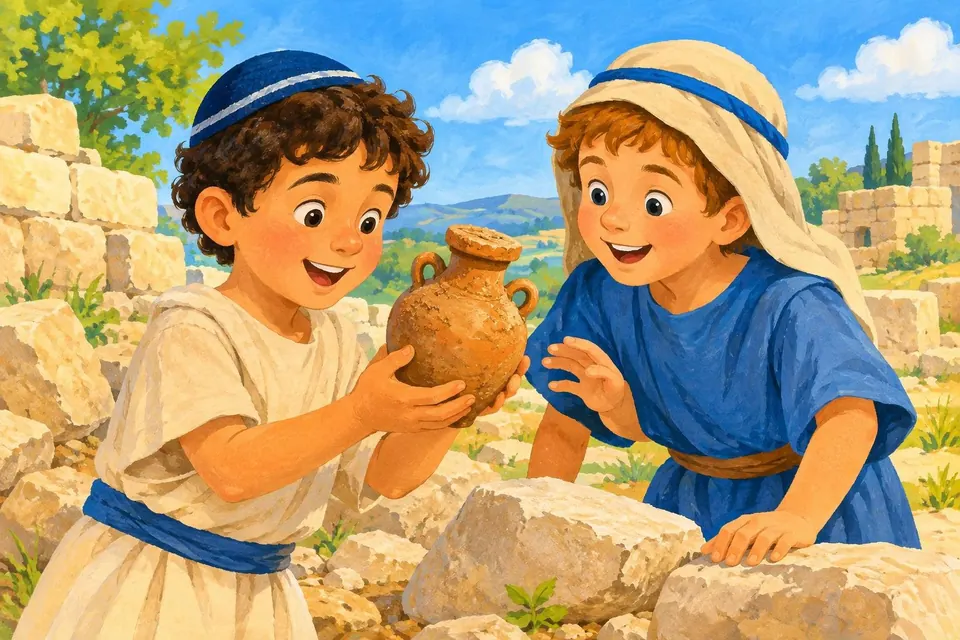
Suddenly, in the lishkat hashemanim, the oil storeroom, he noticed that one of the floor stones was not stone at all. It was fired clay—the bottom of a jug. He called Julius and the other boys who were helping clean the Temple. The High Priest himself came, too. Together, with the greatest care, they pulled the cleverly hidden jug out of the stone floor. It wasn't so little after all.
But after examining the High Priest's seal on the neck of the jug and judging how much oil it held, the kohanim said it would last for only one day. New oil would not arrive from the territory of Asher for another eight days. Some people suggested dividing the oil into eight portions and lighting the menorah for a short time each day. But the High Priest ruled that, for at least one day, the menorah would burn all night as commanded. After that, may God help us.
And God did help. The sacred, pure olive oil from the little jug burned without going out for eight days. Surely it was the second of the “little jugs” Jacob had saved from Esau's dark angel.
In honor of the great miracle of the oil, the Sages established the festival of Hanukkah for all generations: a festival of light, of the dedication of the Temple, and of the victory of the few Jews over the countless Greek hordes, the weak over the strong, and the pure over those who defiled themselves with idolatry.
Keep reading
More →Hanukkah: Never Lose Hope
Hanukkah teaches that even in spiritual darkness, it is possible to turn to God and find light.
Guide · HanukkahWhen Should You Light Hanukkah Candles?
Jewish authorities differ on whether Hanukkah candles should be lit at sunset or after nightfall.
HanukkahWhy Is Hanukkah the Last Holiday?
Hanukkah reveals how the darkness of forgetting can lead to a flourishing of Torah.
HanukkahTorah and Greek Wisdom: What Does Hanukkah Teach Us?
Hanukkah reflects a struggle over the purpose of wisdom and the influence of the world around us.







