Hanukkah: What Do We Really Want?
Rabbi Yaakov Galinsky explores what the Hanukkah story reveals about the Jewish people's desire to serve God.
In brief
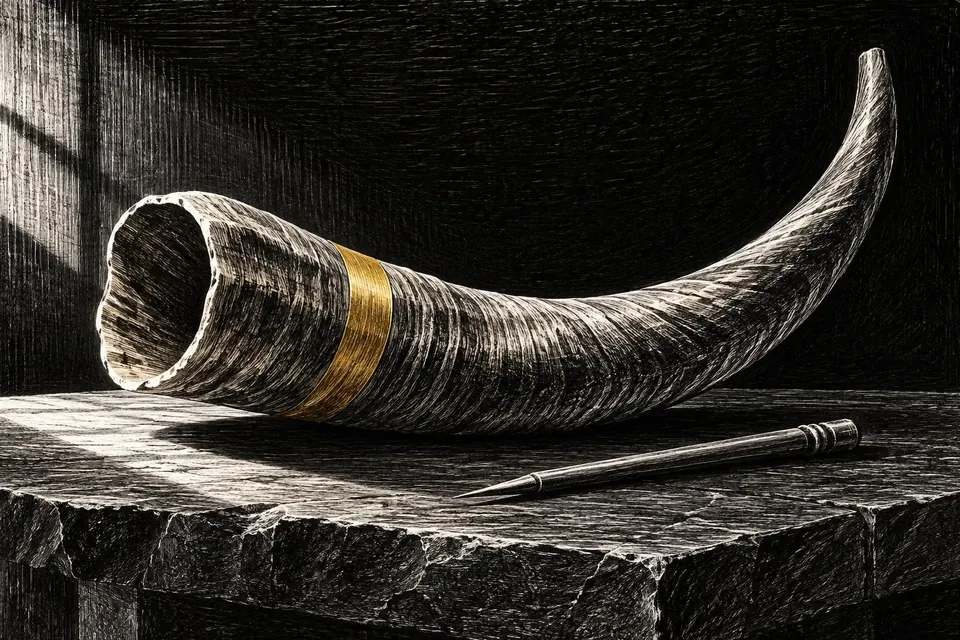
- The Midrash singles out the Greek decree that Jews write on an ox's horn that they have no share in the God of Israel.
- The Greeks believed the Jewish people wanted to be free of the Torah and its mitzvot.
- The Jewish revolt revealed a deep desire to fulfill God's will.
- The miracle of the oil allowed the Jews to light the Temple menorah rather than be excused from the mitzvah.
“When the wicked Greek kingdom rose up against Your people Israel, to make them forget Your Torah and violate Your laws” [Al Hanissim, Hanukkah].
Bereishit Rabbah (2:4) comments on the verse: “The earth was unformed and empty, and darkness was over the face of the deep, and the spirit of God hovered over the waters” (Genesis 1:2). The Midrash explains that the verse alludes to four kingdoms that would rule over Israel. The “unformed” earth is the Babylonian exile, and “empty” is the exile of Media. “Darkness” is the Greek exile, which darkened the eyes of the people of Israel with its prohibitions and decrees, telling them, “Write on an ox's horn that you have no share in the God of Israel.”
“Over the face of the deep” is the exile under the wicked kingdom of Edom, which, like the deep, has no end. “The spirit of God hovered” is the spirit of the Messiah, about whom it is said, “The spirit of God will rest upon him” (Isaiah 11:2). And “over the waters” refers to the merit of repentance, which is compared to water, as it says, “Pour out your heart like water” (Lamentations 2:19).
Why, out of all the destructive decrees meant “to make them forget Your Torah and violate Your laws,” out of all the prohibitions that “darkened the eyes of the people of Israel,” does the Midrash choose this one: “Write on an ox's horn that you have no share in the God of Israel”?
The Decree of the Ox's Horn#
After all, the Jews stood firm against this decree, and things even turned out for the better. The “Midrash on Hanukkah” (Yalkut Sippurim, Miketz) relates:
The Greeks decided to devise a scheme against the people of Israel. They said, “Let us impose more and more restrictions on them until they reject their God and come to believe in our gods.” They decreed that anyone who put a lock on his door would be put to the sword, so that the Jews would have no dignity, private property, or modesty.
Then they decreed that anyone who owned an ox must engrave on its horn that he had no share in the God of Israel. This would prevent them from plowing. “They won't be able to bear this,” the Greeks said.
But when the Jews heard this, they were deeply distressed and said, “God forbid that we should betray our God!” They went and sold all their livestock. Deer, gazelles, and various kosher birds entered the Jews' homes because there were no locks. The Jews slaughtered them and blessed the Almighty, who had turned their enemies' plans to good. Had the doors been locked, none of this game could have entered.
It seems, then, that this was not a decree that “darkened our eyes.”
Rashi, however, writes in his commentary on the Midrash that the Greeks meant to allude to the sin of the Golden Calf: “Since you made the image of an ox, you showed everyone from that moment on that you have no share in the God of Israel.”
The Maharal of Prague explains in Ner Mitzvah (a work on Hanukkah) that the horn is part of the ox itself. The Greeks wanted to suggest that the Jews' sin was an expression of their very nature, not an isolated mistake. The horn is also one of the strongest things in the world. Thus, the sins, as it were, said that this was rooted in the Jews' stubbornness, as it says in the account of the calf: “I have seen this people, and they are a stiff-necked people. Now leave Me, and I will destroy them” [Exodus 32:9–10].
Let us explain. The Greeks simply felt sorry for us!
Poor Jews, with so many mitzvot! The Torah is so complicated, with so many laws and details. And all the more so the Oral Torah, which at the time could not yet be written down and had to be remembered by heart: “It is so difficult to study, and it involves great hardship and sleeplessness, and one must carefully observe all the mitzvot, both the easier and the more difficult” (Midrash Tanchuma 58:3).
So they were ready to save us and release us from captivity. They would issue a decree forbidding us to keep the mitzvot and study Torah. Then, since “the Merciful One excuses a person who is prevented by circumstances beyond their control” [Bava Kamma 28b], there would be nothing we could do, and we would be free of these inconvenient bonds.
They even had proof: We received the Torah under threat of destruction, when God held the mountain over us! And at the first opportunity we made the calf. That, they argued, showed our true desire: We supposedly longed to throw off this yoke and stubbornly refused to listen to the Creator. If so, “write on an ox's horn that you have no share in the God of Israel,” God forbid.
What the Greeks Misunderstood#
This is what we mean when we say, “When the wicked Greek kingdom rose up against Your people Israel.” Why use the expression “rose up”? Why not say that it attacked or issued wicked decrees?
King David says, “Satan will stand at his right hand” (Psalms 109:6). Metsudat David (a commentary on the Hebrew Bible) explains: “To be ready to accuse him.” The Greeks accused us before the Creator when they sought “to make them forget Your Torah and violate Your laws.” They claimed that we did not want to study or know the Torah; that it was not “our Torah” but “Your Torah,” and we were forced to study it. And so, too, with “violate Your laws,” literally, “the laws of Your will.” They claimed that all the mitzvot were merely a heavy burden to us: They were “Your will,” not our desire.
Then, to their utter amazement, we rose up and rebelled against them! Ungrateful, weren't we? Not only did we fail to thank them for graciously freeing us and breaking the burden on our necks; we even spurned their kindness and went to war against them!
They had been terribly mistaken: “But You, in Your great mercy, stood by them in their time of distress” [Al Hanissim, Hanukkah]. How much is contained in that one word! The Jews did not rejoice when they were “freed” from keeping the mitzvot by circumstances beyond their control. They felt it was a terrible misfortune, a time of distress! “It darkened the eyes of Israel with its prohibitions and decrees.” Our hearts ached; our eyes grew dark. For the Torah is our Torah, and the mitzvot are our will, our desire:
It is revealed and known to You that our desire is to do Your will. What stands in our way? The leaven in the dough—the evil inclination in our hearts, which causes us to “sour”—and the rule of foreign kingdoms. May it be Your will to save us from them, so that we may return to fulfilling the laws of Your will with a whole heart! (Berakhot 17a)
Yes, they are the “laws of Your will,” but we want to fulfill them!
Our acceptance of the Torah at Mount Sinai was genuine, a passionate expression of our deepest desire: “We will do and understand” [Exodus 24:7]. The sin of the Golden Calf does not reflect who we are. It was the erev rav (the mixed multitude who joined the Israelites) who led us into sin.
The Talmud (Berakhot 32b) explains the words in Isaiah 49:15, “Even if these should be forgotten, I will not forget,” as follows: The sin of the Golden Calf, of which the people said, “These are your gods, Israel” [Exodus 32:4], will be forgotten because it is only external. But “I”—anochi, the Hebrew word with which the giving of the Torah begins, “I am the Lord your God” [Exodus 20:2]—will not be forgotten. For this is our deepest essence, our own “I”!
On this subject, the Bach writes in his commentary Bayit Chadash on Orach Chaim 670:
On Hanukkah, the principal punishment came because the people had grown negligent in their service of the Creator. Therefore, a decree was issued from Heaven to prevent them from performing that service. But when they repented and were ready to sacrifice their lives for it, God saved them through the priests who performed the service in the Temple. The miracle of the lights in the Temple took place precisely because the Jews had awakened and were ready to die in order to perform that service. For this reason, the Sages did not establish a festive meal. Instead, they ordained praise and thanksgiving to the Creator, which are service of the heart.
At first glance, the Greeks had proof that we kept the Torah's mitzvot only because we had to, and that we would be glad to rid ourselves of the burden. They saw us neglecting the mitzvot and performing them carelessly, merely to get them over with. So they thought we would be grateful when they forbade us to keep them: We would be “forced” not to observe them and would therefore be excused.
They did not understand that, on the contrary, they had awakened our deepest desire to do God's will and restore His crown to its place!
From Bialystok to Siberia#
I remember when I studied in the yeshiva in Bialystok. Naturally, some students were more diligent than others, and there were even some who just hung around the yeshiva, doing nothing. When the war broke out, you might have thought their time had come: They no longer had to study.
We fled from Bialystok to Vilnius. And then came a wonder: Every one of those idlers, just like every diligent student, took tefillin and a volume of Talmud along with him! Amazing! Why do you need a Talmud? What do you mean, why? I'm a yeshiva student!
In Vilnius they had plenty to occupy them. For the diligent students, of course, there was nothing but Torah. But for the others—oh, so much news! Which other yeshivas had arrived, and where they had settled. What rumors were coming out of occupied Poland.
Then came the revolution, secret study despite the Communist prohibition, and a great roundup. We found ourselves on a train bound for Siberia. I looked around and saw that every one of those “idlers,” just like us, had tefillin and a Talmud! Why? You didn't study in Bialystok, you didn't study in Vilnius, and now you're going to study in Siberia? But he's a yeshiva student!
We arrived at a labor camp and were told that we had been sentenced to 25 years of hard labor. They tore the tefillin from our hands—I managed to hide mine, and one other pair was saved—grabbed the volumes of Talmud, lit a fire, and threw them all in. My heart was breaking, my eyes grew dark, and my legs gave way. I could not see myself, but I glanced at those young men: Their eyes bulged in horror, and their faces were as pale as the dead.
You might think they should have been glad. If they had previously idled by choice, now they could not study because it was impossible, so Heaven could have no complaint against them. But the secret was now revealed: Their idleness had been only the work of the “leaven in the dough”; it was external. They had always thought, “It's all right, I'll start studying yet.” But now that the “rule of kingdoms” had come and shut the door, their eyes grew dark and their hearts ached. Because, in truth, “our desire is to do Your will”!
The Miracle of the Oil#
This was the true meaning of the miracle of the small jar of oil:
When the Greeks entered the Temple, they defiled all the oils. When the Hasmoneans defeated them and entered the Temple to restore the service, they found only one small jar of oil, sealed with the high priest's seal. It contained enough for only one day. But a miracle occurred, and they lit from its oil for all eight days (Shabbat 21b).
We need to understand: They found enough oil for one day, so let them light it. On the remaining days, “the Merciful One excuses a person who is prevented by circumstances beyond their control”—that is, He releases them from the obligation to perform the mitzvah.
But that was the very point of the revolt! The Greeks had offered us an excuse for not performing mitzvot on a silver platter! And we rebelled against them. We do not want to be “released from the obligation.” “Our desire is to do Your will”!
So Heaven did not leave us without oil, relying on an exemption from the mitzvah. A miracle occurred, and we were able to fulfill the mitzvah of lighting the Temple menorah every day!
That is why the Sages instructed us to light candles in memory of the miracle, and also gave us the opportunity to perform the mitzvah in the finest way, by lighting olive oil and the like. For we do not want to be excused or to fulfill mitzvot however we happen to manage. We want to fulfill the Creator's mitzvot in the finest way, because “the laws of Your will” are “the laws of our will”!
By Rabbi Yaakov Galinsky
Keep reading
More →Hanukkah: Never Lose Hope
Hanukkah teaches that even in spiritual darkness, it is possible to turn to God and find light.
Guide · HanukkahWhen Should You Light Hanukkah Candles?
Jewish authorities differ on whether Hanukkah candles should be lit at sunset or after nightfall.
HanukkahWhy Is Hanukkah the Last Holiday?
Hanukkah reveals how the darkness of forgetting can lead to a flourishing of Torah.
HanukkahTorah and Greek Wisdom: What Does Hanukkah Teach Us?
Hanukkah reflects a struggle over the purpose of wisdom and the influence of the world around us.







