The Hanukkah Miracle as a Sign of God’s Love
The miracle of the oil reveals a special expression of God’s love for the Jewish people.
In brief
- The military victory saved the Jewish people, but the miracle of the oil revealed God’s special love for them.
- The fragrant spices on Joseph’s journey to Egypt were a sign that God had not abandoned him.
- Miracles that seem to serve minor purposes can be expressions of particular affection.
- The Maccabees risked their lives out of love for God and were rewarded with a miracle that expressed His love.
“What is Hanukkah? (Rashi explains that the question ‘What is Hanukkah?’ means: ‘In honor of which miracle was it established?’) Our Sages taught: On the 25th of Kislev ... When the Greeks entered the Temple, they defiled all the oil that was there. When the Hasmonean kingdom prevailed over them and defeated them, they searched and found only one jar of pure oil, sealed by the High Priest. It contained enough to light the menorah for only one day. A miracle occurred, and it burned for eight days. The following year, they established these days as a festival of praise and thanksgiving” (Shabbat 21b).
This calls for reflection. At that time, the entire people of Israel faced the threat of destruction, God forbid. The addition to the Hanukkah prayers mentions this: “When the wicked Greek kingdom rose against Your people Israel to make them forget Your Torah and cause them to transgress the laws of Your will.” Great miracles then occurred: “You delivered the mighty into the hands of the weak, and the many into the hands of the few ... You made for Yourself a great and holy name in Your world, and for Your people Israel You brought about a great salvation and deliverance to this day.”
At first glance, it would seem more logical to connect Hanukkah with that deliverance. [But the festival was established not on the day of the victory over the Greeks, but on the following day, when the miracle of the oil occurred.] Can the miracle of the small jar of oil, needed to light the menorah in purity for seven days, compare with the miracle of deliverance? That deliverance saved the entire Jewish people from destruction and allowed them to survive, study Torah, and keep the mitzvot—not only in that generation, but in every generation afterward.
The Fragrance of Spices#
The Torah says of Joseph’s journey to Egypt: “A caravan of Ishmaelites was coming from Gilead, with their camels carrying spices, balm, and ladanum, on their way down to Egypt” (Genesis 37:25). The Sages comment: “Do Ishmaelites not usually load their animals with nothing but hides and tar? But look at what the Almighty prepared for this righteous man, Joseph: bundles full of spices, a source of fragrance instead of the usual stench that accompanies caravans” (Yalkut Shimoni, Genesis, section 142).
At first, this is difficult to understand. It was a terrible moment for Joseph, who was being taken to Egypt against his will. In an instant, he had fallen from the heights. Only recently, he had been the beloved son of his elderly father, Jacob, who had taught him all the wisdom he had acquired in the houses of study of Shem and Ever. Now Joseph had fallen into the deepest pit: He had been sold into slavery, and in Egypt, a place that had sunk through all 49 levels of impurity. Egypt was sealed off, and no slave had ever managed to escape. It seemed that Joseph would never be free again.
All this had happened so quickly and unexpectedly that Joseph had no time to grow accustomed to his terrible situation. At such a dark hour, what difference could it make to him whether he smelled resin and tar or spices? Could the fragrance of spices help him in any way, or even lift his spirits? It is astonishing.
On deeper consideration, however, we see that the scent of the spices was enormously significant.
Its purpose was not simply to give Joseph something pleasant to smell. At that bitter moment, when his entire life had suddenly fallen apart, Joseph might have fallen into complete despair, God forbid. It seemed that the Almighty had hidden Himself from him entirely, and that he was lost and forgotten, God forbid.
At that difficult moment, Heaven gave him a hint that the opposite was true. God was with him, continually directing everything that happened to him. Joseph should not stop trusting in Him. The Almighty had deliberately prepared a pleasant scent for him, departing from the ordinary course of events to show him that he was neither lost nor forgotten. On the contrary, God was “leading him by the hand” and going down to Egypt with him. This is what God told Jacob: “I will go down with you to Egypt, and I will surely bring you back” (Genesis 46:4).
The fragrance was a ray of light for Joseph in the darkness into which he had been thrown. It gave him hope that he could escape his difficult situation. This resembles what the prophet Jonah said: “I have been cast away from before Your eyes, yet I will look again toward Your holy Temple” (Jonah 2:5). Rashi explains: “When I saw that You were keeping me alive all this time, I understood that I would yet see Your holy Temple.”
We can now understand that the miracle for Joseph was not simply meant to spare him a repulsive smell. God revealed Himself to encourage Joseph, so that he would understand and feel that even in this situation he had not been abandoned. God was with him, loved him, and sent him the fragrance of spices. From this Joseph could conclude that God was sending him all his suffering only out of love.
Miracles That Seem Minor#
The Torah describes several miracles that, at first glance, seem to have served minor purposes. One example occurred during David’s fight with Goliath. Scripture says: “David put his hand into his bag, took a stone from it, and slung it. He struck the Philistine on the forehead, and the stone sank into his forehead, and he fell face down to the ground” (1 Samuel 17:49).
Someone struck hard on the forehead should fall backward. But a miracle occurred so that David would not have to walk as far to cut off Goliath’s head. David thus saved himself 12 cubits and 2 handbreadths: Goliath was 6 cubits and a handbreadth tall (Rashi on 1 Samuel 17:49, citing Midrash Tehillim; see also 1 Samuel 17:4 and Metzudat Zion there).
This is surprising, especially in light of what the Sages said: “How disgraceful is this man, for whose sake the laws of nature were changed” (Shabbat 53b; see also Taanit 24a). Changing the laws of nature is no small matter. Yet here they were changed to save David a few steps on his way to cut off Goliath’s head. The extra distance would have posed no difficulty for him at all.
A Miracle for Abraham#
We find something similar in the Or HaChaim’s commentary on Genesis 13:14. The verse says: “Lift up your eyes and look from the place where you are, northward and southward, eastward and westward.” The Or HaChaim writes: “It says ‘from the place where you are’ because a great miracle occurred for Abraham. He saw from north to south and from east to west from one place, without turning.”
This calls for an explanation. Would it have been so hard for Abraham to turn around and look at the entire Promised Land in every direction? Did he really need this great miracle? [Elsewhere, the author explains that seeing the whole Land of Israel at once is in fact qualitatively different from seeing it in parts. The whole is always qualitatively different from the sum of its parts. But the words of the Or HaChaim suggest that the miracle was needed to spare Abraham the trouble of turning his head.]
The principle we have established can explain these miracles: some miracles are needed only so that God’s “face” can be revealed. But first, a short parable.
A family lost an extremely valuable diamond that had been passed down from generation to generation. Everyone was deeply upset, and they spared no effort in searching for it. After a long and exhausting search, one of the children found the lost jewel. His father came over and kissed him on the forehead. The whole family was overjoyed, and the child shared in their joy. But he also had a joy of his own: the kiss he had received from his father.
This is the great significance of these miracles. There is no doubt that David’s killing of Goliath was itself a great miracle. It sanctified the Creator’s name and saved the entire people of Israel, including David himself. But David was also granted a miracle of his own, performed especially for him—his own “kiss.”
The miracle of Goliath’s falling forward, which saved David 12 cubits and 2 handbreadths, has no significance of its own. Its entire meaning lies in the special favor shown to David while a miracle was being performed for all Israel. Indeed, the less practical need there was for David’s personal miracle, the more clearly it showed that special favor.
The miracle performed for Abraham can be understood in the same way. He saw the entire Land of Israel in a single glance, without having to turn his head. At that moment he received a promise: “For all the land that you see, I will give to you and your descendants forever. I will make your descendants like the dust of the earth, so that if anyone can count the dust of the earth, your descendants too can be counted. Rise and walk through the land, its length and its breadth, for I will give it to you” (Genesis 13:15–17).
This contains the promise that the people of Israel would come into being and that the land of Canaan would be given to them. Through this, all creation would attain the purpose for which it was created. But even as Abraham received this promise, he was granted an additional “kiss.” A miracle occurred so that he would not have to turn around to see the whole Land of Israel. This miracle was not for the entire people, but for Abraham personally—a special revelation of the favor he had earned.
Yocheved’s Wages#
The same principle helps us understand what happened to Yocheved. After Pharaoh’s daughter Bithiah rescued Moses, “Pharaoh’s daughter said to her, ‘Take this child and nurse him for me, and I will pay you.’ The woman took the child and nursed him” (Exodus 2:9). The Sages said: “Not only is what the righteous have lost returned to them, but they are also paid for it. ... The Almighty returned her son to her and even gave her wages for it.”
At first, what value could Yocheved’s pay have compared with the great miracle she had experienced? The child whom the Egyptians had sought to kill, and whom she herself had been forced to place in the Nile, had been saved. And his rescue mattered not only to Moses’ immediate family. It was known that Moses was the savior of Israel, and that deliverance from Egyptian slavery depended on him and no one else. Saving Moses therefore meant saving the entire people of Israel. Compared with that, what significance did Yocheved’s pay have?
The explanation is the same as in the examples above. Yocheved’s pay had no significance of its own. Its entire purpose was to be a sign of favor intended especially for her. At a time of great deliverance—the rescue of Moses—the words “I will pay you” showed her special favor.
The Jar of Oil#
This principle—that a miracle can sometimes be a “kiss,” meant only to show God’s favor—also helps us understand the miracle of the jar of oil and why Hanukkah was established specifically in its honor. This is so even though the miracle cannot be compared in importance with the deliverance of the entire people of Israel.
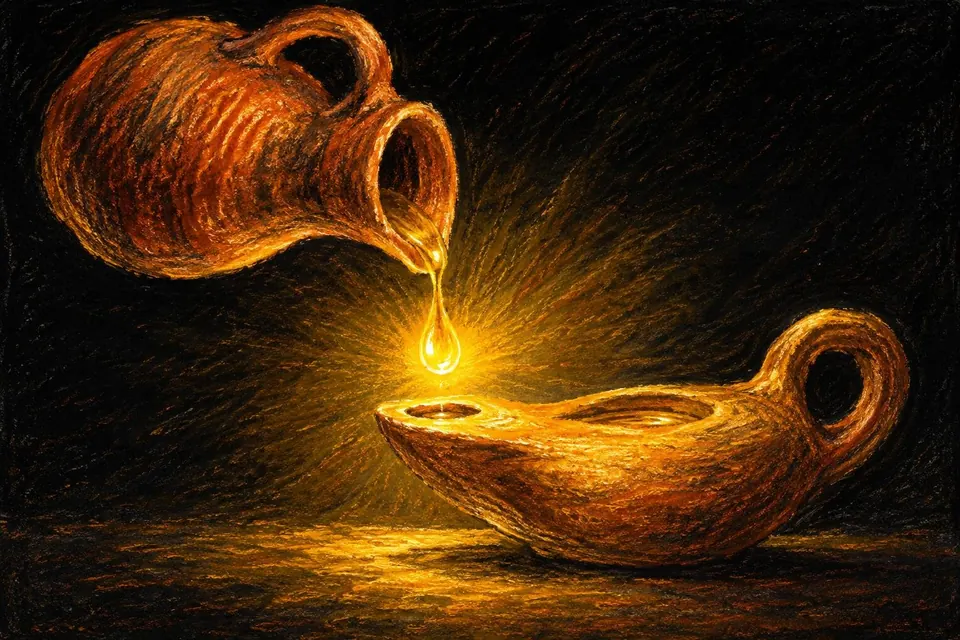
The miracle that made it possible to light the Temple menorah in purity for eight days was a special revelation of God’s love for His people. The whole miracle was like a “kiss,” an expression of God’s particular favor toward the Jewish people.
In the relationship between a father and his children, a father’s love can be seen precisely when he gives them things they do not need—extras. If a father has a child of whom he is not fond because that child has not chosen a path of piety, he gives him only the necessities. But if he has a dearly loved son who brings him great joy, he is ready to give him whatever he wants.
On reflection, we can see that although meeting a child’s basic needs is more important than giving him all kinds of extras, it is the extras that show how highly the father values his son. The less necessary the gift, the more it expresses his special love.
The same can be said of the Hanukkah miracle.
The miraculous military victory over the Greeks, in which the mighty were delivered into the hands of the weak and the many into the hands of the few, was a necessity. It enabled the community of Israel to continue to exist, and it fulfilled the promise concerning the study of Torah: “It will not be forgotten from the mouths of their descendants” (Deuteronomy 31:21). But God’s love for the people of Israel was not revealed as clearly in that miracle.
The miracle of the jar of pure oil, on the other hand, was performed only to make it possible to fulfill the mitzvah a little better. Compared with the other miracles of Hanukkah, it could be described as an “extra.” It was an expression of special favor, showing that the people of Israel had been granted a revelation of the Creator’s great love.
It was to remember that the people of Israel were granted not merely a victory, but a victory in which the Creator’s love was revealed, that the Sages established these eight days of Hanukkah for us to “give thanks and praise.”
[The fact that they were granted this particular miracle—a miracle expressing favor and pointing to God’s great love—was a result of a special quality of the Maccabees. They loved God so deeply that they were willing to sacrifice themselves to sanctify His name. They went to war, although they were weak and few, because a burning love for the Creator filled their hearts. They were therefore granted a miracle that expressed love.]
Keep reading
More →Hanukkah: Never Lose Hope
Hanukkah teaches that even in spiritual darkness, it is possible to turn to God and find light.
Guide · HanukkahWhen Should You Light Hanukkah Candles?
Jewish authorities differ on whether Hanukkah candles should be lit at sunset or after nightfall.
HanukkahWhy Is Hanukkah the Last Holiday?
Hanukkah reveals how the darkness of forgetting can lead to a flourishing of Torah.
HanukkahTorah and Greek Wisdom: What Does Hanukkah Teach Us?
Hanukkah reflects a struggle over the purpose of wisdom and the influence of the world around us.







