What Do the Four Species of Sukkot Mean?
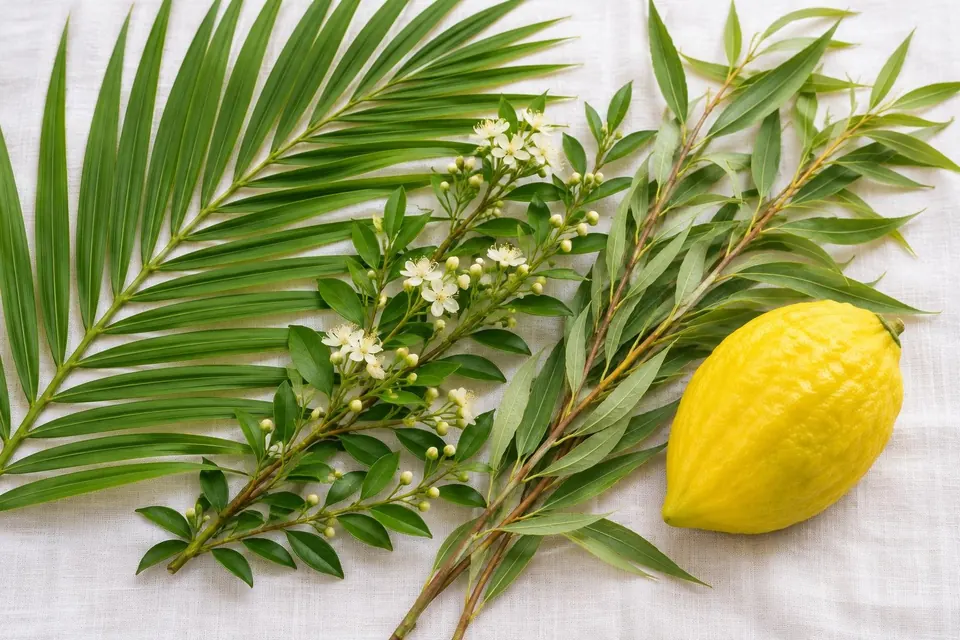
The Sages offer several explanations of what the four species represent.
In brief
- One explanation links the four species to four types of Jews.
- Their union teaches that members of the Jewish people can lift up and support one another.
- Other interpretations associate the species with God, biblical figures, the Jewish court, and parts of the body.
- All four species must be suitable for the mitzvah, so the willow should not be neglected.
The best-known explanation offered by our Sages is that the four species represent four types of Jews.
The etrog (citron), which has both taste and fragrance, represents a Torah scholar who also has both taste, meaning Torah, and fragrance, meaning mitzvot.
The lulav (palm branch), which has taste in its fruit, the dates, but no fragrance, represents someone who has taste, meaning Torah, but no mitzvot—that is, no good deeds.
The hadas (myrtle), which has fragrance but no taste, represents someone who has fragrance, meaning mitzvot, but no taste, meaning Torah study.
The willow, which has neither taste nor fragrance, represents those who have neither Torah nor mitzvot.
Yet when they are all joined together, even the least accomplished are lifted up. Our holy books teach that it is the etrog that influences the willow. When we take the palm branch in our right hand, the willow is bound to its left side. The etrog is in the left hand and touches the willow. This suggests that someone who has both Torah and good deeds can help bring others closer.
Winning the Judgment#
A well-known Midrash says that on Rosh Hashanah, the Jewish people and the nations of the world stand in judgment against one another, and it is not known who has won. When we take the lulav on Sukkot, it shows that we have won.
A wonderful student from St. Petersburg once asked me, “Can there really be any doubt about who won? Surely the Jewish people, with the holiness of Torah and mitzvot, are better!”
I answered him, “If all Jews were like you, there would be no doubt. But the problem is that there are Jews whose difference from members of other nations cannot be seen by human eyes. It is about them that there is doubt on Rosh Hashanah.”
How does the lulav help? On Sukkot, we proclaim that we are one, and in this way we can lift up the least worthy among us. Among other nations, by contrast, it is every person for themselves: they do not have the strength of community.
Midrash Rabbah on the portion of Emor says:
“The bough of a leafy tree” (Leviticus 23:40) represents the Jewish people. Just as the myrtle has fragrance but no taste, so there are Jews who have good deeds but no Torah. “And willows of the brook” (Leviticus 23:40) represent the Jewish people. Just as the willow has neither taste nor fragrance, so there are Jews who have neither Torah nor good deeds.
What does the Holy One, blessed be He, do with them? It is impossible to destroy them. So the Holy One, blessed be He, said: “Let them all be bound together as one, and let some atone for the others. If you do this, I will immediately be exalted.”
As it is written: “He built His upper chambers in the heavens” (Amos 9:6). When does He ascend? When they become one, as it says in the same verse: “And founded His vault upon the earth.” Therefore Moses urges Israel: “And you shall take for yourselves on the first day…”
The Babylonian Talmud says in Menachot 27a:
Two of the four species bear fruit, and two do not. Those that bear fruit are joined to those that do not, and those that do not bear fruit are joined to those that do. A person cannot fulfill the obligation until all of them are joined together as one. The same is true of the Jewish people: when they fast, they are not answered until they all become one.
Do Not Neglect the Willow#
I have noticed that some people who want to perform the mitzvot in the finest way spend $200 on the very best etrog.
If they are blessed with financial abundance, that is wonderful. But if they already struggle to make ends meet, clearly they should not spend so much on exceptionally fine specimens of the four species. Such a person should instead buy four species that are simply fit for the mitzvah and use the rest of the money to buy plenty of food for the holiday, as well as a new garment or a piece of jewelry for his wife. In this way, he will fulfill the mitzvah of the four species and also fulfill the mitzvah “you shall rejoice on your festival” in the way our Sages taught us [Deuteronomy 16:14].
They spend $50 on a very fine lulav and another $50 on very fine myrtle branches. Yet they buy the cheapest willow branches, and often those branches are unfit for the mitzvah.
For example, they may buy willow branches from children. Such branches are unfit for the mitzvah on the first day because a child cannot sell anything. There is also a possibility that dishonest children or youths steal the branches, which also makes them unfit for the mitzvah.
Apparently, they have forgotten the Mishnah in Menachot, which teaches that the mitzvah of the four species is fulfilled only if all four species are fit for the mitzvah. If even one is unfit, having all the others serves no purpose.
What led them to neglect the willow? Perhaps it was the Sages’ teaching that the willow branches represent the most spiritually empty members of our people. But if only they knew that, according to other interpretations of the Sages, the willow branch represents the Holy One, blessed be He! Or our matriarch Rachel! Or the righteous Joseph! If they knew these interpretations, they would not neglect the willow branch. With this in mind, I decided to share these less familiar explanations from our Sages.
Other Meanings of the Four Species#
Midrash Rabbah on Emor, chapter 30, says:
Another explanation: “The fruit of a beautiful tree” (Leviticus 23:40) is the Holy One, blessed be He, of whom it is written: “You have clothed Yourself in glory and splendor” (Psalms 104:1). “Palm branches” (Leviticus 23:40) are the Holy One, blessed be He, of whom it is written: “The righteous will flourish like a palm” (Psalms 92:13). “A bough of a myrtle tree” (Leviticus 23:40) is the Holy One, blessed be He, of whom it is written: “He stood among the myrtles” (Zechariah 1:8). “And willows of the brook” (Leviticus 23:40) are the Holy One, blessed be He, of whom it is written: “Exalt the One who rides through the heavens; the Lord is His name” (Psalms 68:5). In this verse, the heavens are called aravot in Hebrew, a word also associated with willows.
Another explanation: “The fruit of a beautiful tree”—hadar, “beautiful”—is Abraham, whom the Holy One, blessed be He, adorned with a good old age. As it says, “Abraham was old, advanced in years” (Genesis 24:1), and it says, “Honor the presence of an elder” (Leviticus 19:32), using the related word vehadarta, “you shall honor.” “Palm branches”—kapot—are Isaac, who was bound, kafut, and laid on the altar. “A bough of a myrtle tree” is Jacob: just as a myrtle branch is rich in leaves, Jacob was rich in sons. “And willows of the brook” are Joseph: just as a willow branch withers faster than the other three species, Joseph died before his brothers.
Another explanation: “The fruit of a beautiful tree” is Sarah, whom the Holy One, blessed be He, adorned with a good old age, as it says: “Abraham and Sarah were old” (Genesis 18:11). “Palm branches” are Rebecca: just as a palm has both edible fruit and thorns, Rebecca carried a righteous son and a wicked son. “A bough of a leafy tree” is Leah: just as a myrtle branch is rich in leaves, Leah was rich in sons. “And willows of the brook” are Rachel: just as a willow branch withers faster than the other three species, Rachel died before her sister.
Another explanation: “The fruit of a beautiful tree” is the Great Sanhedrin of the Jewish people, whose members the Holy One, blessed be He, adorned with a good old age, as it says: “Rise before the gray-haired” (Leviticus 19:32). “Palm branches” are the Torah sages, who make an effort to learn Torah from one another. “A bough of a myrtle tree” is the three rows of students sitting before them. “And willows of the brook” are the two judges’ scribes who stand before them and record the words of those arguing for acquittal and those arguing for conviction.
Rabbi Mani began his discourse with the verse: “All my bones will say, ‘Lord, who is like You?’” (Psalms 35:10). This verse was said in honor of the lulav. The spine of the lulav resembles a person’s spine. The myrtle resembles the eye, the willow branch resembles the mouth, and the etrog resembles the heart. David said: “Among all the organs, none are greater than these, which are as significant as the whole body. Thus, all my bones will say it.”
Serving God With the Whole Body#
The holy books teach that after we have purified ourselves on Yom Kippur, we once again engage our most important organs in serving God.
The spine, the foundation of the body’s structure, serves through the performance of mitzvot and diligent Torah study. The eye serves through Torah study, checking for leaven before Passover, searching for a very fine etrog, and looking kindly upon our friends. The mouth serves through Torah study, prayer, and saying things that will bring people joy. The heart serves through love of God, awe of Him, and love of fellow Jews.
May the Almighty spread His sukkah of peace over us.
Addition by Rabbi Yigal Polishchuk: The most important reason not to neglect the willow, however, is the wholeness of our service to God, which comes before all these wonderful symbolic meanings.
And if we speak of symbolism, how important it is to bind Jews who have neither Torah, the taste, nor good deeds, the fragrance, together with everyone else. In this way, there is hope that they too will want to study and do good deeds. This does not contradict the idea that the aravah (willow) represents a less admirable part of the people of Israel. By bringing them closer to Torah, we help fulfill the Creator’s will to turn evil into good.
Moreover, without the aravah, the mitzvah simply cannot be fulfilled. This, too, suggests that without the unity of our entire people in serving the Creator, we are incomplete and not ready to receive the Torah fully. For the Torah was given to our people when they were in a state of the greatest unity, as it says, “Israel camped there” [Exodus 19:2]. Rashi explains that the verse uses the singular rather than the plural because they were all like one person with one heart [Rashi on Exodus 19:2].
By Rabbi Avraham Kuperman
Keep reading
More →How to Build a Sukkah: General Rules
The basic rules for choosing a location and covering a sukkah.
Guide · SukkotHow to Choose a Kosher Etrog
A guide to some of the features that can affect an etrog’s kosher status.
SukkotWhy Is Sukkot Called the Time of Our Joy?
The joy of Sukkot can deepen our love of God and prepare us for repentance.
SukkotWhy Celebrate Jewish Holidays With Food and Wine?
A parable from the Maggid of Dubno explores the connection between physical and spiritual joy.







