How to Build a Sukkah: General Rules
The basic rules for choosing a location and covering a sukkah.
In brief
- Begin building the sukkah after Yom Kippur, or study or discuss its laws if you cannot begin.
- A sukkah must be open to the sky when it is used for the mitzvah.
- Schach must be made from detached plant material that meets certain conditions.
- The schach must block most of the sunlight.
Begin building the sukkah at the end of Yom Kippur. If, for any reason, you cannot begin immediately after Yom Kippur—for example, if you feel unwell from fasting—you should spend that time studying the laws of building a sukkah, or at least discussing questions about the sukkah.
Even if Yom Kippur falls on Thursday, you should begin building the sukkah and continue until noon on Friday. According to many opinions, building it after noon is forbidden, since that time should be devoted entirely to preparing for Shabbat.
You cannot fulfill the mitzvah of sitting in a sukkah if it is under a roof or a tree. You may, however, build a sukkah under a tree and then cut down the tree or the branches above the sukkah.
You may also build a sukkah under a roof that opens. You may close the roof even during the festival to protect the sukkah from rain. When it is raining and sitting in the sukkah is unpleasant, there is no obligation to eat or sleep there. But when the weather allows you to be in the sukkah, the roof must be opened so that you can fulfill the mitzvah.
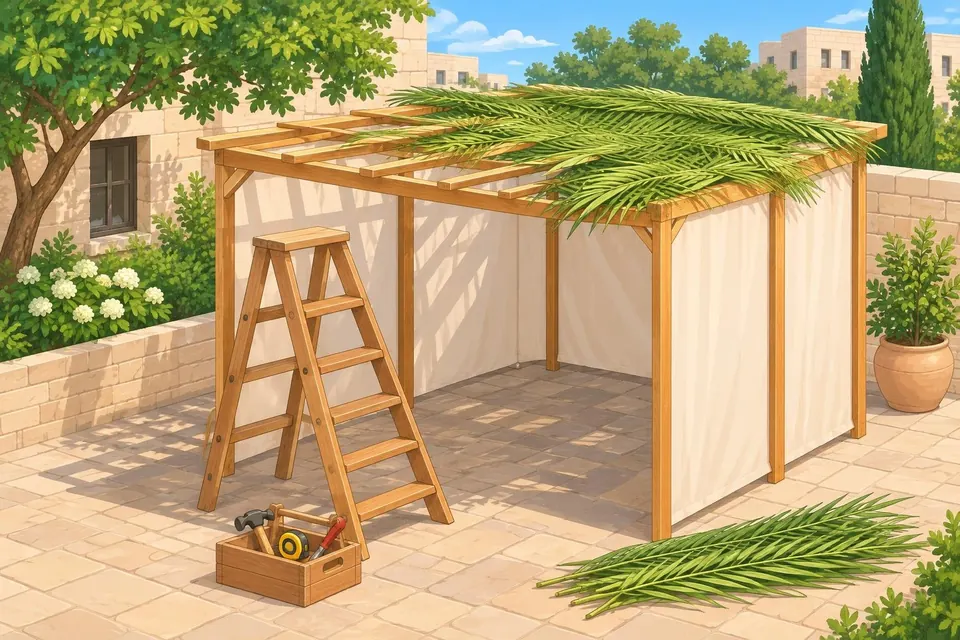
To fulfill the mitzvah, the sukkah’s “roof,” called schach, must be directly under the open sky. Schach is made from branches, leaves, sticks, and similar materials, and only from plant materials. These materials must also meet several conditions:
- They must no longer be growing from the ground. A sukkah built under a tree is therefore not kosher. But if branches from that same tree are cut so that they fall onto the sukkah, they are suitable for schach.
- They must not be utensils, clothing, pieces of broken furniture, or the like. An exception is a wooden utensil without a hollow space. Thus, a wooden fork or hammer may be used as part of the schach, but a wooden spoon or bowl may not.
- Even plant-based food is unsuitable for schach.
If there is a small amount of material unsuitable for schach among the branches, the sukkah remains kosher. If part of the sukkah’s roof consists of invalid material and is wider than approximately 40 cm (about 16 inches), however, you may not sleep or eat under that part.
The schach itself must be arranged so that it blocks most of the sun’s rays.
(Based on Shulchan Aruch, Orach Chaim 625 and 626:1–3; Mishnah Berurah; Dirshu.)
Practical law. This page reports a ruling given for a specific question. For your own situation, ask a rabbi who knows you.
Keep reading
More →How to Choose a Kosher Etrog
A guide to some of the features that can affect an etrog’s kosher status.
SukkotWhy Is Sukkot Called the Time of Our Joy?
The joy of Sukkot can deepen our love of God and prepare us for repentance.
SukkotWhy Celebrate Jewish Holidays With Food and Wine?
A parable from the Maggid of Dubno explores the connection between physical and spiritual joy.
Guide · SukkotSukkah Building Laws: Size, Walls, and Schach
- Laws of Building a Sukkah







