How to Choose a Kosher Etrog
A guide to some of the features that can affect an etrog’s kosher status.
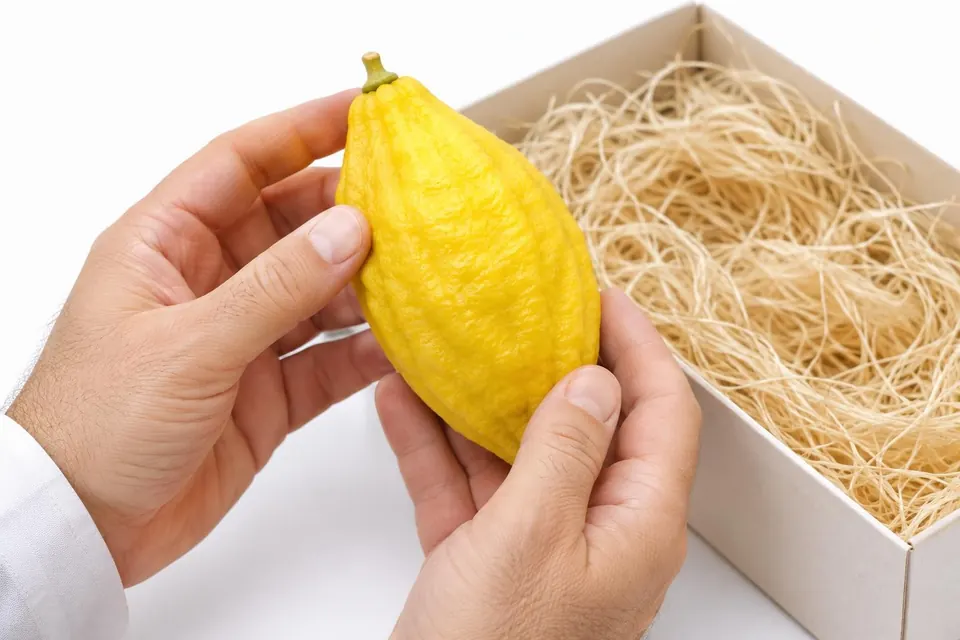
In brief
- An etrog should be whole and free of certain kinds of damage.
- A missing flower stem does not disqualify an etrog if it fell off while the fruit was still growing.
- Visible spots on the upper part of an etrog can make it non-kosher.
- Some dark marks are dirt or insects that can be removed carefully.
One of the four plants taken on Sukkot is the etrog (citron).
To choose a kosher etrog, you need to know at least some of the basic laws that apply to it.
An etrog must be whole. If a piece has been broken or cut off, if the stem connecting it to the tree (oketz, עוקץ, meaning “stem”) has been broken off at its base, if the flower stem (pitam, פיטם, meaning “flower stem”), part of which usually remains on the etrog, has broken off, or if the etrog has been dented, it is most likely not kosher. But if the flower stem fell off while the etrog was still growing on the tree, the etrog is kosher. Rabbis familiar with the laws of kosher etrogim can usually tell when a missing flower stem broke off.
A black or dark brown dot visible to the naked eye on the upper part of the etrog makes it non-kosher. The upper part is the area closer to the flower, where the etrog begins to taper. Any spots that do not make an etrog non-kosher still diminish its status. Someone who wants to perform the mitzvah in the best possible way should therefore try to find an etrog with a blemish-free peel. The peel should not be completely smooth, however, because a smooth peel is a sign that the etrog is not kosher.
Some black dots on etrogim are simply dirt or insects that live on citrus plants. Both can be carefully removed with a soft brush, soap and water, or similar means. Of course, this must be done with great care to avoid damaging the peel.
If pressure on an etrog has left a brown mark, the etrog is kosher. It is nevertheless preferable to avoid such marks, because they may turn black over time, making the etrog non-kosher.
A noticeable white spot, or a spot of another color, on the upper part of the etrog makes it non-kosher. The same applies when there are several small dots: even if none is very noticeable on its own, the etrog is not kosher if they would be conspicuous when joined together.
(According to Rabbi Yehudah Chesner, Shaarei Chag HaSukkot 10:2:1–8.)
Practical law. This page reports a ruling given for a specific question. For your own situation, ask a rabbi who knows you.
Keep reading
More →How to Build a Sukkah: General Rules
The basic rules for choosing a location and covering a sukkah.
SukkotWhy Is Sukkot Called the Time of Our Joy?
The joy of Sukkot can deepen our love of God and prepare us for repentance.
SukkotWhy Celebrate Jewish Holidays With Food and Wine?
A parable from the Maggid of Dubno explores the connection between physical and spiritual joy.
Guide · SukkotSukkah Building Laws: Size, Walls, and Schach
- Laws of Building a Sukkah







