Sukkah Building Laws: Size, Walls, and Schach
A concise guide to sukkah dimensions, walls, and roof covering.
In brief
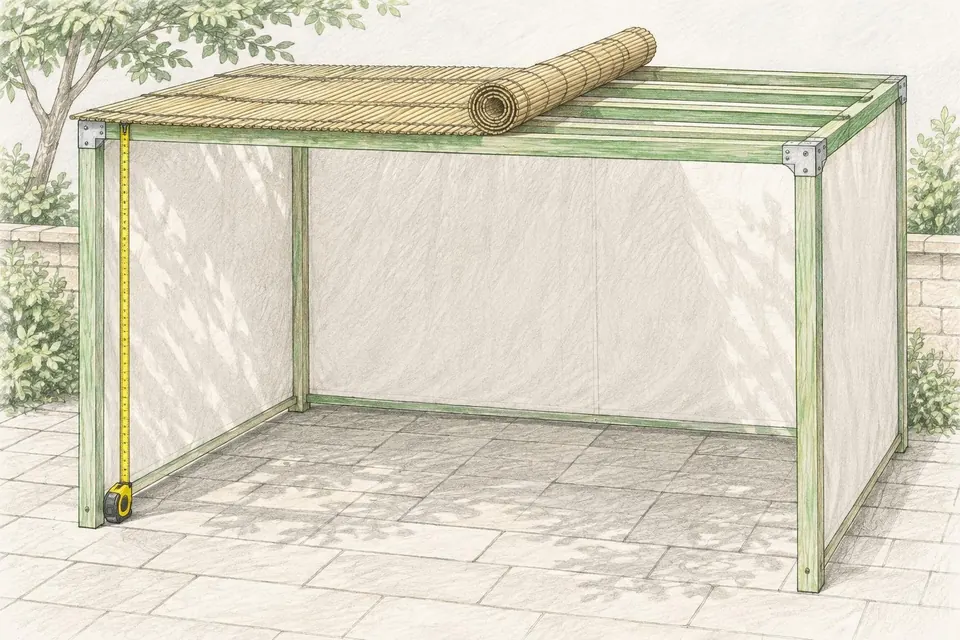
- A sukkah must meet minimum size and height requirements and have at least three walls.
- Its walls must be solid and sturdy, and a rabbi should be consulted for practical guidance.
- The schach must be made from suitable plant material and provide more shade than sun.
- The sukkah must stand directly under the open sky and serve as a temporary dwelling.
Laws of Building a Sukkah#
- A sukkah must be at least 70 cm by 70 cm (about 27.5 by 27.5 inches).
- A sukkah must be at least 96 cm (about 38 inches) high.
- The walls of a sukkah must be at least 96 cm (about 38 inches) high.
- The walls of a sukkah must not stop 24 cm (about 9.5 inches) or more above the ground; that is, the gap beneath the walls must be less than 24 cm.
- The schach (sukkah roof covering) must not be separated from the walls by a gap of 24 cm (about 9.5 inches) or more at the sides.
- If the walls are directly beneath the schach, they do not need to touch it and may be any distance below it.
- A sukkah must have at least three walls, each at least 70 cm (about 27.5 inches) wide on the inside.
- The walls must be solid and sturdy, so that an ordinary wind cannot sway the sukkah. It is therefore important to consult a rabbi and receive practical guidance on building a sukkah.
- Schach must be made from material that grew from the ground, has been cut, and is not susceptible to ritual impurity.
- Among items used in everyday life, the following are generally susceptible to ritual impurity: various kinds of food, household utensils, clothing, and things intended for sitting or lying on, such as chairs, mats, or mattresses. None of these is suitable for schach, nor are their broken pieces or remnants.
- Cut tree branches are suitable for covering a sukkah because they grew from the ground and are not susceptible to ritual impurity. They must not, however, be bound together. Boards are also suitable, provided each one is less than 32 cm (about 12.6 inches) wide.
- The covering must provide more shade than sun when the sun is directly overhead.
- Make sure, too, that no uncovered gap exceeds 24 cm by 24 cm (about 9.5 by 9.5 inches).
- A sukkah must be built directly under the open sky, not beneath tree branches or the like.
- A sukkah must be a temporary dwelling. Therefore, if the schach served as the roof of a permanent dwelling, it cannot be used as schach for a sukkah.
- It is permissible, however, to lift this schach slightly—at least one tefach (handbreadth), about 10 cm (4 inches)—and put it back with the intention that it serve as schach for the sukkah.
Practical law. This page reports a ruling given for a specific question. For your own situation, ask a rabbi who knows you.
Keep reading
More →Guide · Sukkot
How to Build a Sukkah: General Rules
The basic rules for choosing a location and covering a sukkah.
Guide · SukkotHow to Choose a Kosher Etrog
A guide to some of the features that can affect an etrog’s kosher status.
SukkotWhy Is Sukkot Called the Time of Our Joy?
The joy of Sukkot can deepen our love of God and prepare us for repentance.
SukkotWhy Celebrate Jewish Holidays With Food and Wine?
A parable from the Maggid of Dubno explores the connection between physical and spiritual joy.







