Why Celebrate Jewish Holidays With Food and Wine?
A parable from the Maggid of Dubno explores the connection between physical and spiritual joy.
In brief
- Jewish holidays are celebrated with festive meals, wine, and fine clothes.
- The Maggid of Dubno tells a parable about two companions who help one another enjoy a celebration.
- The parable compares the companions to the body and the soul.
- Physical pleasures help bring the body and soul together in holiday joy.
“And Rejoice in Your Festival”#
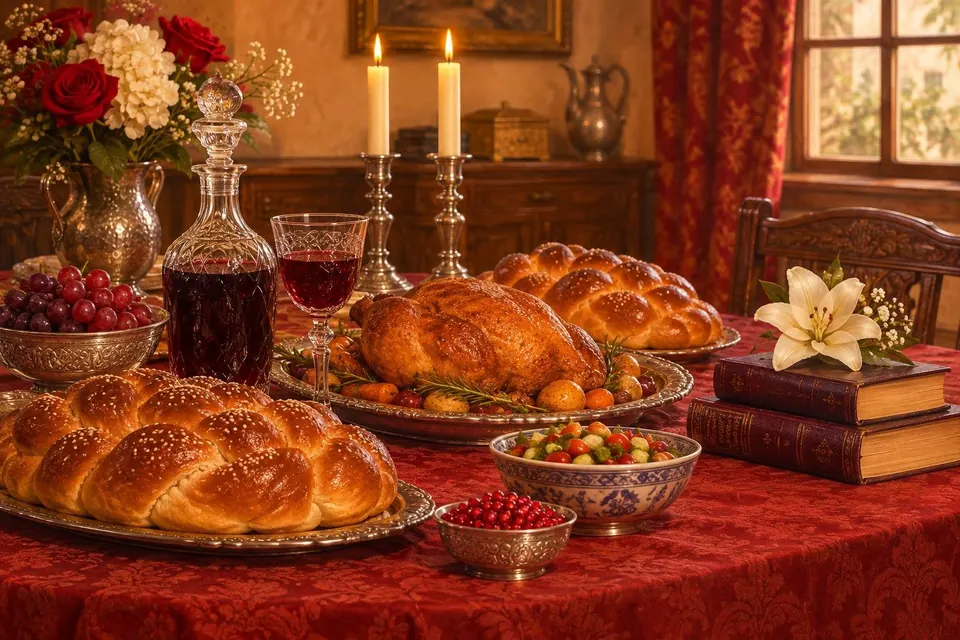
We all know the commandment to celebrate the festivals, yamim tovim, with festive meals, wine, and fine clothes. But are such material things really the only way to mark our holy days? If not, why does Torah law specify these ways of expressing our joy? Why place so much importance on physical pleasures, gashmiyut, when the true meaning of the holidays lies in the spiritual dimension, ruchaniyut, in uplifting our souls?
This apparent contradiction can be explained by the following mashal (parable) from the Maggid of Dubno (Rabbi Jacob Krantz, a great sage and close friend of the Vilna Gaon).
A man who could not walk without help lived in a small town. He was deeply troubled that he could not travel to another town to earn a living, as people in his town customarily did. But he had a neighbor who was deaf and physically strong. The first man had an idea: if the two joined forces, they could travel together to earn a living, helping each other by making up for their physical limitations. They agreed that the deaf man would carry his companion on his shoulders all day, and his companion would help and guide him.
They set out, and one day they passed a place where beautiful music was playing and people in fine clothes were dancing joyfully. Though the man who could not walk had no way to join the dancing, he wanted to stop for a while and enjoy the wonderful music. But how could he get his deaf friend to stop when he had no idea what there was to stop for?
Then he had an idea. He had a small bottle of gin and a little glass in his pocket. He filled the glass and offered it to his companion. The deaf man naturally stopped to drink the gin, giving his friend a chance to listen to the music. When he had finished, the man on his shoulders poured him another glass, and then a third.
The deaf man was now in such good spirits that his feet began to move on their own. He started dancing and having a wonderful time. His companion had never imagined he could be so fortunate: he was not only enjoying the music but even getting to “dance” on his friend’s shoulders, as his friend grew livelier with each drink. The little glasses of gin had made both companions happy.
The Maggid of Dubno explains that the two companions represent our soul and body. The neshamah yeterah, or “additional soul,” which according to the Talmud joins us every Shabbat, is nourished by spiritual things, ruchaniyut [Beitzah 16a]. But the soul is truly joyful only when the body is joyful too. That is why it is so important to delight the body with delicious food, good wine, and fine clothes. In this way, we can achieve the true harmony of joy and celebration that God expects of us on all our holidays.
Keep reading
More →How to Build a Sukkah: General Rules
The basic rules for choosing a location and covering a sukkah.
Guide · SukkotHow to Choose a Kosher Etrog
A guide to some of the features that can affect an etrog’s kosher status.
SukkotWhy Is Sukkot Called the Time of Our Joy?
The joy of Sukkot can deepen our love of God and prepare us for repentance.
Guide · SukkotSukkah Building Laws: Size, Walls, and Schach
- Laws of Building a Sukkah







