Why Is Sukkot Called the Time of Our Joy?
The joy of Sukkot can deepen our love of God and prepare us for repentance.
In brief
- Each Jewish holiday brings back a spiritual influence associated with that time of year.
- Sukkot offers a special opportunity to fulfill the mitzvah of joy.
- Joy in Torah and mitzvot expresses love of God and can lead to repentance out of love.
- Torah and mitzvot in this world can help a person attain a greater place in the World to Come.
Sukkot is called “the time of our joy,” Passover “the time of our freedom,” and Shavuot “the time of the giving of our Torah.” I have been asked about these names. At first glance, it is clear why Passover is called the time of freedom: It was then that the Jews left slavery in Egypt and became free. Shavuot is called the time of the giving of the Torah because it was then that we were privileged to receive it at Mount Sinai.
But we do not find that any occasion of particular joy took place on Sukkot. Why, then, do we call it “the time of our joy”? It is celebrated in memory of the Clouds of Glory that accompanied us when we left Egypt, not because of any particular joyful event.
The explanation can be found in the words of Rabbi Moshe Chaim Luzzatto (the Ramchal) in Derech Hashem (The Way of God), and in other books as well: The holidays do not merely remind us of events that happened long ago. The spiritual influence of that time returns each year. Any spiritual influence revealed at a particular time is awakened again at that same time year after year.
The Spiritual Influence of the Holidays#
For example, when Passover is called “the time of our freedom,” it means more than physical freedom. It refers primarily to the soul’s freedom from the impurity of Egypt. In the evening prayer, we say: “He brought His people Israel out from among them to everlasting freedom.” But there were later exiles, so what kind of “everlasting freedom” was this?
It means spiritual freedom. The Jews emerged from the 49 gates of impurity and attained freedom from the yetzer hara (the evil inclination). As the Sages say, “Only one who engages in Torah is free” (Mishnah Avot 6:2). This freedom is indeed eternal. Every Passover, the influence that frees us from the evil inclination is awakened again.
After Passover come the days of counting the Omer, the period between Passover and Shavuot. Sefer HaChinuch (commandment 306) explains their meaning: When the Jews left Egypt, they heard that they were going to Mount Sinai to receive the Torah. They already knew what Torah was. In Egypt, the tribe of Levi had studied it, and our holy forefathers had also studied in a yeshiva.
When the Jews heard that they were going to receive the Torah, they were overjoyed. They waited and longed for it with great anticipation, counting the days that had passed since they left Egypt: another day had gone by, and then another, bringing them closer to the great moment when they would be privileged to receive the Torah.
Each year, during the counting of the Omer, the influence associated with preparing and longing for Torah returns. During these days, everyone can become ready to receive the Torah and make great progress in the qualities needed to acquire it. As the books explain, the 49 days of the count correspond to those qualities. The sixth chapter of Avot says that Torah is acquired through 48 qualities [Mishnah Avot 6:6]. On each day of the Omer, a person can rise and attain another one. The final day encompasses and secures them all, so that they become a firm and lasting attainment.
On Shavuot, “the time of the giving of our Torah,” we reach a time especially suited to success in Torah. Each year on this day, an influence returns from Heaven that enables us to receive the Torah, as we did at Mount Sinai. This is one reason we stay awake all night on Shavuot: to make use of this special time and attain every level of Torah understanding we can.
When we say “the time of the giving of our Torah,” we do not mean only that the Torah was given on this holiday long ago. Every year, this day is a time of giving the Torah, and each person can attain success in it according to the preparation they have made.
So when we speak of Passover as “the time of our freedom” and Shavuot as “the time of the giving of our Torah,” we are not simply recalling events that happened once. Passover is a time of freedom today, too, because we can attain freedom from the evil inclination and overcome physical desires anew each year. Shavuot, too, is a time of giving the Torah every year, as explained above.
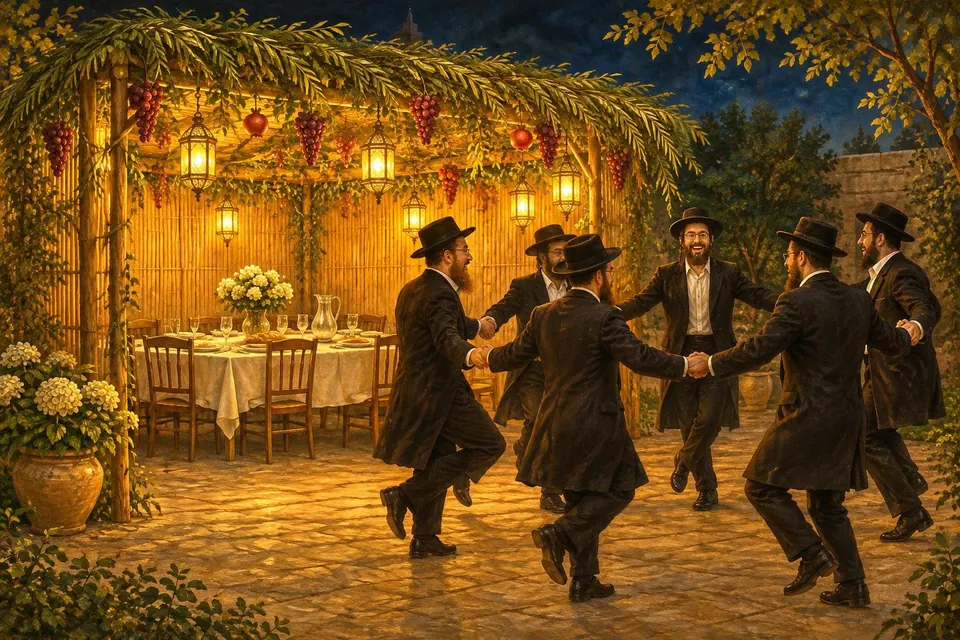
We can now understand why Sukkot is called “the time of our joy.” It is not because a joyful event took place long ago. Sukkot is a time of joy every year.
The Mitzvah of Joy#
The Midrash Yalkut Shimoni (Emor 654) notes that the Torah mentions joy three times in connection with Sukkot. It does not mention it at all in connection with Passover, and it mentions it only once in connection with Shavuot. The Yalkut explains that on Passover the harvest is judged, and on Shavuot the fruit of the trees is judged, so a person worries about the harvest and the fruit.
But on Sukkot, because souls were granted atonement on Yom Kippur, as it says, “For on this day atonement will be made for you” [Leviticus 16:30], and because the harvest and the fruit of the trees have already been gathered into storage, joy is mentioned three times: “Rejoice on your festival” [Deuteronomy 16:14], “Rejoice before the Lord your God” [Leviticus 23:40], and “You shall have nothing but joy” [Deuteronomy 16:15].
It follows that the mitzvah of joy applies to Sukkot more than to any other festival. And when there is a mitzvah, a person is given strength from Above to fulfill it. This is why Sukkot is called “the time of our joy”: At this time, there is more opportunity to rejoice than during the rest of the year.
As the Yalkut says, the festival comes after we have received a favorable judgment on Yom Kippur and brought the harvest and the fruit of the trees into our homes. It is natural, therefore, that greater joy is fitting here and that we can fulfill the mitzvah, “Rejoice on your festival.”
However, the mitzvah to rejoice on a festival calls primarily for joy that includes service of God. Maimonides (the Rambam) writes: “We were not commanded to engage in frivolity and foolishness, but in joy that includes service of the Creator of all” (Maimonides, Laws of Festivals 6:20).
The Midrash also says:
“This is the day that God has made; let us exult and rejoice in Him.” Rabbi Avin said: We do not know whether to rejoice in the day or in the Holy One, blessed be He. Solomon came and explained: “Let us exult and rejoice in You” [Song of Songs 1:4]—in You, the Holy One, blessed be He; in You, in Your salvation; in You, in Your Torah; in You, in awe of You. Rabbi Isaac said: “In You” (בך)—in the 22 letters that You gave us in the Torah. Bet is two and kaf is 20, for a total of 22 (בך). (Song of Songs Rabbah 1:31; see Psalms 118:24.)
The central mitzvah of rejoicing on a festival, then, is to rejoice in Torah and mitzvot. The material joy of gathering the harvest also serves primarily a spiritual purpose: It eases a person’s worries, so that they can rejoice more fully in Torah and mitzvot.
Shaarei Teshuvah (The Gates of Repentance) explains the meaning of the mitzvah to have a festive meal: “On the other festivals, we hold a meal as an expression of joy in the mitzvah” (Shaarei Teshuvah 4:9). The joy is connected to the mitzvah, not to the material meal, which is intended only to increase joy in the mitzvah. The meal leaves a person calm and free from hunger, allowing them to rejoice fully in the mitzvah.
Joy in a Mitzvah and Love of God#
At the end of Sukkot comes Hoshanah Rabbah, a day of judgment and final decree. In the “May It Be Your Will” prayer after the Hoshanot—the prayers of supplication recited on Sukkot—we say: “Issue a good decree for us ... and seal us finally in the book of a good life.”
Before Rosh Hashanah and Yom Kippur, we devote considerable effort to preparing for the Day of Judgment, blowing the shofar throughout the month of Elul. There are also customs of reciting chapters of Psalms every day. During the Ten Days of Repentance, we say Avinu Malkeinu (“Our Father, Our King”) and add many prayers in order to merit a favorable judgment. Why do we not make similar preparations before Hoshanah Rabbah? We do not see people engaging in teshuvah (repentance) and confessing their sins during Sukkot.
There are two levels of teshuvah: repentance out of fear and repentance out of love. The lower level is repentance out of fear, when people return to God because they fear punishment, believing that there is reward and punishment in this world and the next. This level is reached during the Days of Awe through preparation, repentance, and confession.
On Yom Kippur, we are granted forgiveness and atonement for our sins, and through this our souls become pure. We can then reach a higher level: teshuvah out of love. During Sukkot, we prepare for it through the joy of fulfilling a mitzvah.
This can be understood in light of what Mesillat Yesharim (The Path of the Just) says: Joy in Torah and mitzvot is a branch of love of God (Mesillat Yesharim, chapter 19). It is difficult to reach a high level of love of God, because we do not see His existence directly; we only know of Him and believe in Him. But love of God has branches.
When a person is in a river with a strong current and at risk of drowning, they may see a tree branch, grab it, and pull themselves along until they reach the tree itself. Similarly, when a person engages in Torah and mitzvot with joy, that joy comes from the love of God within them. Through it, they connect to the love itself.
Every member of the Jewish people has love of God within. The soul is a part of God Above. Faith and love of God are part of human nature, but “many schemes” make a person forget them, as it is written: “God made human beings upright, but they pursued many schemes” (Ecclesiastes 7:29).
Because of those schemes, faith is hidden within and does not show itself, like the roots of a tree hidden in the ground while only its branches are visible. Love of God, too, is hidden in a person’s heart. But when someone rejoices in Torah and mitzvot, that is one of the branches of love appearing outwardly.
Rabbi Yisrael Salanter gives an example. A man has a son and a student. He loves the student deeply and is attached to him. He also benefits greatly from him, just as Rabbi Yochanan needed Reish Lakish (see Bava Metzia 84a). His son, on the other hand, does not follow in his ways or accept his admonitions.
On the surface, it seems that the man loves his student more than his son. But in a moment of danger, if he has to save one of them, he will certainly save his son first, because his love for his son lies beneath his conscious awareness. In danger, that love immediately acts and shows itself.
So, too, love of God exists deep in a Jew’s heart. Sometimes it is suppressed and does not show itself, but there are moments when it breaks through and becomes visible.
A story is told of an apostate during the Holocaust who helped the Germans. At first he helped them only with technical matters, but one day they wanted to use him to destroy other Jews. He refused, saying that he would rather die a Jew than help them. He sacrificed himself, and they killed him. Such is the love of God that lives in the heart of every Jew.
In our time, too, there are ordinary Jews who are ready to give their lives for their faith. A Jewish man once told me that he was in another country, among another people, when someone with a weapon approached him, threatened him, and demanded that he renounce his faith. At that moment, he was ready to give up his life and die rather than say a single word against his faith. This was an ordinary Jew who outwardly showed nothing exceptional, but deep in his heart was a hidden love of God. So, in a moment of danger, he was ready to die rather than renounce his faith.
There was another case in Russia, when a fire broke out in a synagogue and the Torah scrolls were in danger of burning. A man rushed into the fire and saved them. Later, people asked him, “According to the law of preserving life, you weren’t required to put yourself in such danger!” He replied, “But they’re Torah scrolls! How could I stand by?”
When there is love of Torah and love of everything holy, people make no calculations. If a child is drowning, a father jumps into the water to save him without worrying about the danger to himself. Love for his son overrides every other consideration. The same is true of love of God.
On Sukkot, “the time of our joy,” an influence from Above helps us attain joy in a mitzvah more than on other days of the year. Through this, we naturally come to love God. As Mesillat Yesharim explains, every joy in mitzvot is a branch of love. Through it, we can attain teshuvah out of love, the best preparation for receiving a good judgment on Hoshanah Rabbah.
This World and the World to Come#
I would also like to offer an explanation of the Sages’ teaching in Pirkei Avot (Ethics of the Fathers): “One hour of teshuvah and good deeds in this world is better than all the life of the World to Come” (Mishnah Avot 4:17). In other words, even if a person had all the life of the World to Come, it would be less than teshuvah and good deeds in this world.
This needs explaining. The World to Come is the best there can be. All the pleasures of our world cannot compare to the delight of the World to Come, of which it is said: “No eye has seen a God besides You, who acts for the one who waits for Him” (Isaiah 64:4). How can teshuvah and good deeds in our world have an advantage over all the life of the World to Come?
The explanation is this: The World to Come is undoubtedly the best, but we find that it has many levels. As the Sages say, “Every righteous person has a chuppah (canopy) and a place in the World to Come according to their honor” (Bava Batra 75a). And it is written, “For a person goes to the home of their world” (Ecclesiastes 12:5). The Sages comment: “It does not simply say ‘the home of the world,’ but ‘the home of their world.’ This teaches that every righteous person has a world of their own” (Vayikra Rabbah 18:1).
Just as a person has a physical home in this world, so in the future each person will have a spiritual home and a place according to their honor—that is, according to what they have earned through good deeds.
There in the Talmud (Bava Batra 75a), the Sages derive from Scripture that there will be fire in the chuppah. From this they learn that each person is burned by another’s chuppah. Each person will have a chuppah and a place in the World to Come according to their honor, and the more merits and good deeds they have, the more wonderful a place they will receive there.
On seeing that another person has received a more honored place, they will suffer greatly and feel pain as though burned. They will blame themselves: Why did I not try to do more good deeds in the physical world? Had I worked with all my strength to attain perfection, as I should have, I too would have received such a wonderful place.
A person may already have performed good deeds and have a place in the World to Come, but that place is limited; it is not the wonderful place they could have attained. If they fulfill more mitzvot, do something good, or devote another moment to teshuvah and drawing closer to God, they will earn a far more honored place. All the life of the World to Come that they now have is less than the place they could receive. That place will be better in quality if they devote another hour to teshuvah and good deeds in this world. If not, they will eventually regret it.
The story is told that before his death, the Vilna Gaon took his tzitzit, the ritual fringes on his garment, in his hands and wept. He said, “Here, in this world, it takes only a little effort and a few coins to fulfill the mitzvah of tzitzit. But in the World to Come, there will no longer be an opportunity to perform mitzvot.”
I heard that he did not regret leaving Torah study, because it continues in the World to Come, as the Sages said: “Torah scholars have no rest, either in this world or in the next” (Berakhot 64a). Rashi explains that they go from one yeshiva to another and from one interpretation to another (Rashi on Berakhot 64a). Thus, a person will enjoy Torah in the World to Come, too, but there will be no mitzvot there.
This is the meaning of “One hour of teshuvah and good deeds in this world is better than all the life of the World to Come.” Even if a person already has a place in the World to Come, they can add more good deeds and earn a more honored place there. Through teshuvah and good deeds in this world, they can attain a place that is better in quality and greater than all the life of the World to Come they already have. May it be God’s will that we merit this!
Keep reading
More →How to Build a Sukkah: General Rules
The basic rules for choosing a location and covering a sukkah.
Guide · SukkotHow to Choose a Kosher Etrog
A guide to some of the features that can affect an etrog’s kosher status.
SukkotWhy Celebrate Jewish Holidays With Food and Wine?
A parable from the Maggid of Dubno explores the connection between physical and spiritual joy.
Guide · SukkotSukkah Building Laws: Size, Walls, and Schach
- Laws of Building a Sukkah







