How to Build a Sukkah and Live in It: Rules for Sukkot
A rabbi walks through the laws of the sukkah just before Sukkot: schach, walls, where to build, sleeping, and Chol Hamoed.
In brief
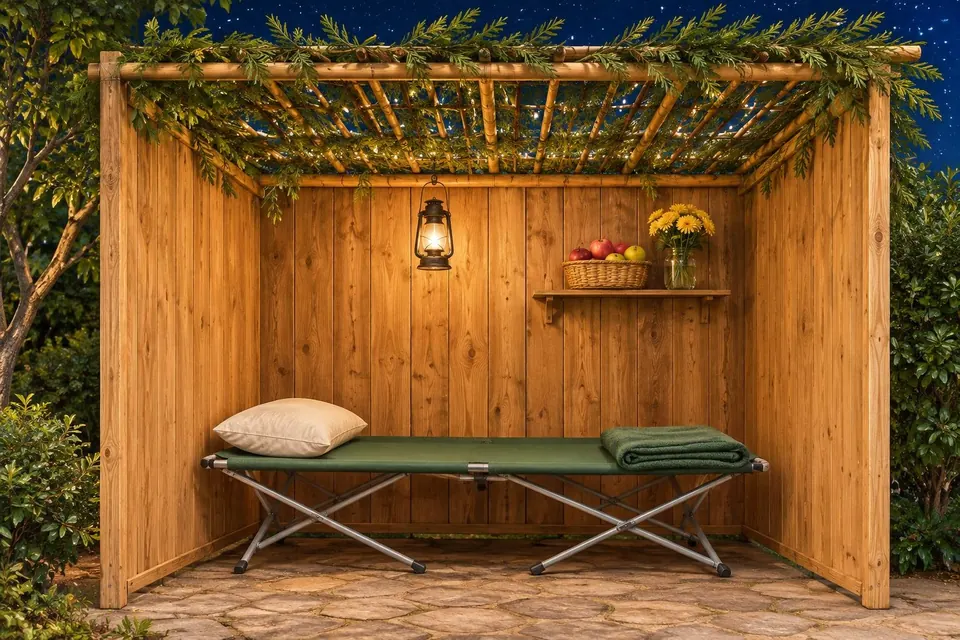
- Schach must come from something that grows from the ground, be detached from it, not be susceptible to tumah, and cover more than half of the roof.
- A sukkah normally has three walls, though the third may be partial; it must be at least seven tefachim by seven tefachim, with walls at least ten tefachim high that hold up in an ordinary wind.
- You may not build on someone else's space, on a living tree (because you may not climb a tree on Shabbat and holidays), or under a roof or overhanging branches that cover too much of the schach.
- Eating a meal in the sukkah is required; a person who is uncomfortable there is exempt from it, and travelers are exempt too; on Chol Hamoed haircuts and laundry are restricted.
Thank God, yesterday was Yom Kippur, and, thank God, the Jewish people filled the synagogues, prayed, and fasted. Let us hope that God helped. The repentance and prayer of the Jewish people on Yom Kippur are a great gift that He gave us. It is interesting that even people who are relatively distant from tradition sense what Yom Kippur is: in Israel, the roads are practically empty on this day, and nobody drives.
What the Sukkah Recalls#
From Yom Kippur we go on to Sukkot. The Torah says: "Live in sukkot for seven days, lemaan yedu doroteichem, so that your generations will know: ki vasukkot hoshavti et bnei Yisrael, that I settled the Israelites in sukkot" [Leviticus 23:42-43]. The Talmud gives two opinions about what these sukkot were [Sukkah 11b]. According to one, they were the clouds of glory with which God covered the camp of Israel: the clouds saved the Jews from the heat, protected them from their enemies, and so on. According to the other, they were the little huts that the Jews built in the desert.
What is special about little huts? Nachmanides (the Ramban), in his commentary on the Torah, explains it this way: for forty years the Jews lived in a place where people normally cannot live. And we are talking about two, two and a half, three million people, with children and elderly. It was a place with no houses, only huts.
One theme of Sukkot, if we follow the opinion about the clouds of glory, is that we are under God's shadow. We repented on Yom Kippur, and now we are, so to speak, God's guests. Why we celebrate this holiday, the memory of the clouds of glory, specifically now, on the 15th of Tishrei, I will discuss in more detail, bli neder (without making a vow), in the lesson for Chol Hamoed. For now, right before Sukkot, I would like to dwell on the laws and rules of building a sukkah.
Schach: What to Cover the Sukkah With#
The central element of the sukkah is the schach, that is, what covers the roof. It cannot be just any material. Schach must come from something that grows from the ground, must be detached from the ground, and must not be susceptible to tumah (ritual impurity). That is why, for example, you cannot cover a sukkah with food: a cluster of grapes grows from the ground, but it is food, and food is susceptible to tumah. Clusters of grapes or dates are not suitable for schach. Branches, reeds, and leaves are suitable; in principle, you may cover a sukkah with grasses, shrubs, and any kind of branches. But there is a rule: do not cover the sukkah with something that will dry out within the seven days. The schach must last for seven days. This morning palm branches for our sukkah were brought to our home. It is the same plant that the lulav comes from, but here it is taken before it has opened; when it opens and the leaves come out, they are good for covering. Any branches will do.
How much schach should you put on? We are told that the covered part must be greater than the uncovered part: tzilatah meruba mechamatah, there must be more shade than sun. By a second definition, inside the sukkah the patches of shade and sun should be equal, and then we know that more than half of the top is covered. A gap of three tefachim (handbreadths; 23 centimeters, about 9 inches) is not acceptable if it runs across the entire sukkah. If there is such a small gap in one corner, the sukkah may be valid. But a hole of three tefachim by three tefachim (23 by 23 centimeters) is not acceptable. The usual practice is to cover it well, so that there is no gap at all.
There is another law: what the schach rests on must also not be susceptible to tumah, for example, iron rods. In practice, if the frame is made of iron beams, people lay boards across them perpendicularly, and the schach lies on the boards. They take care that the schach does not lie on anything that is susceptible to tumah and unfit for schach.
People ask whether you may fasten the schach with plastic cable ties (azikonim). They are not valid for schach, because they are plastic. If there is another way to do it, tying it with thread, a long leaf, grass, or a branch, you should tie it that way. But if there is no other way, you may use cable ties: the law is that you do not support the schach with something that is unfit for it, but if a person cannot manage otherwise, they should do this. If the schach normally stays in place on its own, and a person adds the cable ties in case of wind, for extra security, then it is probably valid even lechatchila (in the first instance). If the schach normally does not stay in place, then, if you can tie it with a long leaf, say from a date palm, that is good; and if you cannot, use the cable ties. In Israel they also sell, in bundles, special ropes made of unprocessed plant material that are valid for schach; you can tie with those. I admit that cable ties are more convenient and more secure. People also asked about the linen twine sold in Haifa: if it is unprocessed, it really is valid. I do not know exactly what kind it is, but that is what the law says. I think it is worth getting. After all, it is not used for covering, only for tying, and it is certainly better than cable ties, which are definitely unfit for schach.
The Walls of the Sukkah#
A sukkah should normally have three walls. Two walls must be complete, and the third may be incomplete, but for that you need to know the laws. One thing I can say for certain: if a person has built two walls, and on the third has made only seven tefachim, seventy centimeters (about 28 inches), attached to one of those two walls, then even in a sukkah of two by three meters or three by three meters it is valid. That is, two walls form the letter "L," and a wall of seventy centimeters is attached to one of them. The simplest thing is just to make three walls.
The minimum size of a sukkah is seven tefachim by seven tefachim. One opinion holds that a tefach is ten centimeters, and another that it is eight. Since this is a law of the Torah, it is right to follow the stricter opinion: a minimum of seventy by seventy centimeters. Of course, we try to build a sukkah of a size that is pleasant and comfortable for us. In Israel many people have a terrace with an open or openable section, and they build the sukkah there, so its size is determined by that space. Those who have no such terrace build downstairs, and there a person is their own boss: they build whatever size they want, and they only need building materials. All around you can see people carrying plywood with boards nailed to it for walls. They are building, thank God.
The minimum height of the walls is ten tefachim: in all the laws of the Torah, a barrier (mechitzah) must be at least ten tefachim high. If, following the strict opinion, we count a tefach as ten centimeters, the height comes to one meter (about 3 feet 3 inches). By law this is enough, although in practice it is uncomfortable to sit in such a sukkah. But there is a big difference: a person can make the bottom meter a solid plywood wall and stretch, for example, sheets above it. What the part above is made of no longer matters, and the walls can go all the way up to the schach, if a person wants.
The walls of a sukkah must hold up beruach metzuyah, in an ordinary wind. The Beit Yosef discusses this in detail. If the walls are made of sheets or fabric, the question is how firmly they hold: perhaps they sway in an ordinary wind. The Talmud says that walls must hold up in an ordinary wind, because walls are something that stands; if they do not hold properly in an ordinary wind, they are not sturdy enough to be walls. Of course, we are speaking of an ordinary wind: in a hurricane any wall will fall.
That is why the Shulchan Aruch says that someone who makes walls out of sheets should put poles in the middle, every three tefachim. Here we are already following the other opinion, that a tefach is eight centimeters or even less, so that three tefachim are twenty-three centimeters: the distance between the poles must be less than twenty-three centimeters. Then even if the sheets are poorly stretched and begin to sway, there is still a wall of poles. We have a rule that if the distance between two poles is less than three tefachim, it is considered as if the whole space were closed. So making walls out of sheets is not bad; this is what the Shulchan Aruch writes, as long as the gaps between the poles are less than twenty-three centimeters.
People asked about a fabric sukkah that is sold with straps stretched in two rows along the walls. This is the same as what is described in the Shulchan Aruch: when the walls are fabric, it is hard to say whether they are taut and not swaying in the wind, and they might suddenly become less taut. So straps are put in, so that there is no large gap: even if the fabric walls do not count as walls, the straps save the situation, and the straps are also like walls. If, however, the purpose of the straps is simply to pull the fabric tight, then whether it is technically better to stretch them on the inside or the outside is a technical question, not a legal one. The main thing is that everything holds firmly and the gap is no more than three tefachim. Inside or outside is not a matter of principle.
And in general, when you can, make the sukkah so that a person is pleased and comfortable being in it, within their real means, of course.
Where You May Build#
I remember how my father, of blessed memory, built a sukkah in Kazan and in Tashkent. In Kazan we rented an apartment from a Tatar landlord who treated us well. He had a small garden, and my father asked permission to build a little hut there, and it stood year after year, but every year it had to be covered with branches again. Each time my father asked the landlord for permission to cut branches from the tree, and he agreed. We sometimes went out there late. If my father had a class on Sukkot against his wishes, he would of course go on foot, write nothing, but he could not skip it; then he would come back, my mother would come back, and we would go out to the sukkah. I remember that for some reason cats followed us; probably my father tossed them something. In Tashkent we had a small yard, and in practically every apartment in the yard a person could build whatever they wanted.
Thank God, here in Israel everyone is busy building a sukkah. This year people are starting especially early, but in fact one could and should have built even before Yom Kippur: between Yom Kippur and Sukkot there is almost no time left. Today is Friday, then Shabbat and Sunday, and on Monday it is already the eve of Sukkot.
People ask whether a permit from the city is needed. In Jerusalem and in Israel generally, it is allowed, everyone builds, and nobody protests. I heard a different question: people argue among themselves about who built where last year. The city does not mind. What goes on in Odessa or Kiev I cannot say; but I think that if the city government is friendly to Jews, a hut for one week bothers nobody. Of course, you must build in a way that does not disturb the neighbors and leaves room on the sidewalk for passersby. But you may not seize someone else's space and build a sukkah there. Suppose someone has a parking space: if you build a sukkah where they park their car, that is robbery. You may not rob a Jew, and you may not rob a non-Jew, in order to build a sukkah.
People ask whether you may build a sukkah in a tree. There is a law that on Shabbat and holidays you may not climb a tree. If it is simply a sawn-off stump, a wide one standing on the ground as a base, then it is no longer a tree, and you may do this. But on a living tree, the sukkah might be valid for the middle days of Sukkot, but we need it for the first day and for Shabbat. A wooden floor under the open sky is fine: build the sukkah as you like.
And there is one more very important law that not everyone knows. You may not build a sukkah under a roof: that is not a sukkah. The same applies to a tree: sometimes people build a sukkah, and over it is a spreading tree whose branches cover it, and this can make the sukkah invalid (pasul). This is very practical and very important. You must either cut off the branches that hang over the sukkah or tie them back; I think the second suggestion is less practical than the first.
How many such branches does it take to make the schach invalid? As already said, in a sukkah the covered part must be greater than the uncovered part. Suppose a person has covered sixty percent of the roof with schach, and the branches over the sukkah cover twenty percent. If those branches are removed, sixty minus twenty, forty percent, remains; that is not acceptable. And if a person has covered eighty percent, and the branches cover thirty-five, then eighty minus thirty-five is forty-five, which is also not acceptable. First: the overhanging branches must cover less than half; that is clear-cut. Second: if you remove the part of the covering that the branches create, a majority must remain covered. That is the second principle.
What It Means to Live in the Sukkah#
A person must live in the sukkah. What does "live" mean? Eat, drink, sleep, and receive guests. Eating means eating a meal with bread, cake, and so on: that meal we are obligated to eat in the sukkah. By law, if a person wants to eat an apple or drink a glass of tea, they are not required to do it in the sukkah. But the Talmud relates that there were people who were stringent (chumra) and ate even a fruit or drank water in the sukkah. This is a desire for stringency: whoever wants to do it does, and some do not.
In Israel, thank God, there is usually no rain on Sukkot, no particularly strong wind, no severe cold or special heat, so in the sukkah you can both eat and sleep. I will say honestly that I sleep much better in the sukkah than at home, for two reasons. First, there is simply more air there. Second, it is a very pleasant feeling: you sleep, and by this you fulfill a mitzvah.
But there is an interesting law: mitztaer patur min hasukkah, a person who is uncomfortable in the sukkah is exempt from the sukkah. A mitztaer is someone for whom it is hard to be in the sukkah because of rain, wind, heat, or cold. For this reason, in Poland and Belarus Jews usually did not sleep in the sukkah. As the Mishnah Berurah says, only the mehadrim bemitzvot, those who were especially diligent in mitzvot, slept in the sukkah. I read in our family that my father's grandfather had a sukkah in the entrance hall, where there was a stove, and he could sleep there. But if a person is cold, they are exempt. I heard about one great American rabbi who did not sleep in his sukkah in America at night, but slept there during the day: at night it was cold for him there and he was a mitztaer, but during the day it was not so cold, and in the daytime he slept in the sukkah. May you use a sleeping bag? Of course, use one, it is very good.
What should you do if the sukkah has no way for a husband and wife to be there together, for example in a communal sukkah at the synagogue, where sleeping in couples is impossible and improper? The Rema gives two explanations for why we do not sleep in the sukkah. The first is that it really was cold there, and so a person is a mitztaer: whoever is uncomfortable is not required to be in the sukkah. The second is that a man cannot sleep with his wife in the sukkah. The Rema says: such a sukkah is valid for eating, but he is not required to sleep in it, because he cannot sleep there with his wife. Others dispute this. The Taz explains differently: in such a case the man is occupied with the mitzvah of gladdening his wife, sleeping with her in one room, and there is a law, haosek bemitzvah patur min hamitzvah, one who is occupied with one mitzvah is exempt from another. Some agree with the Taz, but more disagree with him. A sukkah in which a husband and wife cannot sleep together is still valid. If the wife lets him, may he go and sleep in the communal sukkah? He may, if he is not a mitztaer there, for example if he has a sleeping bag and everything is fine.
Interestingly, the Mishnah Berurah, or more precisely the Beur Halacha by the same author, writes: if it is really very cold, but a person nevertheless went to eat in the sukkah and wants to say the blessing leshev basukkah ("to dwell in the sukkah"), they should dress warmly.
The Blessing for Sleeping in the Sukkah#
If a person is going to sleep in the sukkah, may they say the blessing over the sukkah, or only if they are going to eat there? This is a good question; I cannot say that it is decided unambiguously, and even among the poskim (halachic authorities) there are different opinions. First, the principle is that we say a blessing over eating, and the eating "takes care of" everything else, including sleep. Therefore, usually, if a person was in the sukkah and there was no large, serious break, there is no need to say a blessing for sleeping. But if a person went away somewhere for a long time and then came back home, there are two ways: either take a piece of cake larger than the volume of an egg and say the blessing over it, or say the blessing over sleeping in the sukkah itself. Rabbi Shlomo Zalman Auerbach said the blessing over sleeping in the sukkah. And I personally do the same: I do not torment myself with eating a piece of cake, but rely on the opinion that one may say the blessing over sleeping in the sukkah even after a long break. In general, though, our custom is to say the blessing over eating, and it takes care of all the rest of our time in the sukkah.
Travel, Transport, and Chol Hamoed#
There is a law that olchei derachim, those who are on the road, are exempt from the sukkah. A person who is traveling is not required to look for a sukkah; but if there is a sukkah along the way, they should go into it. And if they stop for a day or a night, they should try to build one. People asked whether one eats bread on public transport. I would not lump everything together. On an airplane a person is certainly an olech derachim (a traveler) and has no sukkah; on a train that runs for many hours they are also exempt. About a bus that travels for an hour, I do not know. And may a person doze off on the way in a bus from Jerusalem to Bnei Brak or Haifa? Perhaps yes, because they are a traveler. As for a meal, I do not know: they will arrive soon, and whether they must do something, I am not sure.
People also asked this: if it is quite cold at night and warm during the day, is it not better for a person to sleep in the sukkah during the day, or not to sleep at home at all? Not sleeping at night is wrong. A person should live a normal, natural life, the main time for sleep is the night, and at night people go to sleep. If they are cold, they are a mitztaer and exempt from the sukkah; if they can heat it, they will fulfill the mitzvah of sleeping in the sukkah as well. As for daytime sleep, when it is warm during the day, let them sleep in the sukkah. There is an objection that the sukkah is communal and far away, and someone else will want to eat there; I do not know how that fits. When a person has their own sukkah, they are master of the situation: if it is cold at night and warm during the day, they sleep in the sukkah during the day. And for us, thank God, it is pleasant even at night.
Now, about Chol Hamoed. Any medical treatment may be done on Chol Hamoed, including a vaccination: whatever is needed for treatment is done. You may not do laundry on Chol Hamoed: everything must be washed before the holiday, and you may wash only for small children, who get everything dirty all the time. For adults, laundry must be done in advance. It is very important for housewives to pay attention to this. Likewise, you may not get a haircut on Chol Hamoed, and the basis of this law is as follows: a person must come to the holiday with their hair cut. If haircuts were allowed on Chol Hamoed, a person would say: "I'm overloaded, I have to build the sukkah, I need the four species, there's no time; on Chol Hamoed I'll have time, and then I'll get my haircut." But they must enter the holiday with their hair already cut. The same goes for laundry, except for small children's clothes: even if you wash them before the holiday, they will get dirty on Chol Hamoed. And this applies to everyone, men and women: whoever needs a haircut should get it before the holiday.
People ask whether a haircut done before Rosh Hashanah is good for Sukkot, or whether one must get a new haircut. It is a good question; I think the answer is practical: how does the person look? If they look as though they have had a haircut and everything is fine, that is enough, since this is for the honor of the holiday. And if not, it is worth getting another haircut. I, to be honest, did not get a haircut before Rosh Hashanah so that I could get one before Sukkot.
People ask whether to go to school on Chol Hamoed. On Chol Hamoed they do the work that is necessary. Here in Israel, schools are closed on Chol Hamoed. And outside Israel, if one is required to go, there is no way out.
From a lesson by Rabbi Ben Zion Zilber
Practical law. This page reports a ruling given for a specific question. For your own situation, ask a rabbi who knows you.
Keep reading
More →How to Build a Sukkah: General Rules
The basic rules for choosing a location and covering a sukkah.
Guide · SukkotHow to Choose a Kosher Etrog
A guide to some of the features that can affect an etrog’s kosher status.
SukkotWhy Is Sukkot Called the Time of Our Joy?
The joy of Sukkot can deepen our love of God and prepare us for repentance.
SukkotWhy Celebrate Jewish Holidays With Food and Wine?
A parable from the Maggid of Dubno explores the connection between physical and spiritual joy.







