Sukkot for Women
The sukkah offers women a place for faith, family, and the joy of the holiday.
In brief
- Sukkot challenges us to find joy after the solemn days of Rosh Hashanah and Yom Kippur.
- The sukkah is connected to women through images of shelter, faith, and care.
- Time in the sukkah can bring families and neighbors closer.
- The holiday invites us to give it our hearts and ask God for guidance.
The great Rebbe of Gur, Rabbi Yehudah Aryeh Leib Alter, author of the Sefat Emet, calls Sukkot the holiday of those who have done teshuvah, or repentance. After Rosh Hashanah and Yom Kippur, we have all been purified and have become like angels. But it is very hard for “angels” to begin living an ordinary life. They cannot find a place for themselves in the material world, so the Almighty creates a “new space” for them: the sukkah.
And He commands us to rejoice! That is a test. We already know how to pray, feel remorse, stand bent over in white clothes, and remember our sins. That is easy for us now. But do we know how to rejoice?
In the marathon of preparing for one Tishrei holiday after another, do we stop to think that joy is especially important for women? So important, in fact, that our Sages established an ezrat nashim (women’s section) in the Temple!
As we read in I Chronicles 28:19, the architectural plan of the Temple was complete and, so to speak, ready for construction, without a women’s section. But our Sages saw that women had also come to rejoice at the Simchat Beit Hashoevah (the water-drawing celebration). They therefore instituted a tikkun gadol (a great corrective measure): adding a women’s gallery to the Temple.
It was not easy to permit this addition. Although temporary, it changed the structure of the Temple, which had been given to us from Heaven. The Sages could simply have forbidden women to come: It is a holiday, there are crowds and jostling, and wrongdoing might not be far behind. So, dear ladies, stay home; that would be proper and modest. But no! The wisdom here is that the joy of the holiday is important—extremely important—for women.
Still, from the outside, the sukkah can seem like a mitzvah that is not for women at all, one that has almost nothing to do with them except keeping their husbands and sons company. In fact, the sukkah is especially close to women in its very essence.
First, the sukkah is connected to a woman, as King David says in Psalms: tesukeni beve ten imi—“You knit me together in my mother’s womb” (Psalms 139:13). Despite its fragility compared with a stone house, the sukkah is actually the safest place for us, just like a mother. “For He will shelter me in His sukkah on the day of trouble; He will hide me under the cover of His tent and lift me high upon a rock” (Psalms 27:5).
Second, according to Kabbalah, the Shechinah (God’s presence), which rests in the sukkah and covers us with its wings, resembles a mother bird sheltering her chicks.
The sukkah also resembles a wedding canopy, a chuppah. In the sukkah, close to the Shechinah, we can make personal requests, just as we do when praying at the Western Wall. We can ask, for example, for peace at home, and for love, understanding, and mutual respect in the family.
The sukkah is called tzila dimehemanuta—the shade of faith—and faith is a maternal concept. As the Chazon Ish says in his book Emunah Uvitachon: “ ‘Everything will be good’ is not faith. ‘Whatever happens is good’—that is faith.” Whether rain or heat catches us on Sukkot, that is how it is meant to be.
Song of Songs, the song of love between the Creator and His people, says: “Like an apple tree among the trees of the forest, so is my beloved among the young men. I longed for His shade and sat there” (Song of Songs 2:3). The Midrash says that everyone moves away from an apple tree in the heat. Why? Because it gives no shade. So too, the nations of the world run away, even kicking the door behind them (see Avodah Zarah 3a), rather than remain in the shade of the sukkah, the shade of faith. But you, the Jewish people, come and sit in the shade of the apple tree, in the shade of the sukkah, in the shade of faith. And the Jewish people answer: “I longed for His shade and sat there, and His fruit was sweet to me.”
If we follow the Almighty with faith, “There will be a shelter to give shade from the heat by day, and a refuge and cover from storm and rain” (Isaiah 4:6).
On Sukkot we also read Ecclesiastes, where King Solomon considers questions of faith and concludes: “So I praised joy, for there is nothing better for a person under the sun than to eat, drink, and rejoice. This will accompany him in his labor throughout the days of life that God has given him under the sun” (Ecclesiastes 8:15). The time of our joy is the best time.
And if all this is not enough, it is worth remembering what the Jewish people were doing at this time of year. From the first through the fourth day after Yom Kippur, the Jews in the wilderness generously set aside their possessions for the construction of the Tabernacle, the portable Temple. A major share of the donations came from righteous Jewish women! It turns out that we have a considerable share of our own in the holiday of Sukkot.
Against Our Nature#
But it is very hard for a woman’s nature to adjust to wandering and impermanence. After all, a wife is the home. By nature, she loves stability and strong stone walls around her. A woman’s understanding, binah, works best in a state of banuy—being settled. For a woman, nedudim (wandering) is in some ways akin to niddah, a state of separation: unsettled and uncomfortable. In the sukkah there is rain or wind, and everything outside can be heard and seen. It is uncomfortable. Perhaps this really is not a woman’s place after all.
On the other hand, it is in the thin-walled sukkah that we can spend time together as a family, as we rarely do in our own homes. In the sukkah, we are free of the civilization that constantly draws us in. In today’s homes, children put computers in their own rooms and gather pseudo-friends from all over the world, all the while believing that their families do not care about them! Because of the possibility of bad weather, computers are not brought into the sukkah, so for a whole week we can give our full attention to the people at home. That brings a family closer than strong stone walls do!
In the sukkah, we are often far from the house. In many cases, the house is much farther away than the neighbors’ sukkah, so we can build good relationships with our neighbors by passing things to one another. She brings you a glass of tea for your husband, who has woken up wheezing. You lend her an extension cord so she can put up another lamp.
In the sukkah we also welcome guests: the seven exalted ushpizin (traditional spiritual guests), as well as ordinary friends. And they bless us.
The Joy of the Holiday#
“Rejoice on your festival, and be only joyful” [Deuteronomy 16:14–15]. You must not get angry in the sukkah. If you feel like quarreling, go outside and quarrel for the neighbors’ amusement—if you still want to.
Sukkot is a holiday for the family: for Dad, Mom, and the children. Above all, for the children. We learn this from Jacob’s encounter with Esau. Esau offers to have his brother follow him and settle in Seir. Jacob replies: “Let my lord go ahead of his servant, while I travel slowly, at the pace of the livestock before me and at the pace of the children, until I come to my lord in Seir” (Genesis 33:14). But in fact, “Jacob journeyed to Sukkot” (Genesis 33:17). Because of the children, he separates himself from Esau and his influence. Learning from our ancestors, we too take shelter in the sukkah from Esau’s influence.
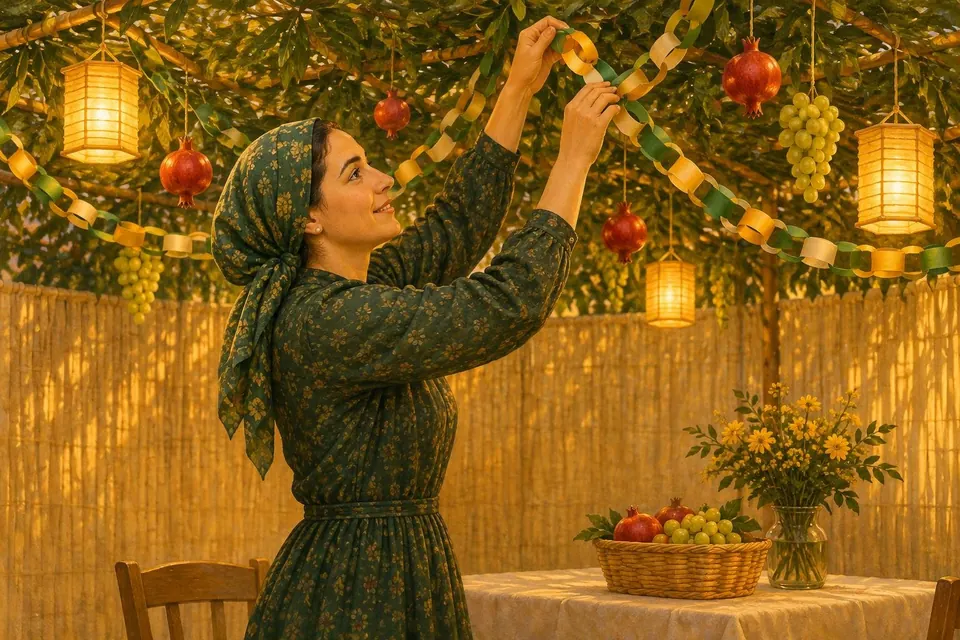
Sukkot is the most child-centered holiday, from the decorations children make for the sukkah with their own hands to the holiday time that can be devoted entirely to being with them. Rabbi Chanina, who remained strong and vigorous into old age, says: “The oil with which my mother anointed me as a child sustained me in my old age” (Chullin 24b). The word sachatani (“she anointed me”) has the same root as sukkah. In other words, the affection he received from his mother in childhood was like a sukkah, sheltering him—sachach—until old age.
On Sukkot we have the most precious thing of all: time. Rabbi Eliezer says (Sukkah 27b): “I praise those who take their time on the festival and stay at home, for it is written: ‘You shall rejoice, you and your household’ ” (Deuteronomy 14:26). Taking our time is worthy of praise! The four species are not the most precious thing, even though they are expensive. By Torah law, they are required only on the first day of the holiday. Time itself is the treasure. And on Sukkot we have it: zman simchateinu, “the time of our joy.” In other words, time itself is joy.
We have seven days to “eat, sleep, and stroll in the sukkah.” Stroll without leaving the sukkah? Walk around the table, stepping on one another’s feet? Not at all. This is our time to talk about our children’s interests. How little time we have during the year to sit down and listen to them! In conversation, we can visit their favorite places and the happy—and not so happy—moments of their lives. Children complain all year that their parents have no time for them, and now—what joy! There is time.
The joy of the holiday is, above all, Simchat Beit Hashoevah, the joy of drawing water. But is water the only thing that can be drawn? It is written that the lights of the celebration were so bright that a woman on the outskirts of Jerusalem could check rice in the middle of the night by their light. Rabbi Tzvi Elimelech Shapiro of Dinov, author of Bnei Yissaschar, asks: Is that what she was doing on the holiday?
He answers that women naturally possess intuition and the ability to separate what is right and good from what is bad. But at this time there is additional light, and everything is much clearer and easier to understand. He adds that the prophet Jonah received the gift of prophecy at Simchat Beit Hashoevah.
A Holiday With Heart#
The Jerusalem Talmud says: “A dried-out lulav is unfit, because ‘the dead do not praise God.’ ” Lulav can be read as two words, lo lev: “To Him—the heart.” This can also be understood as an instruction to give the holiday our hearts and truly feel it.
May it be the Almighty’s will that we can rejoice on the holiday, and then receive all its good signs: rain after the holiday, deliverance from exile, and protection from quarrels and discord in our homes. If we were sentenced to exile from our homes, during the week of Sukkot we have, as it were, fulfilled that sentence.
Rabbi Eliyahu Dessler writes that in the sukkah we can ask the Almighty for advice. If you have been uncertain about something for a long time, ask for an answer in the sukkah, as it is written: “Spread over us the shelter of Your peace, and set us right with Your good counsel” [Hashkivenu prayer].
By Rabbanit Yemima Mizrachi
Keep reading
More →How to Build a Sukkah: General Rules
The basic rules for choosing a location and covering a sukkah.
Guide · SukkotHow to Choose a Kosher Etrog
A guide to some of the features that can affect an etrog’s kosher status.
SukkotWhy Is Sukkot Called the Time of Our Joy?
The joy of Sukkot can deepen our love of God and prepare us for repentance.
SukkotWhy Celebrate Jewish Holidays With Food and Wine?
A parable from the Maggid of Dubno explores the connection between physical and spiritual joy.







