Why Do Parents Bless Sons Like Ephraim and Manasseh?
Three explanations explore the faith and character behind the traditional Friday-night blessing.
In brief
- Jacob said that Israel would bless children to be like Ephraim and Manasseh.
- One explanation focuses on their status as founders of tribes, though the author raises questions about it.
- Another sees their steadfast faith in Egypt as a model of independent spiritual strength.
- Rabbi Yitzchak Zilber explained that the brothers showed neither pride nor jealousy toward each other.
Parashat Vayechi#
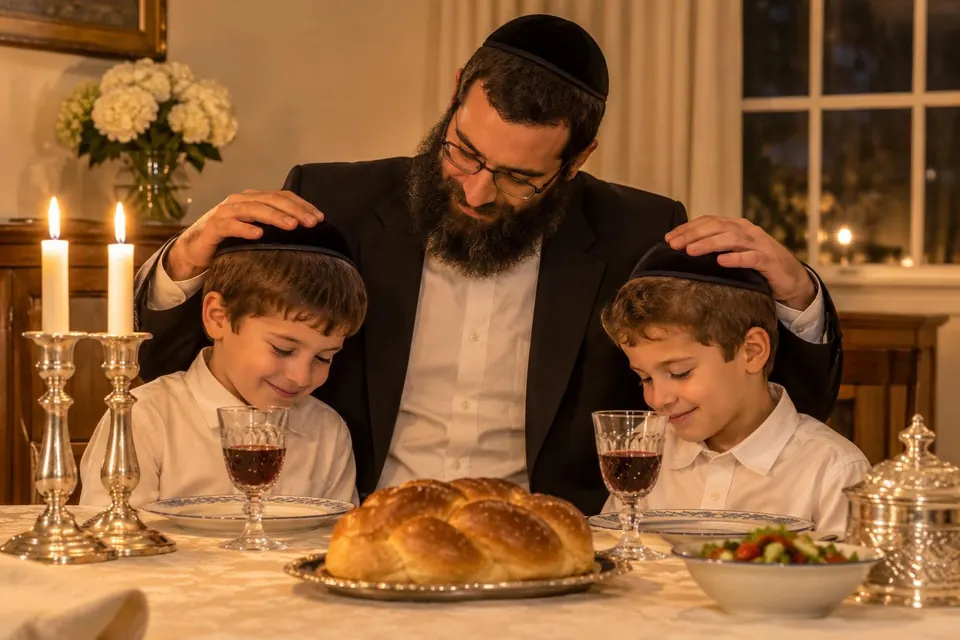
When Jacob blessed Joseph’s children, he said, “Through you Israel will bless, saying, ‘May God make you like Ephraim and Manasseh’” (Genesis 48:20). Rashi explains that anyone who wishes to bless his sons will say to each one, “May God make you like Ephraim and Manasseh.” And this is the custom of the Jewish people: on Friday night, a father gives his children this blessing.
Why did our forefather Jacob choose the tribes of Ephraim and Manasseh from among the 12 tribes? Were there no other tribes more worthy of this blessing?
The first answer many give is that Ephraim and Manasseh were the only grandchildren privileged to become founders of tribes, like members of the preceding generation. Judah’s well-known sons Perez and Zerah, for example, did not receive that status. Every father therefore blesses his children that the Holy One, blessed be He, make them like Ephraim and Manasseh—that is, that they not show a decline from one generation to the next.
This answer, however, is not entirely clear. First, Horayot 6b states unequivocally that Ephraim and Manasseh count as two tribes only with regard to their banners and tribal leaders, but not in other respects. In other words, Ephraim and Manasseh did not become fully equivalent to their father Joseph’s brothers.
Second, the great sage Rabbi Shlomo Heiman demonstrated that Joseph was not only one of the founders of the tribes but is also regarded as comparable to the forefathers of the Jewish people. Joseph is also the only person besides the forefathers Abraham, Isaac, and Jacob to be represented by one of the four species of plants used on Sukkot. And a verse in Psalms says, “With Your arm You redeemed Your people, the children of Jacob and Joseph. Selah” (Psalms 77:15).
It follows that even if Joseph’s sons were considered founders of tribes, this would still be a decline from one generation to the next (for Joseph’s sons, in the context of this explanation), since their father was not only a founder of a tribe but almost on the level of the forefathers of the Jewish people.
A second answer, offered by many, is that Ephraim and Manasseh were the only founders of tribes who grew up in a foreign land, without Jacob, surrounded by the impurity of Egypt. Despite this, they remained strong in their faith. The other founders of tribes lived under Jacob’s protection, so it was not difficult for them to remain firm in their faith.
This explains why a father blesses his children to be like Ephraim and Manasseh. He wishes that, however difficult their circumstances, nothing will prevent them from remaining firm in their faith and continuing to observe the mitzvot.
I once spoke about this subject, and one of the listeners did not understand. He asked, “Is it really a blessing to wish that children will be forced to go somewhere without Torah and succeed there?” His question calls for a fuller explanation.
Consider a train. It has a locomotive and other cars. Ordinary cars have no engine and cannot move on their own. But because they are connected to the locomotive, it pulls them along.
Someone who grew up in a religious environment or studies in a yeshiva is like a train car. As long as they do not disconnect themselves, they will continue to pray, study, and observe the mitzvot, because that is what the community around them—the locomotive—does.
But if someone prays, studies, and observes the mitzvot even in a place where none of these things are practiced, it shows that they have a deep connection to the spiritual world. In other words, they are a true locomotive themselves.
That is why every father blesses his sons to be “locomotives,” not “ordinary cars.”
I heard a third answer to our original question from my father-in-law, Rabbi Yitzchak Zilber. Before Jacob’s blessing, Manasseh grew up as the firstborn, the pride of the family. Then his grandfather came and took that honored status from him, giving it to Ephraim, Manasseh’s younger brother, and placing Ephraim above him. What would we expect to happen? Manasseh might have come to hate his brother Ephraim bitterly. Who knows what he might have done to him?
For example, their great-uncle Esau willingly sold his birthright to Jacob and then wanted to kill him for the rest of his life. Manasseh sold nothing; in effect, his birthright was taken from him by force. Surely Manasseh’s feelings toward Ephraim might have been no less hostile.
Yet neither in the verses of the Torah nor in the words of our Sages do we find a single hint that Manasseh hated his brother, much less that he intended to harm Ephraim.
And what usually happens to a younger brother who suddenly rises to greatness? He becomes proud. Yet we see no sign that Ephraim became proud or treated Manasseh arrogantly.
That is why every father blesses his sons, “May God make you like Ephraim and Manasseh”: like Ephraim, without pride, and like Manasseh, without jealousy or hatred.
A couple of points, however, need to be made.
- In the Midrash on Song of Songs, the verse “If only you were like a brother to me” (Song of Songs 8:1) is understood to mean that the people of Israel long for the Holy One, blessed be He, to be like a brother to them. The Midrash asks: What kind of brother does Israel have in mind?
It means Moses and Aaron, for Aaron sincerely rejoiced in his brother’s greatness.
At first glance, this seems inconsistent with my father-in-law’s explanation. Why does the Midrash not cite Manasseh and Ephraim as its example?
The answer is that Manasseh and Ephraim’s relationship reached the level of “turn away from evil” (Psalms 34:14), but we find no mention of Manasseh rejoicing in Ephraim’s greatness. In Jacob’s generation, then, Manasseh and Ephraim did indeed reach the highest level of brotherly love and solidarity. In later generations, however, we see the higher level of rejoicing in another person’s success.
- We do not find any mention of Ephraim’s pride or of his treating his older brother Manasseh arrogantly. But when we look at later generations, we see many examples of pride in the tribe of Ephraim: in the book of Judges, in the accounts of Gideon and Jephthah, and many times in the books of the later prophets.
I have heard in the name of the Arizal that Moses and Aaron corrected the sin of Cain and Abel. But we must begin by turning away from evil, even though not everyone can be expected to reach the greatness of Moses and Aaron. May we all be privileged to have both steadfast faith and genuine love for others, and may the blessing “May God make you like Ephraim and Manasseh” be fulfilled in us.
By Rabbi Avraham Kuperman
Keep reading
More →Matot-Masei: Children or Money?
Moses challenges two tribes to reconsider what comes first: their property or their children.
ParashaDevarim: Knowing When to Say No
The story of the spies offers a lesson about when children are ready to hear a refusal.
FamilyHow Much Must You Honor Your Parents?
Parashat Vaetchanan and a Talmudic story reveal the depth of the mitzvah to honor parents.
FamilyIs Hospitality Greater Than Greeting the Shechinah?
Abraham’s rush to welcome travelers offers a window into the greatness of hospitality.







