Chayei Sarah: The Strength of Old Age
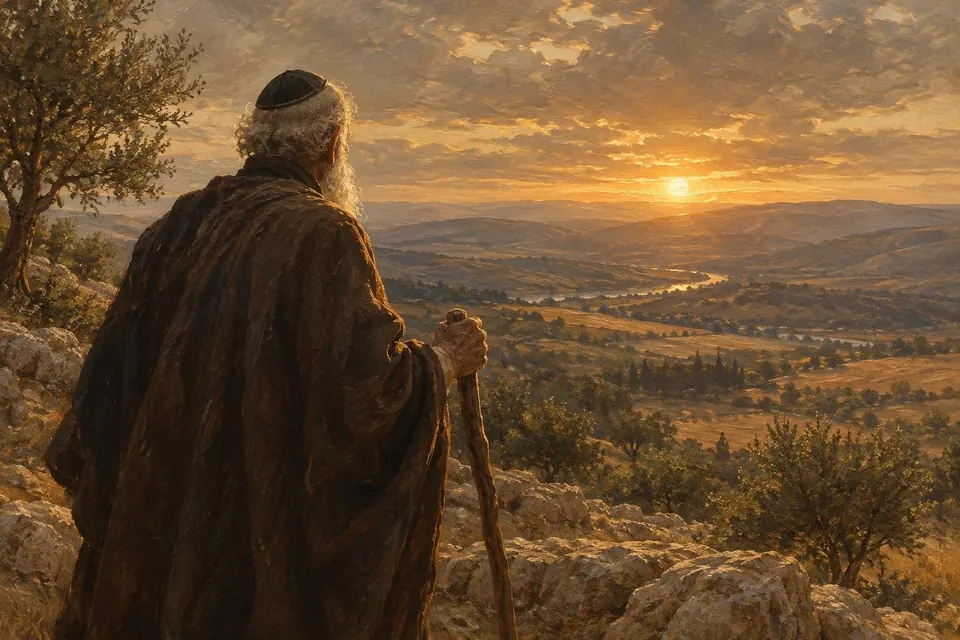
Abraham wanted to look old because a lifetime of growth gives new depth to the present.
In brief
- Abraham asked God to give him the appearance of old age.
- In earlier generations, age was honored as a sign of a life filled with achievement.
- A lifetime of spiritual growth gives a person's actions in the present greater depth.
- Abraham's kindness teaches us to give ourselves fully to each mitzvah and act of kindness.
Parashat Chayei Sarah#
“Abraham was old, advanced in years” (Genesis 24:1).
Rabbi Yehudah bar Simon said: Abraham asked God for old age. He said to Him, “Master of the universe, a man and his son come to a place, and people do not know which one to honor. Adorn a person with old age, and people will know whom to honor.” God replied, “By your life, you have asked for a good thing, and it will begin with you.” From the beginning of Genesis until this point, old age is not mentioned. Because Abraham asked for it, God gave him old age, as it says, “Abraham was old, advanced in years” (Bereishit Rabbah 65:9).
Our forefather Abraham was the first person to look old. Before then, everyone looked the same age. Abraham told God that he and his son Isaac looked exactly alike, so people confused them. Please, God, he said, I want to look old. God told him that it was a wonderful idea and that he would be the first to look old, as it says, “Abraham was old.”
We might think that Abraham wanted to look old for a practical reason: so that people would not confuse the older man with the younger one, Isaac with Abraham.
But the Midrash (Bereishit Rabbah) explains that the verse in Psalms, “You are the most beautiful of men; grace flows from your lips” (Psalms 45:3), refers to our forefather Abraham. In other words, he wanted to look old not for practical reasons, but because he wanted to look beautiful—to look like an elder. A crown of beauty was placed on Abraham: he looked like an elder, with gray hair and a gray beard.
In our generation, we cannot even understand what this means. Imagine a woman saying to a friend, “Oh, you look wonderful—you look old!” People spend millions of dollars to look young. Yet our forefather Abraham wanted to look old.
We cannot understand why. What is so beautiful about an old person?
When I was little, I heard people speak of the Alter fun Kelm and the Alter fun Slobodka—“the Elder of Kelm” and “the Elder of Slobodka.” These were great Torah sages: Rabbi Simcha Zissel Broide of Kelm and Rabbi Nathan Tzvi Finkel of Slobodka. It bothered me terribly. Why were they insulting them?
But I was mistaken. Clearly, in earlier times, “old” and “old man” were not insulting words. Of course, people do not really speak that way today. In Hebrew, they say Saba miKelm, literally “Grandfather of Kelm”; in Russian, the customary term is “Elder of Kelm.” In our generation, people avoid saying “old man” because it is unflattering. But there were times when being old was an honor.
Let us explain why “old” was a compliment in earlier generations and is an insult today. First we will offer a simple explanation, and then a deeper, more accurate one.
A Long Past and a Short Future#
A person's life has three parts: the past, the present, and the future. When people look at their past and ask, “What have I accomplished? What have I built in my life?” the answer is usually: nothing! And the present—what can one accomplish in a single instant? Almost nothing at all. Only the future is beautiful and vast. Oh, what a beautiful future! Everyone dreams of becoming rich, wise, and righteous. The past and present are not worth a penny; only the future is full of roses.
According to this outlook, an old person, with a long past and a short future, is worth nothing. How much longer does such a person have to live? A year or two? They already have one foot in the grave. That is why “old man” is considered an insult in our generation.
In earlier generations, the outlook was exactly the opposite. The future was nothing, because no one can know what tomorrow will bring. You cannot rely on the future. The past, by contrast, was what mattered: there a person had accumulated greatness. He had studied a great deal of Torah and fulfilled many mitzvot with self-sacrifice.
Naturally, in earlier generations it was more honorable to look like a gray-bearded elder. It meant that a Jew had a past full of great deeds behind him and was himself a great person. He had a great past and a small future. A young man, on the other hand—what has he managed to accomplish in life? Almost nothing. And his future is unknown. No one knows what tomorrow will bring, so naturally it is worth nothing.
Living Every Moment#
The Torah says, “These are the years of Abraham's life, which he lived: one hundred years, and seventy years, and five years” [Genesis 25:7]. It also says of Sarah, “the years of Sarah's life” [Genesis 23:1].
I once heard an explanation in the name of Rabbi Yerucham Levovitz, the spiritual mentor of the Mir yeshiva. What does it mean to live? When a person sits and eats pizza or ice cream, is that called living? No! Living means moments of achieving greatness and closeness to God.
If someone lives 80 years, God willing, they might be able to gather a few minutes of real life from all their days—a moment here and a moment there. If a person can gather a few whole years of real life, that is already greatness.
Our forefather Abraham lived 175 years of pure life! There was not a single moment when he was not living. Every moment of Abraham's life was a moment of true life!
So, upon reaching 175, our forefather Abraham said to God: Master of the universe, I want some kind of “sign” that will testify that I am ba bayamim, literally, “come in days,” translated as “advanced in years.” I have a magnificent past behind me; I carry 170 years of greatness on my shoulders. I deserve a “medal”: a gray beard!
And what about us? By the time we reach 80, what have we accomplished in the years we were given? Yes, we had dreams, but those dreams did not come true. So there is no particular significance to being old.
That is the simple explanation. Now let us try to explain it on a deeper level.
The Value of Old Age Is in the Present#
It seems to me that the past of any person, even our forefather Abraham, is not the most beautiful part of their life. A person's greatness does not find expression in the past. They may have been the greatest person in the past, but it has already passed, vanished from the world. Of course, we will take it with us to the World to Come, but that is not what we are discussing now. The future, too, is not in our hands.
What, then, has value? What matters? There is only one thing of value: the present! If a person can pray now, saying, “Blessed are You, Lord our God, King of the universe,” or say, “Blessed is He, and blessed is His name,” that moment is a moment of greatness. It is valuable because only this moment is mine. We own neither the past nor the future. All that belongs to us is the present.
And what is the present worth? What is this moment worth? It is worth as much as the past! Let us explain.
Imagine our forefather Abraham on his birthday, turning 175. Suppose he knows that this afternoon he will go to the World to Come, to the Garden of Eden. Abraham has 175 years of a forefather's greatness behind him. He has not wasted a second of his life; he has “come in days.”
And where is he going? To the World to Come, to eternity!
No! He is going to say the morning prayer, Shacharit. And this is not the Shacharit of a 20-year-old, or a 50-year-old, or even a 120-year-old. This Shacharit contains the greatness of 175 years of spiritual growth and ascent! Our forefather Abraham put all 175 of his great years into a single Shacharit prayer!
That is what it means to be an elder. “Elder” means: Today I am old, and I want people to know that I am old, so they can appreciate and understand what “today” means.
Imagine that people are looking for a head for a large, well-known yeshiva, and someone recommends a friend who is ... eighteen. Does anyone think he should be appointed? Of course not. The head of a yeshiva of that stature should be at least 40, because the position calls for someone with 40 years of history behind him.
But why? What difference does it make if he is a young man under 20?
When he stands before the yeshiva to give a lesson, we want that lesson to be the product of 40 years of spiritual growth. This is not a matter of the past; it is a matter of the present. Right now, at this moment, he must possess the greatness of those 40 years!
An old person is not great because they have a past. That is a mistake. They are great because they have a present! When they pray today, when they study Torah today, they put their 80 or 100 years of spiritual growth into everything they do. Naturally, their present—their life today—is of an entirely different quality. That is the importance of old age.
For our forefather Abraham, it was worth investing 175 years of greatness in order to say a single Amidah prayer properly!
Chesed: Giving Without Calculating#
It seems to me that this is also the simplest meaning of the word “Hasid”—a pious person. A Hasid is a person who acts with chesed, kindness. When they are about to perform a mitzvah, they make no calculations. They put all the strength at their disposal into that one moment.
The opposite of chesed is din, judgment. There, everything is measured. And that is our biggest problem: we measure everything.
A Jew walks up to the refrigerator, pours himself a glass of soda water, and rushes through the blessing, swallowing his words: “Blessed are You, Lord our God, King of the universe, by Whose word everything exists.”
If we ask him, “My dear fellow, why do you say the blessing so quickly? Wouldn't it be fitting to say each word properly?”
Here is what he will answer: “My friend, I'm not a fool. I have a head on my shoulders, and I've made a simple calculation. There's a mitzvah to say 100 blessings every day, right? If you multiply 100 blessings by 365 days a year, you get 36,500 blessings in a year. And if God helps me live 100 years, I'll say more than three and a half million blessings in my lifetime. So the blessing I'm saying now is one out of three and a half million. What's so important about it that I have to make a whole production out of it?”
That is din. We measure what a blessing is “worth” and treat it accordingly. A person thinks: If I at least said, “Blessed are You, Lord our God ...”—quickly, without any heartfelt attention—that is more than enough.
Last week I prayed Shacharit in a shtiebel, a synagogue where many minyans meet at different times, in the Mea Shearim neighborhood. A young man came into the room, heard that they were saying “Baruch Sheamar,” the opening of Pesukei Dezimra, the verses of praise, and turned around and left. He did not have time to start from the beginning. He was looking for a minyan that had already reached “Yishtabach,” the end of Pesukei Dezimra.
If he were asked, “Why can't you show the morning prayer a little respect and say the whole thing, from beginning to end?”
Here too, the answer would be the same: “I pray Shacharit 365 days a year. With God's help, I'll have 36,500 prayers in my lifetime. This prayer is one out of 36,000. Why pay so much attention to it? If I don't pray well today, I'll pray well tomorrow or next week. How many more prayers do I have ahead of me!” That is din: measuring what each prayer and each blessing is “worth.”
The complete opposite is the quality of chesed, which our forefather Abraham represents. When Abraham saw three Bedouins, he did not “measure” them: What are you worth? Who are you? How much Torah have you studied? Our forefather Abraham did not act that way. His mitzvah of welcoming guests did not depend on the guest's importance. He put his whole self into the mitzvah, giving everything he had. That is because he was a baal chesed, literally a “person of kindness,” someone who consistently acts with this quality.
When our forefather Abraham said a blessing on his 175th birthday, he put all 175 years of greatness and spiritual growth into it. He said to God: Master of the universe, thank You for giving me 175 years of spiritual growth and greatness so that I could finally understand all the hidden meanings, the kavanot, that one should have in mind when saying a single blessing. If he had been asked, “Abraham, is this one blessing really so valuable to you that it is worth putting so much into it?” he would have answered: “Of course, because I am the root of the quality of chesed in the world.”
Measuring Everything#
One of our biggest problems is that we measure everything!
A man comes to see me and wants to talk. Of course, I am happy to receive him. After all, it is an act of kindness to a fellow Jew! Five minutes pass, then ten—everything is wonderful. But after 15 minutes, I begin to feel: Ugh, what a bore. When will he finish?! Why? Because I “measure” him and decide that he is worth ten minutes of my time, no more. He is a pleasant person, but after ten minutes, he should leave me alone!
Let me share a very profound thought. Why is it easier to help the neighbor across the way than the people in one's own household? When a person does a kindness for a neighbor, he can “measure” the importance of the good deed. During the week they do not see each other at all: the neighbor prays at seven in the morning, and he prays at eight. They see each other only on Shabbat, when he says to his neighbor with a smile, “Good morning, Shabbat shalom!” In other words, this person is worth one smile a week.
But if he had to smile every time he came home, that would mean hundreds of thousands of smiles. And in his opinion, the people in his household are not worth that much. There is no need to overdo it ...
That attitude contradicts what it means to be a Jew. Judaism is chesed. And a Jew's goal is to become a Hasid—that is, to put one's whole self into everything one does. You come home in the morning on an ordinary weekday, not on the eve of Yom Kippur? Say “Good morning!” in a pleasant voice and with a broad smile.
You sit down to breakfast and say the blessing, “Who brings forth bread from the earth”? Remember how you said that blessing before eating matzah!
Let us try to embrace this quality of our forefather Abraham, the quality of chesed. Then we will merit the honored title of “an elder, advanced in years.”
By Rabbi Shimshon Pincus
Keep reading
More →Matot-Masei: Children or Money?
Moses challenges two tribes to reconsider what comes first: their property or their children.
ParashaDevarim: Knowing When to Say No
The story of the spies offers a lesson about when children are ready to hear a refusal.
FamilyHow Much Must You Honor Your Parents?
Parashat Vaetchanan and a Talmudic story reveal the depth of the mitzvah to honor parents.
FamilyIs Hospitality Greater Than Greeting the Shechinah?
Abraham’s rush to welcome travelers offers a window into the greatness of hospitality.







