What Is the Goal of Jewish Parenting?
Raising independent children calls for clear goals, self-reflection, and the courage to let go.
In brief
- The goal of Jewish education is to raise a person who believes in God and lives by that belief.
- Parents must use the time they can influence their children, then let them become independent.
- Raising children is also an opportunity for parents to work on themselves.
- Parents can help children learn to face mistakes and disappointments.
Excerpts from the book Grow!
Rabbi Kavas compares raising children to shooting an arrow. To hit the target, you must:
- See the target very clearly.
- Draw the bowstring with all your strength.
- Most important, let the arrow go at the end.
These are the three tasks of raising children:
1. See the target very clearly. Raising children presents us with questions and challenges almost every minute.
There is a parable about a man who asks a rabbi, “Please tell me, which road should I take?” The rabbi replies, “That depends on where you want to go.” This is the “rule of the city and the road.” To choose the right road, I must first decide which city I want to reach. I need to set a goal and only then consider how to get there. The more clearly the goal is defined, the easier it is to find solutions.
What is your goal as a parent? The main goal of Jewish education is to raise a person who believes in God and lives according to that belief.
2. Draw the bowstring with all your strength. The time when we can directly and effectively influence a child is a short period in that child’s life. Before long, we find ourselves with a grown person, and the only way to maintain a peaceful relationship is to respect their opinions and decisions. That makes it all the more important to value and use this brief time and “draw the bowstring with all our strength.”
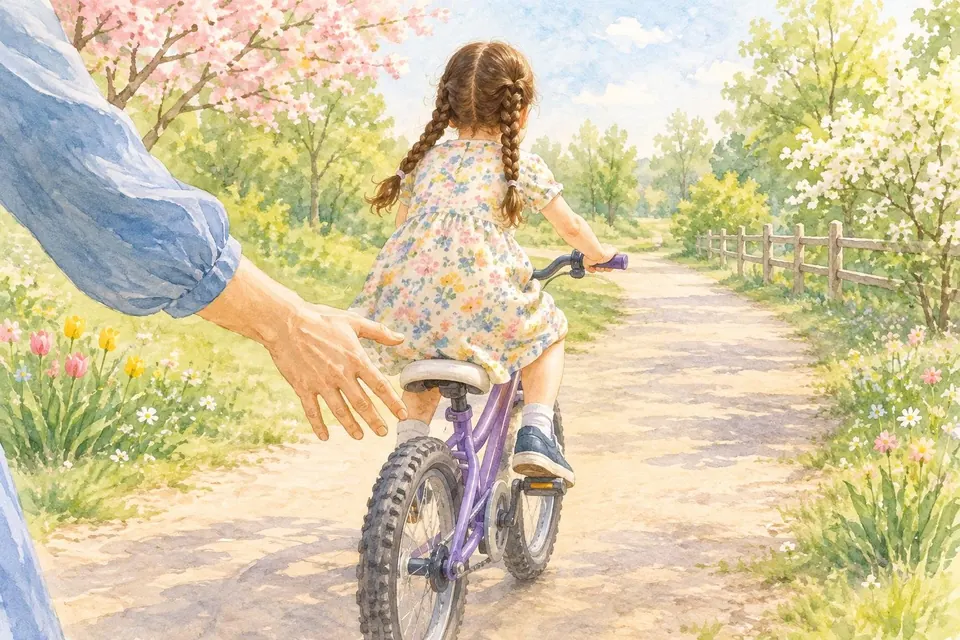
3. Most important, let the arrow go at the end. We see the result of raising a child only after the child has become independent. Independence, then, is a measure of successful parenting.
This is a commonplace idea, yet how many parents never stop fighting against their children’s growing up? How does a toddler learn to walk? At first, the child crawls while holding on to Mom. Mom feels wonderful: she is needed. Then the child starts walking alone, just a few steps at first. Each time, the distance grows. We rejoice because it means the child is growing and becoming more independent.
Once the child has learned to walk, there is no need to reach out a hand and say, “Hold on so you don’t fall!” It hurts to see a child fall and get hurt, and we want to support and protect them—I’ve known how to walk successfully for a long time! It is also frightening to lose the feeling of absolute control over a child. But if it matters to me that my child learns to walk, I will say, “Well done! Keep walking, don’t be afraid!”
The same thing happens again and again with an adult “child” at different stages of life.
Choosing a profession and friends, navigating a marriage, raising children: how we long to step in, prevent mistakes, and protect them! How destructive decisions different from our own can seem! How we long to reinforce and restore our role as the “elder,” the one who “knows,” who “gives,” who “carries” the child in our arms. But if it matters to me that my child becomes a successful adult, I will “let the arrow go” and say, “Well done! Keep walking, don’t be afraid!”
The Meaning of Raising Children#
“As soon as a child can walk holding his father’s hand, the father must take him along when he goes up to the Temple on a festival.” (Maimonides, Laws of Festival Offerings)
“The meaning of education is self-definition.” (Alei Shur)
When people talk about raising children, they usually mean that parents shape their children. In fact, raising children is more like the magnifying glass in a parable.
A man saw a magnifying glass for the first time at a market and asked what it was for. He was told that it made everything bigger. Delighted, he realized that this was just what he had been looking for to solve a problem.
The gate to his yard was very low. Whenever he brought a cartload of hay home, he had to stop at the gate, unload the hay, drive through, and then load it all back onto the cart. What a lot of extra work! And here was an inexpensive wonder glass that made things bigger. It would solve all his problems! Naturally, he bought it.
At home, he loaded his cart and set off. He looked at the gate through the glass, and sure enough, it grew bigger and bigger! He urged the horse on, faster and faster, and suddenly—crash! Everything fell and spilled. No, the gate had not grown bigger!
The next day, he went back to the seller and said, “This is outrageous! You sold me a defective glass. It looked as if the gate had gotten bigger, but the hay spilled anyway!”
“No,” the seller replied, “the glass works. But don’t forget to look both ways: the gate got bigger, but so did the pile of hay.”
Of course, parents try to help their children become better people. But it is important not to forget to look “both ways”: at ourselves, too. To paraphrase a famous saying: “Educator, educate yourself.”
The great Rabbi Shlomo Wolbe, author of Alei Shur, writes in the chapter on education:
“If the meaning of education were ‘only’ to set a child on the path of Torah and righteousness, the work would already be difficult enough. In fact, a father’s character is fully formed only through raising his son. All a person’s ideals, aspirations, and faith remain ‘potential’ until they become ‘actual’ in his sons. The meaning of education is self-definition.”
Raising a child, then, is a wonderful opportunity to grow and educate ourselves. The key is to distinguish between ourselves and the child.
Sometimes parents, especially parents of teenagers and adult “children,” feel hurt: “I try, I invest, I give, and he doesn’t appreciate it! Who needs all this, anyway? Me?” The right answer is: yes, I do. Painful as it may be, a child is not commanded to “be raised.” We, on the other hand, have a mitzvah to raise our children.
What we invest in our children is often not entirely for their sake. A mother, for example, suffers if her children are not dressed better than everyone else. Yet the clothes bring the children nothing but misery. They would much rather dig in the sand in old play clothes than be kept under the watchful eye of a mother anxious about their expensive outfits.
A father is willing to pay for his son’s education because, in their circles, a son without an academic degree or a particular title would be a source of shame and disgrace—to the father.
Sometimes we see our children through ourselves—through our memories, moods, and dreams—and respond not to the child but to ourselves. A grandmother who never forgot her hungry childhood constantly gave her grandchildren food. It is touching, but it does not help them understand one another. A father having trouble at work takes his child’s low grade at school as a personal insult and a tragedy.
We ourselves often behave like children. Sometimes it is hard to tell who is more grown-up, the parent or the child. A grandmother, hurt because her granddaughter has not paid her enough attention, sulks and says, “You look bad today!” Or: “If that’s how it is, I won’t come see you anymore!”
Parents’ relationships with their children often resemble a competition along the lines of “Don’t play with my toys.” It can range from the familiar “Who do you love more?” to “We won’t tell Mom about this,” “You’re the only one who understands me,” and so on.
It is hard to overstate the harm such phrases can do to children. In divorced families, they can easily lead to tragedy. A child sees part of themselves in their mother and part in their father. When we criticize the other parent in front of a child, we do not strengthen our own position; we damage the child.
Troubles or Triumphs: An Ode to Mistakes#
If we want our children to be happy, we must take a good look at ourselves: how do we see the world?
Imagine a child comes home from school and tells Mom that the teacher gave him an unfair grade. The child looks at his mother. Upset by her child’s hurt—and it is not easy to manage her own ambitions, either—she blurts out, “I know that teacher! Of course! She would have given her own child a different grade! She doesn’t know anything herself!”
The harm this mother does is far worse than what the teacher did, even if we assume the grade was unfair. With her reaction, the mother is teaching her child to choose to see mostly evil and injustice in the world.
How would a mother who focuses on goodness and joy respond? She might say to her son, “I know you prepared and tried hard. That’s what matters! You did well!” The child might reply, “But it hurts that the teacher didn’t value me.”
Now a wonderful opportunity arises to explain, depending on the situation and the child’s age:
- That his knowledge has not diminished because it may have been judged unfairly.
- How to think about grades in general.
- How to assess himself properly.
- How to respond to setbacks.
The world is full of blessing, energies, and opportunities because God constantly fills it with them. A person who knows how to see the good in everything that happens triumphs and draws light to themselves. A person who curses the world and constantly says, “Why do things always go so badly for me? Why am I always in such pain? How can He treat me this way without shame?” draws something very different to themselves.
How can we teach children not to become upset when reality does not meet their expectations? How can we accept that we, good parents, sometimes make mistakes and do foolish things?
Rabbi Yakobzon related that on the day he became the principal of a school for troubled teenagers, he gave them this speech:
“Obviously, we can’t get to know one another in a short meeting. So I’ll tell you one tiny thing about myself, just so you understand who you’re dealing with. I’m the best educator in Israel!”
When all the teenagers froze at this display of extraordinary modesty, he continued:
“Why do you think parents make so many mistakes? Parents love their children and want the best for them, yet they make a lot of mistakes. Why did God create the world this way? One answer is that this is how He prepares a child for life. As we grow up, we go out into a world where the people around us often make mistakes in the way they treat us. Some of the consequences are in our hands: we can fix them. Others are entirely beyond our control. And that’s where things get interesting: how do we live with that?
“A person can be so shocked that their whole world falls apart. They may even lose the desire to move or do anything at all. It’s one thing when the people around you simply make mistakes. But there are also people who deliberately do hurtful things. That’s not like a mother who loves you and makes mistakes despite her love. It’s not like a schoolteacher who may not have loved you, but at least wanted to be good and made an unintentional mistake while believing she was right. God knew we would enter a world where people make mistakes!
“We need to be able to forgive and get past a mistake made by someone who loves us. It’s hard to forgive and get past a mistake, even when you understand that the person didn’t mean you harm. Being able to deal with injustice and other people’s mistakes, which may be malicious, is one of the most important skills in life!
“Congratulations: you have the best educator in the world! Nobody makes as many mistakes as I do! Anyone who spends even a year with me and remains an optimist is ready for life!”
We live in a complicated world. But we do not have to become like it in every way! I choose whether life will be a joy or a source of sadness, a gift or a punishment.
By Rebbetzin Esther Offengenden
Keep reading
More →Matot-Masei: Children or Money?
Moses challenges two tribes to reconsider what comes first: their property or their children.
ParashaDevarim: Knowing When to Say No
The story of the spies offers a lesson about when children are ready to hear a refusal.
FamilyHow Much Must You Honor Your Parents?
Parashat Vaetchanan and a Talmudic story reveal the depth of the mitzvah to honor parents.
FamilyIs Hospitality Greater Than Greeting the Shechinah?
Abraham’s rush to welcome travelers offers a window into the greatness of hospitality.







