Shalom Bayit: The Jewish View of Peace in the Home
Jewish teachings place peace between husband and wife at the heart of family life.
In brief
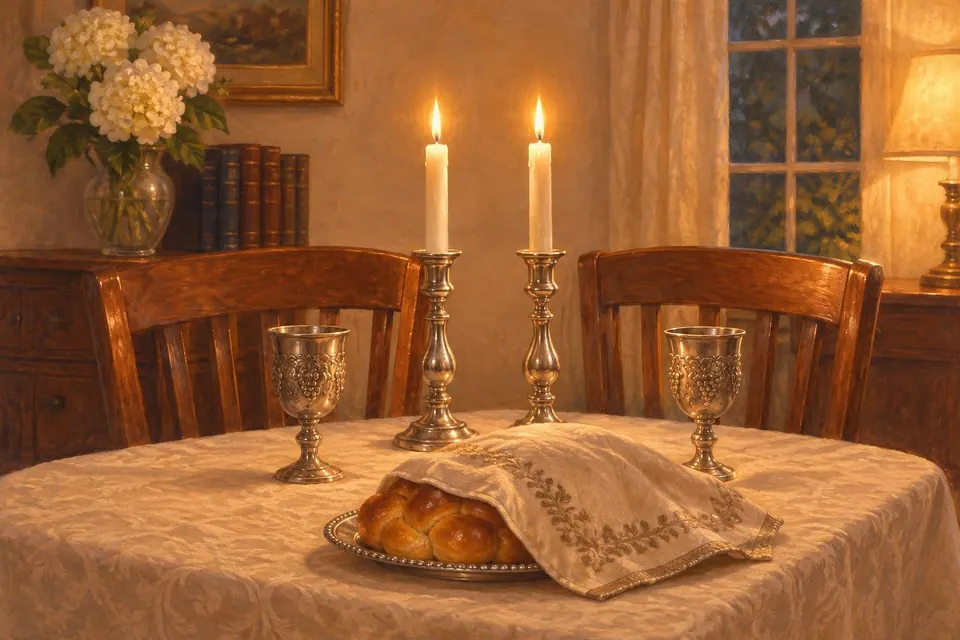
- Maimonides teaches that a Shabbat candle takes precedence over a Hanukkah candle because it brings peace to the home.
- Peace between husband and wife is presented as a particular expression of peace in the world.
- The ketubah and the laws governing marriage help unite husband and wife in every area of life.
- The author teaches that family unity depends on harmony, consent, and work on one’s own conduct.
For What Does God Set Aside His Honor?#
Maimonides (the Rambam) raises a question: Suppose a person is so poor that, for Shabbat during Hanukkah, they can buy only one candle. Should they buy a Shabbat candle or a Hanukkah candle? Lighting Hanukkah candles is a very important mitzvah. If necessary, a person must even ask for charity to fulfill it. Nevertheless, Maimonides says, the Shabbat candle takes precedence because it brings peace to the home. He offers two proofs of the special importance of peace in the family [Maimonides, Laws of Hanukkah 4:14].
The first is found in our holy Torah. The Creator’s sacred Name is erased to bring peace between husband and wife. When a husband suspects his wife of being unfaithful, God forbid, a special procedure described in the Torah’s passage about the sotah (a woman suspected of adultery) tests whether she is innocent. Part of that procedure involves erasing God’s written Name in water that the woman drinks. If she is innocent, she receives a blessing; if she has indeed been unfaithful to her husband, she dies. Thus, for the sake of peace in the family, the Creator commanded us to erase His Name. How important peace in the family must be to the Creator [Numbers 5:11–31].
For his second proof, Maimonides discusses the Torah’s special regard for shalom (peace): “Great is peace, for the entire Torah was given to bring peace to the world, as it is said, ‘Her ways are pleasant ways, and all her paths are peace’” [Maimonides, Laws of Hanukkah 4:14; Proverbs 3:17]. Maimonides explains that if we must choose between two mitzvot, and one brings peace while the other does not have that benefit, we should choose the one that brings peace.
To understand Maimonides better, we should first consider what it means to erase God’s Name for the sake of peace. Erasing God’s Name is one of the most stringent prohibitions. The Talmud says that Shalom is also one of God’s names [Shabbat 10b]. If so, is it also forbidden to erase it, like His other Names? We do not find this stated in either the Mishnah or the Gemara.
The Talmud lists seven Names of God that may not be erased, but Shalom is not among them [Shevuot 35a–b]. The legal authorities disagree: some say that the Name Shalom may not be erased either, while others say it may be erased but must not be treated disrespectfully. The Maharal of Prague explains that when we speak of God’s Name Shalom, we mean not the letters shin, lamed, vav, and mem, but the concept of peace itself. In other words, the very presence of peace reveals the Creator’s unity. The prophets said that after the Messiah comes, predators and herbivores will live together without devouring one another. When there is harmony and peace among people, that is shalom itself, and it reveals the Creator’s unity. We can now better understand Maimonides’ words: the whole Torah was given to bring shalom into this world because its entire purpose and essence is to reveal God’s unity.
The Creator’s Presence or a Consuming Fire?#
As we have said, Maimonides gives two examples: peace between husband and wife, and peace in general.
Why does he not include both in the general concept of shalom? Why does he mention peace between spouses separately? What place does peace in the home have in this whole picture?
Peace in the family is a particular expression of peace throughout the world. The Creator’s unity is revealed not only when there is harmony in the world as a whole, but also when there is peace in a family, between husband and wife.
In Hebrew, a man is called איש (ish) and a woman אשה (isha). Both words contain the same root, אש (esh), meaning “fire.” Each also has an additional letter: י (yud) in the word for man and ה (he) in the word for woman. Together, these letters form a Name of God. The Sages said: “If husband and wife are worthy, the Shechinah (God’s presence) is between them; if they are not worthy, fire consumes them” [Sotah 17a].
The first person to be born was named Cain. Why Cain? Eve, the mother of all humanity, said, “I have acquired a man with God” [Genesis 4:1]. Why did she say this? The Sages teach that there are three partners in the creation of a person: the father, the mother, and God [Kiddushin 30b]. God makes His presence felt in every home, according to whether the couple gives Him a place in it. If husband and wife are worthy and the Shechinah is present in their home, they welcome God into it, and this is certainly reflected in their children. But if they drive Him out, God forbid—if there is no peace, agreement, or harmony in their home—only fire remains between them. Sadly, the soul a child receives from such a union will have many shortcomings from the outset. A lack of peace in the family can therefore often be one cause of children’s behavioral problems.
When it comes to harmony in the world, the main reason for its absence is humanity. Everything in the world was created in harmony, but the human being came and disturbed that order. Rosh Hashanah, the first of Tishrei, is the sixth day of creation. Why, then, is it called the beginning, the first day? It is the day humanity was created. The human being is the central purpose of creation; everything was created for human beings and for their sake. Therefore, when we speak of shalom, it concerns human beings first and foremost.
What Does “One Flesh” Mean?#
When the Torah speaks about the creation of human beings, male and female, it says that they become “one flesh” [Genesis 2:24]. Rashi and Maimonides offer different explanations of these words. Rashi says that the child born to a father and mother is the “one flesh” [Rashi on Genesis 2:24]. Maimonides challenges this explanation: the same “one flesh” also results from animals mating. Yet the Torah mentions “one flesh” in connection with human beings. What, then, distinguishes us?
Maimonides explains that the phrase refers to the child’s parents, not to the child. A human being is called a human being when husband and wife are together. When there is complete unity between husband and wife—not a casual union, as with a cat or a dog, but one flesh, joined together by God—then we have a family. Without that unity, a consuming fire enters the home instead.
The First Human Being’s Sin#
All the suffering in our world is a consequence of the first human being’s sin. The cause of that sin was the serpent.
Let us consider how the serpent struck this world. Among other things, it broke the bond between God and humanity. But it began elsewhere: it tempted Eve and persuaded her to disobey her husband.
Our Sages say that Eve told the serpent that Adam had commanded her not to eat from the Tree of Knowledge and had also forbidden her to touch it. The serpent pushed Eve against the tree, and ... nothing happened. Eve did not die [Bereishit Rabbah 19:3]. We should not understand all these things literally, because we cannot fully grasp who Adam, the first human being, was or what the serpent was. Nevertheless, let us try to learn an essential principle at our own level.
The greatest unity between husband and wife is achieved when a wife listens to her husband, when together they form a whole human being, with shared thoughts and views. That is precisely what the serpent wanted to destroy, and it succeeded. It damaged the bond between Adam and Eve. She disobeyed her husband, stumbled, and ate the forbidden fruit. Then, not wanting to perish alone, she drew Adam after her. The crown and purpose of creation is the human being, and the true human state is the unity of husband and wife: what is called a “whole human being.” The Shulchan Aruch, in Even HaEzer, states in connection with the laws of marriage that a man who is not yet married is not called a human being.
What Makes Shalom Bayit Distinctive?#
There is a concept called darkei shalom (the ways of peace). It is an important mitzvah to maintain good relations with everyone around us: neighbors, coworkers, and others. As we have mentioned, this is part of the manifestation of God’s Name Shalom.
But shalom bayit, peace in the home, has a special and important place. Shalom bayit is not merely a “cold peace,” like that between neighbors or coworkers. It is a peace that joins husband and wife into a single whole. In a family with this genuine peace and closeness between husband and wife, the Shechinah will be present.
The world was created for the sake of the Torah and for Israel—the whole human being who will live by God’s will. A whole human being is one who lives in true peace with his wife. Shalom bayit, peace in the home, therefore occupies a central place and is, in essence, the foundation of creation.
Are People Born Criminals?#
The Talmud speaks of bnei tesha midot, “children of nine qualities.” This refers to children who become criminals. All nine “qualities” concern the relationship between husband and wife at the time of conception [Nedarim 20b].
When there is wholeness in the family, when father and mother merit God’s presence in their lives, children come into the world who continue the line of our forefathers. But if this is not so, then despite their halachic connection to their ancestors, criminals who rebel against the Torah are born. It is important to know this, because we often fail to appreciate the importance of peace in the home. We may seem to observe Torah law while quarreling daily with our spouse, thinking that this is life and nothing can be done about it. This is not how it should be. We must do everything we can to correct it.
When I began studying at yeshiva, my teacher Rabbi Yaakov Friedman said to me, “You have two main responsibilities in life right now: one is to study constantly, and the other is to make sure there is peace in your home.”
What Is “Good” and What Is “Bad”?#
Why does the Torah not say ki tov, “that it was good,” about the second day of creation? On that day, separation, or machloket (division or disagreement), was created. God separated the upper waters from the lower waters. The Midrash says that disagreement was created on that day. God undoubtedly created disagreement for the best of purposes. But the concept of machloket and the words ki tov cannot coexist. There cannot be disagreement and, at the same time, goodness. Once disagreement has corrected what needs to be corrected, it will be possible to say ki tov.
The meaning and purpose of peace is to unite in order to reveal the Creator’s unity. Peace and unity must begin in our own homes.
The Meaning of the Ketubah and Tractate Ketubot#
The ketubah is a marriage document setting out a husband’s financial obligations to his wife, during his lifetime and after divorce or death. The word ketubah comes from ketivah, “writing,” which does not seem to describe it very precisely. “Marriage contract” would seem a better term. Why, then, is it customary to read the ketubah ceremonially under the chuppah (wedding canopy), inviting respected people to do so? What makes the ketubah so significant and important if it is only a contract, a financial agreement?
We have already said that the letter י (yud) in איש, “man,” and the letter ה (he) in אשה, “woman,” together form a Name of God. But this is not the full Name. The full Name consists of four letters: י, ה, ו, ה (yud, he, vav, he).
Why do the two words form an abbreviated Name of the Creator rather than the full one? The Arizal says that the ketubah, with all its conditions and obligations binding the spouses, supplies the missing letters of the Creator’s Name. In other words, the central meaning of the ketubah is to unite husband and wife through God’s Name. The word כתובה (ketubah, “marriage document”) contains the root כתב (katav, “writing”) and two additional letters: ו (vav) and ה (he). Thus, the ketubah represents writing in the two missing letters of God’s Name.
Under Torah law, there are virtually no financial obligations between husband and wife. Why, then, is there a whole tractate, Ketubot, devoted to regulating their relationship, including their financial relationship—what a husband must provide for his wife, what a wife must provide for her husband, and so on?
There is a principle called ishto kegufo: a person’s wife is like part of himself. Its simple meaning is that husband and wife should be united, like parts of one whole. The purpose of the entire tractate of Ketubot and all the Sages’ enactments concerning spouses is to make their unity complete, not only in their intimate life, but in every area of life, so that unity, harmony, and agreement prevail between them. This rests on obligations: a husband’s obligations to his wife and a wife’s obligations to her husband.
The ketubah itself obligates a man to pay his wife money if he gives her a get (a Jewish bill of divorce). The purpose of this law is to make it difficult for a husband to part from his wife. He should not be able simply to go to a civil registry office and divorce easily, as is customary among other nations. It should not be so simple. The meaning of a family is for husband and wife to be one whole. But when a wife can be exchanged every few months, that is not one whole. Without a ketubah, when a man can divorce easily whenever he wishes, such a life resembles promiscuity. It lacks the true unity of husband and wife.
Our greatest Sages knew how to unite husband and wife properly, so that they would become one whole in our families and the Shechinah would be present in our homes. That is the purpose of the ketubah, and that is what the tractate of Ketubot teaches us.
Who Is a “Kosher Wife”?#
To all this we should add a beautiful saying of our Sages: “Who is a kosher wife? One who does her husband’s will.”
The Arizal’s writings offer an interesting parable. When a person wants to raise an arm, the head does not have to make a special appeal to the arm and order it to rise. No command is spoken or received; the person simply raises an arm.
There is another kind of relationship: that of a king and his servants. If the king wants something, his servants do not know it. For his wish to be fulfilled, he must first tell a servant. The servant then carries out the king’s command according to his own understanding. If he understands it correctly, he will carry out the king’s wish correctly. But if he misunderstands, he may do the exact opposite. A gap can arise between the one who commands and the one who carries out the command, because they are not one whole.
In the relationship between husband and wife, both of these states should be present in harmonious proportion.
When there is complete harmony and unity in a family, husband and wife often find themselves thinking the same thing at the same time. This happens because of an invisible inner connection between their hearts. Rabbi Moshe Cordovero, one of the greatest Kabbalists, says that in the portion of Bereishit we read how Eve was created from Adam’s side, or tzela. Afterward, they became one whole. A family according to the Torah is one in which husband and wife act and think literally as one person. Every man has a spiritual source of his own. A part is cut away from it and given to his wife. When he comes into this world and marries, he receives his other half back.
It is important to notice that the saying “a kosher wife does her husband’s will” does not say that she does what her husband orders her to do. It says that she does what he wishes. A special quality of a wife is her ability to sense and understand her husband’s wish even when he does not tell her what it is.
There is just one qualification: when discussing shalom bayit, the words “a kosher wife does her husband’s will” should not be said to a man, only to a woman. Why? Because a husband who hears them may come home, see that his wife has not done what he wanted, and start a fight, complaining that his wife is not kosher.
At the beginning of the tractate of Kiddushin, it says isha niknet, “a woman is acquired” [Mishnah Kiddushin 1:1]. The word niknet is explained to mean that a wife is acquired with her will and consent. The foundation of a family and its unity is the head of the family, who governs the home with his wife’s consent. If we want our wives to do our will, we must build a family on the basis of her consent. If a home is built this way, a wife will do her husband’s will. This cannot be achieved through shouting and fighting.
Every man, of course, wants his wife to be the most wonderful wife. But the words about a kosher wife also place a demand and an obligation on the husband. If his wife does not listen, he must first examine whether he is treating her properly.
The relationship between our people and God is compared to that of husband and wife. The Jewish people are likened to the wife, and God to the husband. A reasonably righteous person can examine how well he conducts himself toward God by looking at how his own wife behaves toward him. Measure for measure: if he acts toward God like a “kosher wife,” doing His will, he will merit having a wife who listens to him. But if he does not act that way toward God and instead lives according to his own ideas, his wife will act the same way toward him ...
May God grant that we build ourselves and our families so that His presence never disappears from our homes.
Keep reading
More →Matot-Masei: Children or Money?
Moses challenges two tribes to reconsider what comes first: their property or their children.
ParashaDevarim: Knowing When to Say No
The story of the spies offers a lesson about when children are ready to hear a refusal.
FamilyHow Much Must You Honor Your Parents?
Parashat Vaetchanan and a Talmudic story reveal the depth of the mitzvah to honor parents.
FamilyIs Hospitality Greater Than Greeting the Shechinah?
Abraham’s rush to welcome travelers offers a window into the greatness of hospitality.







